



"important: European Announcement Officially Releases CBAM Simplification Regulation!"
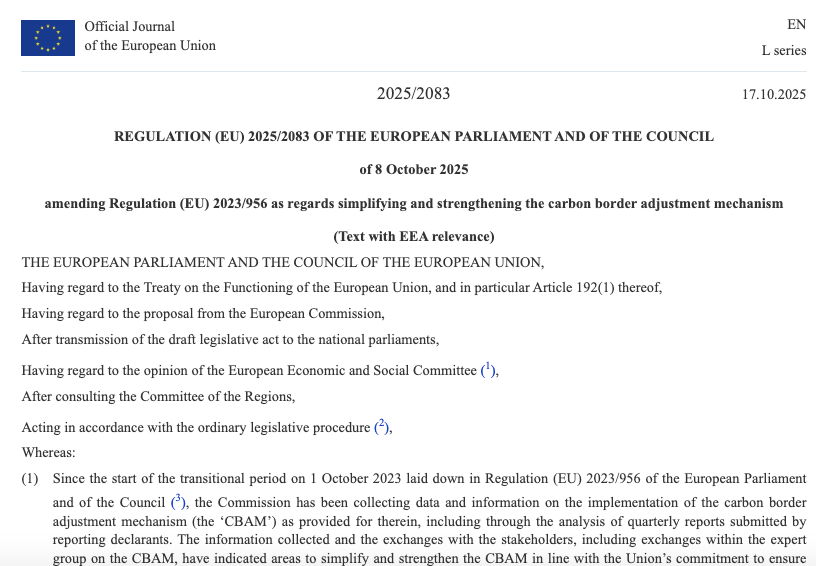
On October 8, 2025, the European Parliament and the Council officially adopted Regulation (EU) 2025/2083, the "Simplified Regulation Amending Regulation (EU) 2023/956 on the Carbon Border Adjustment Mechanism (CBAM)," which was published in the Official Journal of the EU on October 17, 2025. This is the first amendment document since the establishment of CBAM, marking the EU's commitment to maintaining the integrity of its carbon border policy while further implementing its commitment to reducing the compliance burden on businesses and optimizing regulatory processes.
I. Policy Background
The CBAM regulation came into effect in 2023, aiming to prevent the risk of "carbon leakage." It is currently in a transitional period and is expected to be fully implemented in January 2026.
In November 2024, the European Council proposed launching a "Simplification Revolution," calling for the establishment of a "clear, concise, and smart regulatory framework" to significantly reduce the administrative, regulatory, and reporting burdens on businesses.
On February 26, 2025, the European Commission formally proposed a simplified proposal for CBAM legislation in the "Integrated Plan One." Subsequently, the European Parliament and the Council reached a political agreement on June 18. The European Parliament voted to pass it on September 10, and the Council of the European Union gave its final approval on September 29.
The simplified CBAM regulation will officially come into effect on October 20, 2025.
2. Main Revisions
Introduce an exemption mechanism for a "single quality threshold"
The original exemption for CBAM goods with a value below 150 euros per batch has now been replaced by a unified exemption mechanism based on "annual cumulative net mass."
Threshold setting: 50 tons/year, applicable to CBAM products in industries such as steel, aluminum, fertilizer, and cement.
Electricity and hydrogen are not applicable to this threshold due to industry characteristics.
Importers with an annual import volume of less than 50 tons are exempt from the obligations of reporting, declaration, and certificate delivery.
Once the threshold is exceeded, all CBAM imports within the year must fulfill the full obligations.
Annual Review and Adjustment Mechanism for Thresholds
The European Commission will annually review the reasonableness of the threshold to ensure it covers at least 99% of embedded emissions. If the target is not met, the Commission may adjust this value through a delegated act.
3. Threshold Enforcement and Violation Penalties
The national authorities and the committee will share the list of importers approaching the threshold (reaching 90%).
Splitting imports to evade thresholds will be considered a violation.
Unauthorized and excessive importers will be fined 300–500 euros per ton of embedded emissions (3–5 times the standard penalty).
If the excess ratio does not exceed 10%, the penalty can be waived.
4. CBAM Authorized Declarant System
Importers expected to exceed the threshold must apply for authorization in advance.
Applicants can continue to temporarily import during the review period until March 31, 2026.
The authorized applicant may entrust a third party registered in the EU to submit the application, but still bears compliance responsibility.
Annual Report and Certificate Return
The deadline has been extended to September 30th of the year following importation, giving enterprises a more ample compliance period.
The quarterly purchase ratio of CBAM certificates has been reduced from 80% to 50% to alleviate cash flow pressure.
6. Calculation Rules for Embedded Emissions
The actual values verified by accreditation or the default values determined by the committee can be used.
The default value will be based on the average level of the top ten exporting countries with the highest emissions.
7. Carbon Price Reduction Mechanism
Authorized declarants may apply for a reduction in the number of CBAM certificates to be delivered based on the carbon price paid in a third country.
Starting from 2027, the committee will publish the default carbon price of third countries with effective carbon pricing systems in the CBAM register.
If the carbon price is paid outside of a third country, it can also be deducted.
8. Optimization of the CBAM Certification System
Starting from February 1, 2027, CBAM certificates will be sold centrally through a central platform.
The certificates corresponding to the 2026 imports purchased in 2027 will be priced at the quarterly average price of the 2026 EU ETS allowances.
From then on, the certificate price will be determined based on the weekly average auction price of the EU ETS.
The buyback mechanism, expiration rules, and gratuitous cancellation mechanism are updated simultaneously to prevent hoarding of certificates.
9. Optimization of the Penalty Mechanism
Align with the penalty framework of the EU ETS (100 euros per ton).
For minor or unintentional errors, penalties may be reduced at discretion.
10. Department and Technical Clarification
Uncalcined kaolin is excluded from the scope of CBAM.
Power emission calculation is limited to direct emissions.
Registration of third-country facilities requires information about the parent company; verification bodies must complete registration within two months after certification (no earlier than September 1, 2026).
The costs for establishing and managing the central platform will be borne by the authorized applicant.
3. Prospects for Future Legislation
In 2025, the EU is expected to further advance the legislation of the CBAM framework.
(1) Expected to be released in the fourth quarter of 2025:
Revise the CBAM regulations to extend to downstream products and introduce anti-circumvention clauses.
Formulate industry-specific rules for the electricity sector.
(2) Second round of legislation (expected before the end of 2025):
Refine the embedded emission calculation method.
Adjust the number of certificates to reflect ETS free allowances.
Establish clear standards for the deduction of carbon prices in third countries.
(3) Pending Subordinate Legislation:
The qualification standards for inspectors and verification bodies;
CBAM Certificate Trading and Buyback Conditions;
Rules for Customs Information and Data Exchange.
(4) Comprehensive Evaluation:
According to Article 30 of the CBAM regulation, the European Commission will submit a comprehensive review report by the end of 2025, assessing the possibility of extending the scope of CBAM to areas such as organic chemicals, polymers, and transport services.
4. Conclusion
The introduction of simplified CBAM regulations signifies that the EU is seeking a new balance between "climate policy" and "reducing corporate burdens."
For Chinese companies exporting to the EU, this revision:
Reduced compliance pressure for small-scale exports.
The declaration cycle, verification requirements, and penalty mechanisms were clarified in advance.
At the same time, it has strengthened threshold regulation and data verification, placing higher demands on the authenticity and transparency of supply chain carbon emissions.
It is recommended that enterprises should promptly:
Evaluate annual import volume and embedded emission levels to determine if a single quality threshold is reached.
Establish an internal carbon emissions data tracking and verification mechanism.
Pay attention to the upcoming release of the second round of CBAM legislation in the fourth quarter of 2025 to adjust export compliance strategies in advance.
【Copyright and Disclaimer】The above information is collected and organized by PlastMatch. The copyright belongs to the original author. This article is reprinted for the purpose of providing more information, and it does not imply that PlastMatch endorses the views expressed in the article or guarantees its accuracy. If there are any errors in the source attribution or if your legitimate rights have been infringed, please contact us, and we will promptly correct or remove the content. If other media, websites, or individuals use the aforementioned content, they must clearly indicate the original source and origin of the work and assume legal responsibility on their own.
Most Popular
-

Mexico Imposes Tariff Up to 36% on Cross-Border E-Commerce Products, Effective January 1, 2026; Plastic Shows Partial Fluctuation Today
-
4.5 Million Tons! Wanhua Chemical Dominates Globally in MDI, Heavy Investment in Battery Materials Spurs New Storm
-

Trump Delays Tariff Increase on Furniture, Cabinets, and Vanities
-
Wanhua Chemical Invests $27.3 Billion, 2026 Investment Map Revealed, $1.1 Billion Bet on Battery Materials
-
Back-to-back major joker moves! covestro’s 1.32 million ton mdi dual-line expansion and hdi acquisition reshape global polyurethane landscape


