



Differences Between Pc, As, Pp, And Tritan Four Common Water Bottle Materials
PC water cup
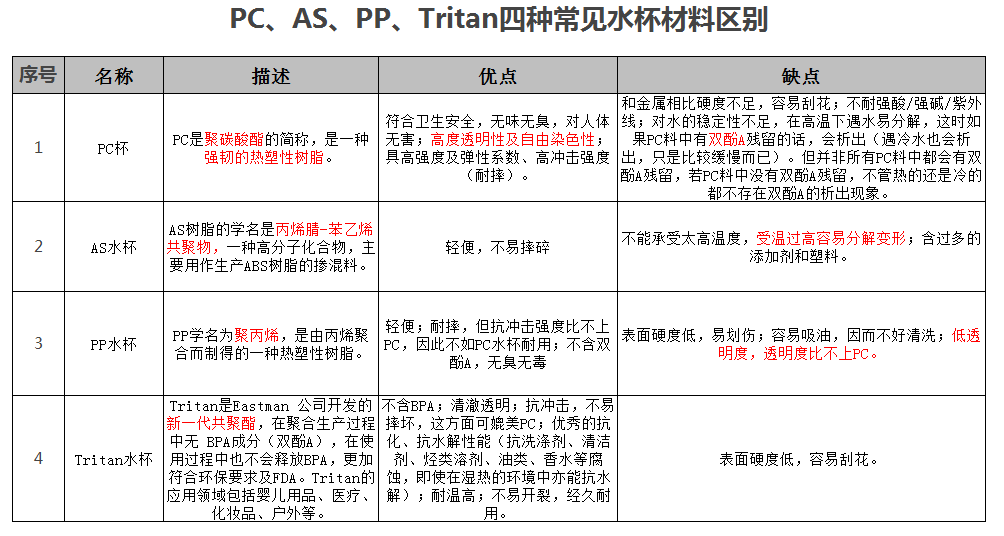
PC is the abbreviation for polycarbonate, a tough thermoplastic resin.
Advantages: It meets hygiene and safety standards, is odorless, and is harmless to the human body; it has high transparency and can be freely dyed; it possesses high strength and elastic modulus, as well as high impact strength (resistant to drops).
Disadvantages: Compared to metals, it has insufficient hardness and is prone to scratching; it is not resistant to strong acids, strong alkalis, or UV radiation; it has poor stability in water and tends to decompose at high temperatures when exposed to water. If bisphenol A residues are present in the PC material, they can leach out (they can also leach out in cold water, albeit more slowly).
Note: PC material itself is non-toxic, but if the conversion from Bisphenol A to PC material is incomplete, it may release toxic Bisphenol A when exposed to high temperatures.
Bisphenol A, also known as BPA, is an organic compound with the molecular formula C15H16O2. In industry, BPA is used to synthesize materials such as polycarbonate (PC) and epoxy resins.
AS water cup
AS resin, whose chemical name is acrylonitrile-styrene copolymer, is a polymer primarily used as a blending component in the production of ABS resin.
Light, not easily broken
Disadvantages: Cannot withstand high temperatures, prone to decomposition and deformation when overheated; contains excessive additives and plastics.
3. PP Water Cup
PP is the scientific name for polypropylene, which is a thermoplastic resin produced by the polymerization of propylene.
Advantages: lightweight; impact-resistant, though its impact strength is inferior to that of PC, making it less durable than PC water bottles; BPA-free, odorless, and non-toxic.
Disadvantages: low surface hardness, prone to scratching; easily absorbs oil, making it difficult to clean; low transparency, inferior to PC in transparency.
4. Tritan water bottle
Tritan is a new-generation copolyester developed by Eastman. It contains no bisphenol A (BPA) during polymerization production and does not release BPA during use, making it more compliant with environmental requirements and FDA regulations.
Advantages: BPA-free; crystal clear; impact-resistant, not easy to break, comparable to PC in this aspect; excellent chemical and hydrolysis resistance (resistant to detergents, cleansers, hydrocarbons, oils, perfumes, etc., and can resist hydrolysis even in a humid and hot environment); high-temperature resistance; not prone to cracking, durable.
Drawback: Low surface hardness, easy to scratch.
【Copyright and Disclaimer】The above information is collected and organized by PlastMatch. The copyright belongs to the original author. This article is reprinted for the purpose of providing more information, and it does not imply that PlastMatch endorses the views expressed in the article or guarantees its accuracy. If there are any errors in the source attribution or if your legitimate rights have been infringed, please contact us, and we will promptly correct or remove the content. If other media, websites, or individuals use the aforementioned content, they must clearly indicate the original source and origin of the work and assume legal responsibility on their own.
Most Popular
-

[overseas news] celanese and toray announce price hikes; basf: European Chemical Industry to Face a Decade of Consolidation
-
Covestro To Cut Antwerp PC Production Capacity, Close Bisphenol A Plant
-

[Overseas News] US Just Relaxed Rebates for Aluminum Can Stock, Saudi Arabia Turns Around and Imposes 38.7% Tax on Aluminum Can Lids
-
Differences Between Pc, As, Pp, And Tritan Four Common Water Bottle Materials
-
China’s First Domestic COP Project in Zhejiang Breaks a 30-Year Japanese Technology Stranglehold