



PC Prices And Bisphenol A Correlation Has Increased Sharply Since The Second Quarter
IntroductionSince the second quarter of 2026, the relationship between domestic PC market price trends and the core raw material bisphenol A has shown a significant strengthening, with the correlation between the two trends reaching a historic high of 0.94.Longzhong InformationThe data show that during April and May, asCrude oilThe entire cost chain from pure benzene to phenol to bisphenol A has entered a synchronized downward spiral. PC prices have closely tracked fluctuations in the upstream raw material bisphenol A, with the two showing an unusually pronounced pattern of resonant decline. The price adjustment transmission cycle has shortened from 5–7 working days in the first quarter to 1–3 trading days, and the industry has shifted from a pattern of “product profitability with weak raw materials” to a cost-following pricing model.
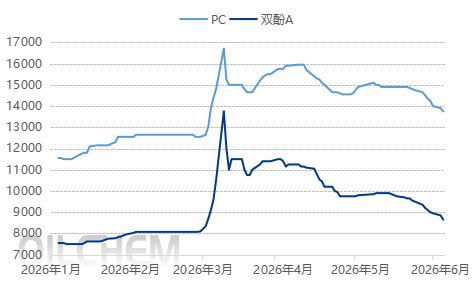
Q1 and Q2 PC andBisphenol A pricePrice rises and falls have become significantly more synchronized.
Figure 1 Comparison of PC and Bisphenol A Price Trends in 2026 (Unit: Yuan/Ton)
Source: Longzhong Information
According to data from Longzhong Information, in the first quarter (January–March), the monthly average price of bisphenol A in the East China market ranged from RMB 7,645 to RMB 10,948 per tonne, with a cumulative price increase of 43.2%. During the same period, the monthly average price of WY-111BR in the Yuyao market ranged from RMB 11,976 to RMB 14,900 per tonne, up 24.41%. Raw material trends were relatively strong, while PC prices rose by a narrower margin, indicating a weak correlation between upstream and downstream trends.
Looking at the second quarter: In April, after carrying over the historical highs seen at the end of March, the bisphenol A market underwent a sharp correction. According to data from Longzhong Information, as of April 30, the reference price for bisphenol A in East China had fallen to around RMB 9,800/ton, down more than 15% during the month. In May, the market weakened further, and by the end of the month, the reference price for bisphenol A in East China stood at RMB 8,950/ton, down 9% from the end of April. In the first three working days of June, the market fell by a cumulative RMB 450/ton, a decline of 5%. As for PC, from April to early June, the market as a whole declined rapidly, with the price of Yuyao WY-111BR falling from RMB 15,750/ton to RMB 13,600/ton, a drop of as much as 14%. Judging from the overall trend in the second quarter, the price movements of PC and bisphenol A were highly synchronized, with each decline in bisphenol A accompanied by a corresponding adjustment in PC prices, indicating a highly significant cost pass-through effect.
2. Resonant Transmission of the Full Cost Chain in the Second Quarter:From "Cost Support" to "Cost Collapse" Reversal
The direct driving factor for the simultaneous decline in the prices of PC and bisphenol A is the overall weakening of the upstream cost chain. According to data from Longzhong Information, since the second quarter, prices have shown a progressive decline from international crude oil to pure benzene, then to phenol, acetone, and finally bisphenol A.
Second Quarter PC Upstream Industry Chain Price Statistics Table (Unit: USD/barrel, RMB/ton)
|
Product |
4 month Average price |
May average price |
June 3 |
|
Brent crude oil |
102.46 |
103.71 |
96 |
|
Pure benzene |
8651 |
8194 |
7755 |
|
Phenol |
8898 |
7768 |
7700 |
|
Acetone |
7787 |
7524 |
6725 |
|
Bisphenol A |
10486 |
9600 |
8500 |
Source: Longzhong Information
From April to May, domestic phenol and acetone prices continued to decline: in May, their average prices fell to RMB 7,768/ton and RMB 7,524/ton, respectively. Production profits of phenol-ketone enterprises dropped into a deep loss range. The decline in upstream raw material prices was transmitted along the industrial chain to bisphenol A, and then further to PC, forming a complete chain of cost pressure transmission.
According to analysis by Longzhong Information, after geopolitical tensions intensified in the first quarter of 2026, upstream pure benzene prices surged sharply, driving a broad rise in the phenol market and continuously pushing up both the production costs and market prices of bisphenol A, thus creating a price uptrend driven by the combined resonance of costs, supply, and rigid demand. After geopolitical tensions eased in the second quarter, the same chain operated in reverse, triggering a resonant decline.
III. The Core Reasons for the Significant Increase in Correlation Between PC and Bisphenol A in the Second Quarter
1. PC: The supply-demand turning point has arrived, and cost-based pricing power is returning.
From the supply side perspective, the PC industry has entered a “vacuum period” for capacity expansion. According to Longzhong data, China’s PC capacity increased by a cumulative 353% from 2017 to 2025, and by 2026, domestic PC industry capacity has been updated to 3.94 million tons/year. After the rapid expansion in 2020–2022, the growth rate of PC capacity has slowed significantly, with no new capacity additions expected in 2026.
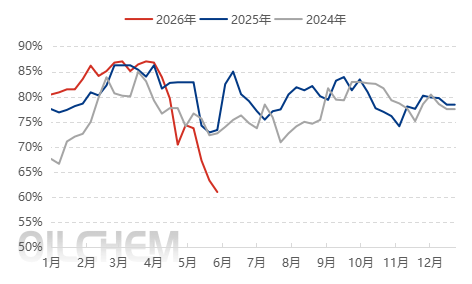
Figure 2: Weekly Capacity Utilization Statistics of China’s PC Industry, 2024–2026
Source: Longzhong Information
From Industry Capacity Utilization In terms of rate, PC The industry’s operation shows high-level fluctuations: in the first quarter, the industry’s weekly capacity utilization rate was at... 81% — 87% Fluctuate between. 3 Reached at the beginning of the month 87.02% the higher-order bits; 4 mid to late month So far, Affected by multiple sets of Lu Xi Chemical, Covestro, etc. production Due to equipment maintenance, the capacity utilization rate temporarily declined to 8 remain at a relatively low level; recently, it has fallen even further to 65% The following low-order bits Although. 2 Quarterly industry capacity utilization continues to decline. But overall, the core remains at a relatively high level in recent years, and supply-side flexibility is limited. 。
This background is crucial: when the industry is in a period of rapid expansion, and companies are competing to ship products to absorb newly added capacity, PC Prices are more driven by their own supply and demand relationships; however, when the growth rate of capacity approaches zero and the industry enters a stage of stock game, changes in the cost side become the most core variable affecting pricing. A high operating rate in the industry with limited production elasticity means that fluctuations on the cost side will directly and quickly impact prices. PC Reflected in prices—this is precisely the fundamental premise for the return of the cost pass-through logic in the second quarter.
Bisphenol A: A fundamental shift from "scarce resource" to "abundant raw material."
The bisphenol A industry has experienced the most dramatic capacity expansion cycle in recent years. According to data from Longzhong Information, in 2026, BPA capacity will reach 6.625 million tons per year, up more than 400,000 tons year on year. On the downstream side, there is no new added PC capacity, while epoxy resin is planned to add 480,000 tons per year of capacity, which is expected to increase BPA consumption by about 340,000 tons. From the perspective of the full-year supply-demand structure, newly added BPA capacity exceeds newly added downstream consumption capacity by about 60,000 tons per year, and the supply-demand gap continues to widen year on year.
The significant expansion of production capacity has transformed the bisphenol A industry from a "scarce resource" to a "conventional raw material." Prices, which were previously driven by a tight balance of supply and demand with dramatic fluctuations, have returned to a role that follows the cost line of upstream benzene and phenol. This shift in role has made the price linkage between bisphenol A and downstream PC smoother and more transparent— the main reason for bisphenol A price fluctuations has changed to cost variations rather than mismatches in its own supply and demand, making it easier for the downstream PC side to follow and absorb these changes.
In May, the maintenance of bisphenol A (BPA) facilities was intensive, leading to a decrease in industry capacity utilization to 63.86%, a month-on-month drop of 7.37 percentage points. This involved the shutdown maintenance of 9 facilities and the reduction of output in several other facilities. Logically, a contraction in supply usually supports prices; however, BPA prices continued to decline in the second quarter. The underlying reason is the simultaneous contraction in demand: the capacity utilization and consumption in the PC industry both fell, causing the contraction on the supply side to fail to reverse the downward trend in prices.
Downstream terminal demand remains weak, and PCs lose independent price increase support.
Longzhong Information tracks three major downstream sectors of PC—automotive, home appliances, and sheet materials: In the second quarter, the average operating rate of automotive plastic parts enterprises was 58.3%, down 7.2 percentage points from the first quarter; home appliance shell and small appliance supporting enterprises operated at 55.7%, with just-in-time procurement mainly in small, urgent orders and no centralized restocking. In the first quarter, low-level downstream restocking and low spot inventory in the market supported PC prices to strengthen independently. In the second quarter, terminal demand remained weak, traders’ willingness to hoard inventory faded, and PC could no longer rely on demand to push up prices, with pricing passively anchored to raw material costs.
4. Outlook for the Market Ahead
Short-term (June to early July): The high linkage pattern between upstream and downstream continues.In the traditional peak seasons for automobiles and home appliances have yet to materialize, and with no significant recovery in terminal demand, the PC demand side still lacks independent driving force, causing prices to continue to follow the trend of bisphenol A. On the raw material side, phenol and acetone remain under pressure from weak crude oil prices, and the continuous release of new bisphenol A production capacity makes it difficult to change the loose supply-demand pattern. The probability of bisphenol A experiencing low-level fluctuations is high, putting pressure on PC as well, and the high correlation between the two trends is expected to continue.Medium to long term (peak season in late July): The linkage coefficient may marginally decline.If the traditional peak consumption season materializes in the third quarter, concentrated restocking by downstream end-users will drive higher PC operating rates and a recovery in demand, while product pricing power will be restored. PC pricing will then return to being driven by both “cost + demand,” and the correlation between PC and bisphenol A will decline significantly, with demand once again carrying greater weight. If the peak season falls short of expectations and weak demand persists, cost-driven market trends will likely continue through the end of the third quarter.
Conclusion:
In Q2 2026, the correlation between PC and bisphenol A prices rose significantly, the result of the combined effects of weakening end-use demand, increased bisphenol A capacity coming on stream, a shift in PC supply-demand balance from tight to loose, and production schedule adjustments by integrated producers. This marks the domestic PC industry’s formal entry into a staged cost-driven cycle. Going forward, the industry chain should focus in the short term on trends in bisphenol A and upstream phenol/ketone prices, while in the medium to long term, attention should be paid to the extent of PC price retracement and the implementation pace of downstream peak-season demand. These variables will determine future changes in the strength of upstream-downstream linkage.
【Copyright and Disclaimer】The above information is collected and organized by PlastMatch. The copyright belongs to the original author. This article is reprinted for the purpose of providing more information, and it does not imply that PlastMatch endorses the views expressed in the article or guarantees its accuracy. If there are any errors in the source attribution or if your legitimate rights have been infringed, please contact us, and we will promptly correct or remove the content. If other media, websites, or individuals use the aforementioned content, they must clearly indicate the original source and origin of the work and assume legal responsibility on their own.
Most Popular
-

A Look at the Material Suppliers Behind SpaceX
-

Government's Triple Action, Enterprises' Three Arrows in Five Days, Semiconductor Reshuffle! What Signal Does Japan's Chemical Industry Release?
-
Fire breaks out at jiangsu meiside!
-
Name change without tax change: POM Anti-Dumping Duty Rate Inheritance Implemented
-
Ethylene: Production Capacity Accelerates Expansion, Global Industry Landscape Is Being Reshaped


