Name change without tax change: POM Anti-Dumping Duty Rate Inheritance Implemented
Introduction: Translate the above content into English and output only the translation, without any explanation.On June 4, 2026, the Ministry of Commerce issued an announcement clarifying the succession of duty rates under the anti-dumping measures on imports of polyoxymethylene copolymer from South Korea, Thailand, and Malaysia following corporate restructuring and name changes. This decision does not constitute a new trade barrier, but rather ensures the continued and effective implementation of the existing trade remedy measures.
Summary of the Original Text of the “Decision of the Ministry of Commerce on the Succession of Anti-Dumping Duty Rates Applicable to Relevant Enterprises Concerning Imports of Copolymerized Polyoxymethylene Originating in South Korea, Thailand, and Malaysia” as follows:
Daicel HPP Malaysia Sdn. Bhd. shall inherit the anti-dumping duty rate of 8.0% and other rights and obligations applicable to Polyplastics Asia Pacific Sdn. Bhd. under the anti-dumping measures on polyoxymethylene copolymer.
(II) KOLON INDUSTRIES, INC. shall succeed to the 6.2% anti-dumping duty rate applicable to KOLON ENP, INC. under the anti-dumping measures on polyoxymethylene copolymer, as well as all other rights and obligations.
(3) Copolymerized polyoxymethylene exported to China in the name of Polyplastics Asia Pacific Sdn. Bhd. shall be subject to the 9.5% anti-dumping duty rate applicable to “all other Malaysian companies” under the anti-dumping measures on copolymerized polyoxymethylene.
(4) Copolymer polyoxymethylene exported to China under the name of KOLON ENP, INC. shall be subject to the anti-dumping duty rate of 30.4% applicable to “all other Korean companies” under the anti-dumping measures on copolymer polyoxymethylene.
Table 1 Overview of POM Anti-Dumping Duty Rates for Malaysia, South Korea, and Thailand
|
Country of origin |
Main body |
New inheriting entity |
Anti-dumping duty rate |
|
Malaysia |
Polyplastics Co., Ltd. (Asia Pacific) |
Daicel Engineering Plastics Malaysia Daicel HPP |
8.0% (Inherited preferential tax rate) |
|
Other Malaysian Companies |
9.5% |
||
|
South Korea |
Kolon ENP Co., Ltd. |
Kolon Industries, Inc. |
6.2% (Inherit the preferential tax rate) |
|
Korea Engineering Plastics Co., Ltd. |
30% |
||
|
Other Korean companies |
30.4% |
||
|
Thailand |
Thailand Polyacetal Co., Ltd. |
18.5% |
|
|
Other Thai companies |
34.9% |
Data source: Ministry of Commerce Longzhong Information
In summary, the reasons for these changes are overseas manufacturers’ equity changes, entity renaming, and business transfers. Following successive entity changes at Polyplastics’ Malaysia plant and Kolon Korea, the Ministry of Commerce, in accordance with the law, approved the inheritance of separate preferential tax rates. Exports under the former entity names are directly subject to the high residual tariff rate. There has been no change in the business entity in Thailand, and the original tax rate remains unchanged.
Overall, the inheritance of the tax rates has not changed the original framework of the anti-dumping duties, and the main brands of imported materials will be affected. Baoli, Kelong, and other tax rates have not increased, so prices are unlikely to surge in the short term. The import costs for smaller non-mainstream companies in Malaysia and South Korea remain high, and low-priced dumping sources are still being continuously curbed, which is beneficial for domestic materials to maintain a stable domestic foundation.
|
Figure 1 Annual Import Volume and Import Dependency Trend of POM in China from 2021 to 2025 (10,000 tons) |
|
|
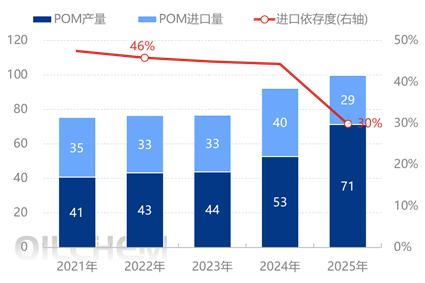
Over the past five years, China’s polyoxymethylene imports have fluctuated, remaining stable at first, then rising, before falling sharply. From 2021 to 2023, import volumes stayed relatively steady at around 330,000 tonnes. In 2024, imports surged to approximately 400,000 tonnes due to temporary factors. In 2025, import volumes fell significantly to 288,000 tonnes, representing a sharp year-on-year decline. This was mainly attributable to the continued expansion of domestic polyoxymethylene capacity, the accelerated substitution of imported materials with domestic products, and the additional boost provided by the implementation of anti-dumping policies.
|
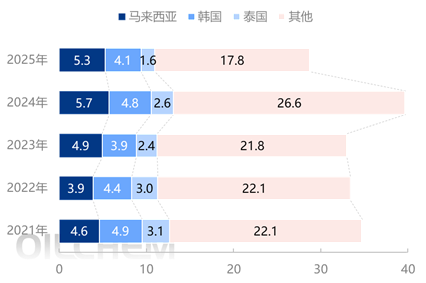
Figure 2 Comparison of Import Volumes of Malaysia, South Korea, and Thailand from 2021 to 2025 |
|
|
Data source: Longzhong Information
From the perspective of import sources, Malaysia and South Korea have long been the main import countries for POM. Malaysia In recent years, Malaysia has consistently remained the largest source of POM imports into China. Its anti-dumping duty rate is 8.0%/9.5%. Malaysia has a dense population, low labor costs, and convenient shipping conditions with well-developed logistics and transportation. It also hosts Polyplastics’ largest production base, and in the short term remains an irreplaceable major source of imported materials to meet market demand.
South Korea is also a major importer of Chinese POM. Its anti-dumping duty rates are 6.2%, 30%, and 30.4%. Affected by relatively high import costs, part of the demand has been replaced by other brands, and its import volume has shown a fluctuating downward trend.
Thailand has the highest overall tax rate among the three countries. Its anti-dumping duty rate stands at 18.5%/34.9%, making it the most significantly suppressed by high anti-dumping duties. Meanwhile, its domestic effectively operating capacity has contracted substantially, and small and medium-sized supporting capacity has been cleared out. Import volumes have continued to decline in recent years, falling to eighth place by 2025.
Overall, this time POM The essence of anti-dumping duty rate succession lies in the confirmation of the entity rather than an adjustment of the duty rate. The tariff costs on exports to China for the two major suppliers remain relatively unchanged from before the announcement, and there is therefore no inherent incentive to adjust prices due to changes in the tax burden. Import traders and downstream users also do not need to adjust their procurement strategies for the time being in response to the policy change.Therefore, the market price of imported materials has not been significantly affected by this. From the perspective of domestic demand, as the traditional off-season approaches, end-user orders may remain sluggish. Meanwhile, most subsequent maintenance plans on the supply side involve individual manufacturers, so supply remains ample. This policy does not change the price trend; the price movement of POM will still mainly depend on supply and demand fundamentals.
【Copyright and Disclaimer】The above information is collected and organized by PlastMatch. The copyright belongs to the original author. This article is reprinted for the purpose of providing more information, and it does not imply that PlastMatch endorses the views expressed in the article or guarantees its accuracy. If there are any errors in the source attribution or if your legitimate rights have been infringed, please contact us, and we will promptly correct or remove the content. If other media, websites, or individuals use the aforementioned content, they must clearly indicate the original source and origin of the work and assume legal responsibility on their own.
Most Popular
-

A Look at the Material Suppliers Behind SpaceX
-
【Overseas Highlights】Celanese Shuts Its Korean Engineering Plastics Plant! BASF to Divest Coatings Business; Six Japanese Corporations Tap Into Plastic Chemical Recycling
-

Global Chemical Giants Accelerate Production Capacity Restructuring, Dow and Celanese Optimize Global Industry Layout
-
Name change without tax change: POM Anti-Dumping Duty Rate Inheritance Implemented
-

Gas Explosion Accident at Shanxi Tongzhou Group Liushenyu Coal Mine Results in 82 Deaths