Ethylene: Production Capacity Accelerates Expansion, Global Industry Landscape Is Being Reshaped
Lead: In recent years, global ethylene production capacity has continued to grow rapidly, currently totaling approximately 230 million tons per year. Compared to 2015, production capacity has increased by over 70 million tons per year, a growth rate of nearly 45%. Globally, the ethylene market generally presents a "three-pole pattern" dominated by the Asia-Pacific region led by China, the North American region led by the United States, and the Middle Eastern region.
Since 2019, China's ethylene production capacity has experienced explosive growth, significantly increasing its share in global ethylene production capacity. China's ethylene production capacity first surpassed that of Europe in 2019, exceeded the Middle East in 2021, and surpassed the United States in 2022, becoming the largest ethylene producer in the world. By 2025, China's ethylene production capacity has reached 62.882 million tons per year, with its share in global ethylene production capacity increasing from less than 15% in 2015 to over 30% currently.
After the shale gas revolution in the United States, the growth rate of capacity has significantly slowed down; in the Middle East, the advantage of ethane feedstock is evident, but currently, the addition of new capacity is limited, and capacity remains basically stable. Meanwhile, with the expansion of ethylene capacity and cost advantages in China, the global ethylene industry landscape is starting to reshape, shifting its focus eastward.
However, corresponding to the tripolar structure is the accelerated exit of capacity in Europe, Japan, and South Korea.
The cost of energy and raw materials in Europe lacks advantages, and the demand outlook within the region remains consistently sluggish. Coupled with the extremely harsh punitive carbon taxes imposed by the EU, geopolitical conflicts also bring a lot of uncertainty to the production, sales, and transportation of its raw materials and products. As can be seen from the table below, several cracking units located in Europe, including those of global petrochemical giants such as ExxonMobil and SABIC, have already begun to shut down, involving an ethylene production capacity of nearly 5.1 million tons per year.
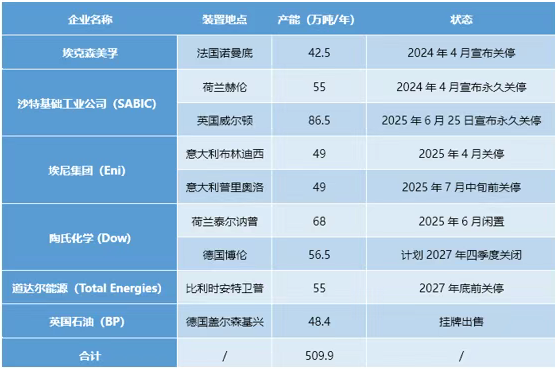
Data Source: Jin Lian Chuang
Due to China's significant cost advantage in coal-to-olefins and ethane cracking, the prices of ethylene derivatives such as polyethylene and ethylene glycol are lower than those of similar products in Japan and South Korea, leading to a loss of market share for Japan and South Korea in the export market. In the short term, Japanese and South Korean cracking operators find it difficult to identify alternative export markets, prompting them to shut down, restructure, or sell.
In 2025, ten South Korean petrochemical companies have agreed to a business restructuring, aiming to reduce ethylene cracking capacity by 25%, approximately 3.7 million tons per year, based on South Korea's total capacity of 14.7 million tons per year. Daesan, Lotte Chemical, and Hyundai Oilbank are discussing the merger of their naphtha cracking center operations. Yeosu, as the largest petrochemical hub in South Korea, is also seen as a key area for integration. Yeosu has seven cracking facilities but only one refinery. Industry insiders expect GS Caltex, LG Chem, and Lotte Chemical to explore joint operations.
According to data from the Japan Chemical Industry Association, Japan's ethylene production capacity currently stands at 6.162 million tons per year. Currently, a total of nearly 1.8 million tons per year of ethylene cracking capacity, including Maruzen (Chiba 550,000 tons/year), Idemitsu Kosan (Chiba 374,000 tons/year), and New Japan Oil (Kawasaki 865,000 tons/year), is planned to be dismantled or shut down in the fiscal years 2026-2028.
【Copyright and Disclaimer】The above information is collected and organized by PlastMatch. The copyright belongs to the original author. This article is reprinted for the purpose of providing more information, and it does not imply that PlastMatch endorses the views expressed in the article or guarantees its accuracy. If there are any errors in the source attribution or if your legitimate rights have been infringed, please contact us, and we will promptly correct or remove the content. If other media, websites, or individuals use the aforementioned content, they must clearly indicate the original source and origin of the work and assume legal responsibility on their own.
Most Popular
-

A Look at the Material Suppliers Behind SpaceX
-
Eastman France PET Depolymerization Plant: Project "Alive," But Construction Paused
-
Mitsubishi Chemical Plans To Split Petrochemical Business By 2028
-

Bola Carbon Black Announces Global Restructuring of Specialty Carbon Black and Multi-Walled Carbon Nanotube Business
-
Ethylene: Production Capacity Accelerates Expansion, Global Industry Landscape Is Being Reshaped