Government's Triple Action, Enterprises' Three Arrows in Five Days, Semiconductor Reshuffle! What Signal Does Japan's Chemical Industry Release?
The value added by Japan's chemical industry accounts for approximately 20% of the entire manufacturing sector, making it second only to the automotive industry. The impact of this systemic transformation extends far beyond Japan's borders.
Government Strategy: Three-Pronged Approach
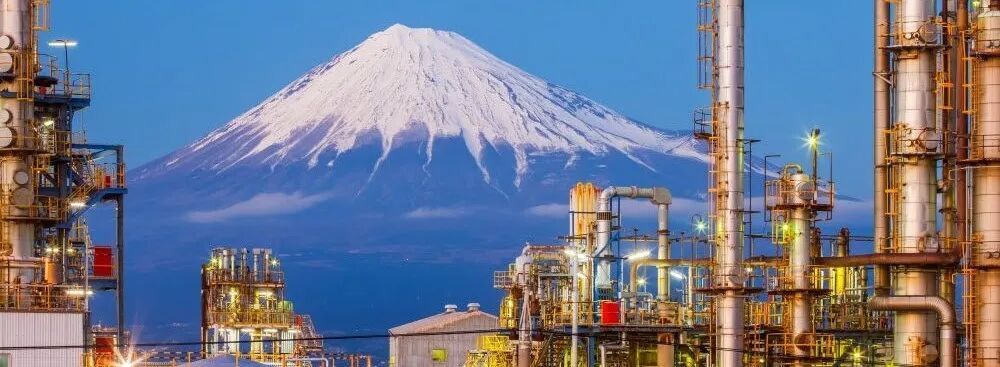
On May 29, at the 2026 Asia Petrochemical Industry Conference (APIC) held in Fukuoka, Japan, Takanori Kikuchi, Director for International Affairs of the Materials Industry Division, Manufacturing Industries Bureau, Ministry of Economy, Trade and Industry (METI), stated clearly that Japan is reshaping its chemical industry through three key measures: supply chain restructuring, AI-enabled new materials R&D, and a vigorous push for green transformation. Japan currently has eight major petrochemical complexes nationwide, with a total of 12 naphtha crackers, deeply integrated with the country’s domestic refining system.
Due to the recent escalation of tensions in the Middle East, Japan’s direct imports of naphtha from the region have basically been disrupted.
As of May, Japan's imports of naphtha from regions outside the Middle East have risen to three times the level before the crisis. The current polyethylene (PE) inventory can cover about 1.8 months of national consumption demand, and the government estimates that relying on inventory turnover can support downstream production operations until the end of the year. In March 2026, Japan's ethylene production was only 272,600 tons, a year-on-year decrease of 38.8%. Among the 12 ethylene facilities, 4 are scheduled for maintenance, and 6 have actively reduced their load, with an average operating rate of only 68.6%.
Under the Economic Security Promotion Act, the Japanese government has provided funding support for expanding production, building strategic stockpiles, and developing resource recycling systems for key chemical materials such as epoxy resins for semiconductors, glass cloth for high-end integrated circuits, polypropylene films for automotive thin-film capacitors, and synthetic silica powder for semiconductors.
Mitsubishi Chemical: Three moves in five days
-
On May 25, the company announced the launch of a review to spin off its basic chemicals business, which is mainly focused on petrochemical products, into a wholly owned subsidiary, with the plan to complete it by March 2028. This marks a significant move by Mitsubishi Chemical in its transition from traditional bulk chemicals to green specialty chemicals.
-
On May 27, it announced that it will discontinue the production of certain grades of epoxy resins at the Kawajiri Plant of its Tokai Works effective September 30, 2027, including bisphenol A-type and bisphenol F-type liquid epoxy resins. The company will focus on specialty epoxy resins for semiconductor packaging and electronic materials.
-
On May 28, it was jointly announced with Accenture the establishment of the AI joint venture RIX Business Partners, in which Mitsubishi Chemical holds an 81% stake, to develop an AI-enabled digital operations platform.
In addition, Mitsubishi Chemical has also been actively advancing multiple business divestitures this year:
In February, the company announced its withdrawal from the carbon materials business, including coke, needle coke, and pitch coke, with production scheduled to cease in the second half of fiscal 2027. In March, it sold its coatings emulsion business to Konishi Co., Ltd. On May 12, it completely exited its PBS biodegradable plastic business in Thailand. The path from “big and all-encompassing” to “small and strong” is now clear.
Industry Capacity Integration: 2.31 Million Tons of Polyolefins Merged
Capacity consolidation in Japan’s chemical industry is advancing at a faster-than-expected pace.
On May 12, Asahi Kasei announced a plan to streamline operations at its Mizushima Works by fiscal 2030: shutting down all styrene monomer (SM) and polyethylene (PE) capacity, eliminating a 200,000 t/y acrylonitrile (AN) production line, increasing the capacity of an existing 50,000 t/y unit to 100,000 t/y, shutting down its polycarbonate diol (PCDL) unit, and consolidating production at the Kashima Works.
On May 19, Mitsui Chemicals, Idemitsu Kosan, and Sumitomo Chemical signed a definitive agreement to integrate their Japanese polyolefin businesses. The integration platform is Prime Polymer (PRM), a joint venture between Mitsui Chemicals and Idemitsu Kosan. In the first phase, on July 1, 2026, Sumitomo Chemical will acquire a 20% stake in PRM; in the second phase, on April 1, 2027, production-related assets and liabilities will be transferred. After the integration, PRM’s annual polypropylene capacity will reach 1.59 million tons, annual polyethylene capacity will reach 720,000 tons, for a total of 2.31 million tons.
Semiconductor Materials: Signals of Change Intensify
The semiconductor materials sector is becoming the forefront of simultaneous strategic retrenchment and concentration in Japan’s chemical industry.
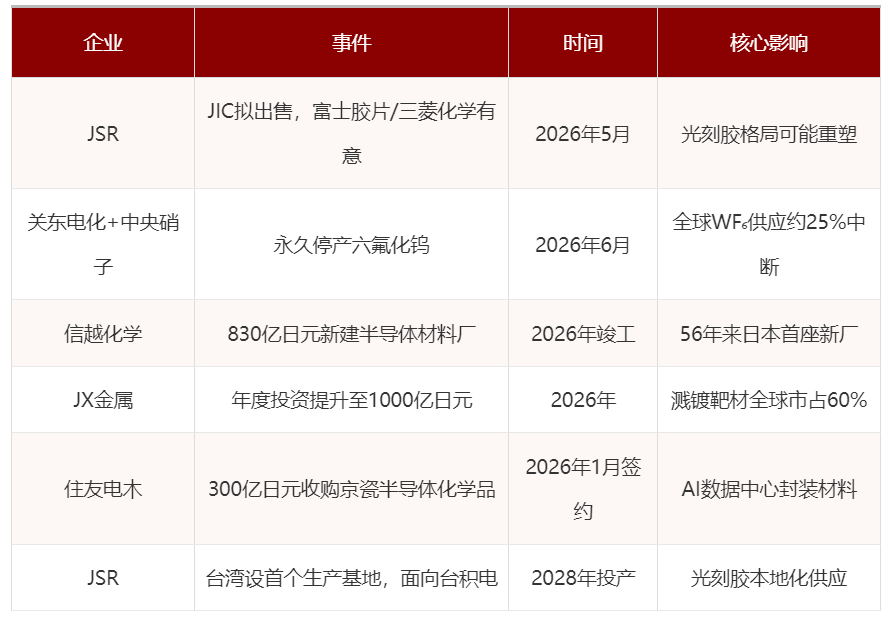
On May 28, Reuters reported exclusively that Japan Investment Corporation (JIC), a state-backed investment fund, is considering the sale of semiconductor materials company JSR; two years ago, the fund took JSR private in a $6 billion deal. Sources confirmed that Fujifilm and Mitsubishi Chemical have expressed interest in acquiring the company. JSR is the world’s second-largest photoresist manufacturer, with an estimated market share of about 19%. In the last fiscal year, it posted revenue of ¥400.7 billion and net profit of ¥60.7 billion. On May 6, JSR announced that it will establish its first semiconductor materials production base in Taiwan, with planned investment of several billion yen and a target to begin operations as early as 2028, mainly to supply photoresists for TSMC.
On June 8, two major Japanese semiconductor materials companies, Kanto Denka and Central Glass, announced that they will permanently shut down their tungsten hexafluoride production lines on June 30, 2026. Together, the two companies account for about 25% of the global supply of tungsten hexafluoride. The shutdown is due to China’s export controls on high-purity tungsten powder, which have made it impossible to obtain raw materials. This incident will have a major impact on the global semiconductor supply chain.
Shin-Etsu Chemical’s new semiconductor materials plant, built in Isesaki, Gunma Prefecture, at an investment of approximately ¥83 billion, is scheduled for completion in 2026. It will be Shin-Etsu Chemical’s first new factory built in Japan in 56 years. JX Metals has announced that it will raise its annual investment to about ¥100 billion and fully shift toward high-value-added materials related to semiconductors and information technology, with a focus on expanding production of sputtering targets, in which it holds roughly a 60% share of the global market.
Green Transition: Bio-based Substitution in Ethylene Plants
On January 27, Asahi Kasei, Mitsui Chemicals, and Mitsubishi Chemical signed an agreement to establish a joint operating entity, “Setouchi Ethylene LLP,” to integrate ethylene capacity in western Japan, with a total investment of JPY 21.2 billion. By fiscal 2030, ethylene production facilities at the Mizushima plant will be shut down, and capacity will be consolidated at Osaka Petrochemical Industries, Ltd. A bioethanol-to-ethylene unit will be built on the former site of the Mizushima plant, using Asahi Kasei’s Revolefin™ technology to reduce the carbon footprint by more than 90%, with commercial production targeted for fiscal 2034. This is a benchmark project for green transformation through the integration of upstream capacity.
On May 22, Mitsubishi Chemical, together with Toyota Motor and nine other companies, launched a feasibility study for the “Greater Tokyo Area Recycled Plastics Integrated Hub.” The project was selected for a subsidy program by Japan’s Ministry of the Environment and will explore technologies such as AI-based sorting and chemical recycling. In April, Idemitsu Kosan began commercial operations at its first plant dedicated to chemical recycling at its Ichihara facility in Chiba Prefecture, with an annual capacity to process 20,000 tons of plastic waste and convert it into approximately 14,000 tons of pyrolysis oil.
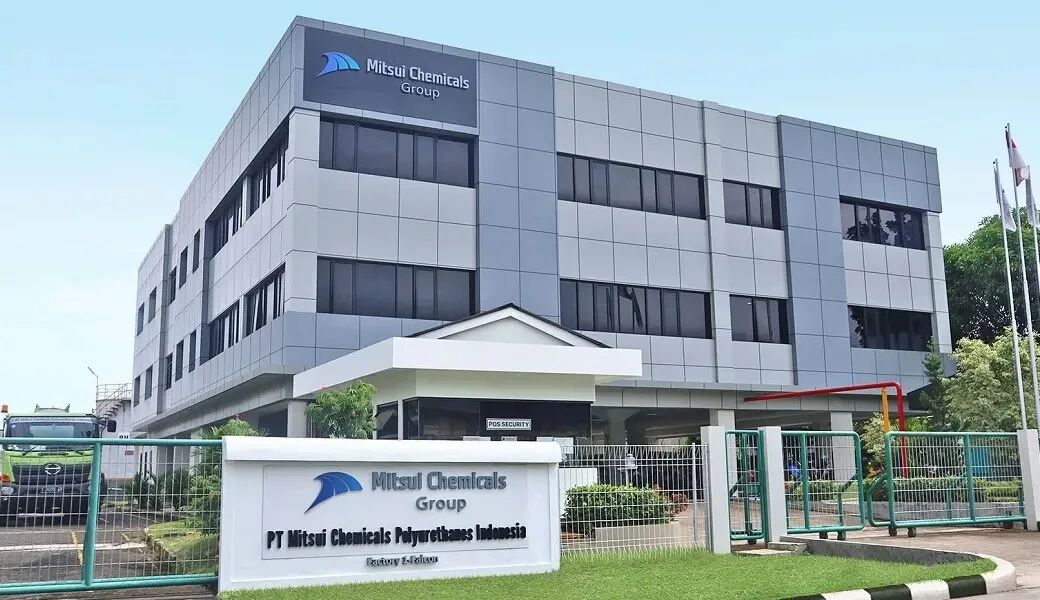
30 giants bet on "Physical AI"
About 30 leading Japanese companies (including Asahi Kasei, Fujitsu, Yaskawa Electric, and others) plan to invest in a newly established AI joint venture under SoftBank, with the goal of developing “physical AI” — integrating manufacturing data to autonomously control machines and robots — and to develop one of Japan’s largest AI models by 2027.
Japan’s Ministry of Economy, Trade and Industry has gone even further, proposing an ambitious goal: to build an industrial collaborative innovation platform that will increase new material R&D efficiency tenfold, integrate vast amounts of experimental data across the industry, and use AI algorithms to predict new material formulations and production processes. This will be supported by a national-level computing platform, enabling companies in the same industry to conduct joint research and development without disclosing their proprietary patent data.
From supply chain security to capacity integration, from the reshuffling of semiconductor materials to the replacement of green ethylene, the Japanese chemical industry is undergoing a systematic project of "self-mutilation and redirection." Mitsubishi Chemical's five-day three arrows is a microcosm, Kanto Denka's halting of hexafluorotungsten production is a signal, and Shin-Etsu Chemical's investment in a new plant worth 83 billion yen is a bet— the direction is set, and the key lies in the pace of capacity clearance and the realization of high value-added transformation over the next two years.
【Copyright and Disclaimer】The above information is collected and organized by PlastMatch. The copyright belongs to the original author. This article is reprinted for the purpose of providing more information, and it does not imply that PlastMatch endorses the views expressed in the article or guarantees its accuracy. If there are any errors in the source attribution or if your legitimate rights have been infringed, please contact us, and we will promptly correct or remove the content. If other media, websites, or individuals use the aforementioned content, they must clearly indicate the original source and origin of the work and assume legal responsibility on their own.
Most Popular
-

Layoffs, Divestments, Plant Closures While Pouring Billions: BASF Undergoes Major Transformation!
-
Ascend Adipic Acid Hit By Force Majeure, Market Expects Supply Resumption In Mid-September
-

Raw Material Supply Shortage! INEOS Phenol Declares Force Majeure on Phenol and Acetone Businesses
-
South Korea initiates anti-dumping investigation against Chinese PVC suspension resin! The target is Tianjin Bohua and Wanhua Chemical. How to break through?
-

Sixth national procurement set to be implemented: A “Reshuffling” Moment for the $10-Billion Medical Device Market