



Lithium Carbonate Price Reaches Key Node at 100,000 Yuan/Ton! Listed Companies Rush to Lock Orders!
The lithium carbonate futures price has returned to the 100,000 yuan mark, indicating that the market remains optimistic about the demand forecast for lithium carbonate next year.
On November 19, the lithium carbonate futures prices strengthened. By the close of trading that day, the main LC2601 contract reached 99,300 yuan/ton, an increase of 4.97%, and at one point broke through the 100,000 yuan/ton mark, hitting a new high since June 2024. All far-month contracts, from LC2604 to LC2611, surpassed 100,000 yuan/ton, continuing to set new highs for the year.
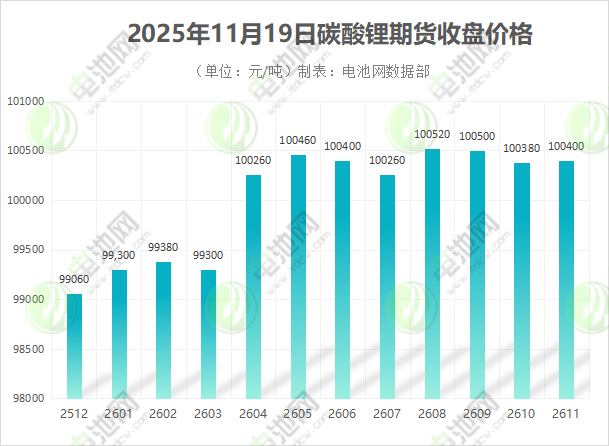
The price of lithium carbonate futures has returned to the 100,000 yuan mark, indicating that the market remains optimistic about the demand for lithium carbonate next year.
SMM analysis indicates that, from the perspective of influencing factors, the earlier market trend was primarily driven by the supply and demand fundamentals of lithium carbonate, accompanied by a gradual influx of capital; recently, however, it has been more reflective of the capital's impact on prices, accelerating the upward trend.
According to SMM data, on November 19th, battery-grade lithium carbonate was quoted at 85,400 to 92,400 yuan per ton, with an average price of 88,900 yuan per ton, an increase of 1,500 yuan per ton compared to the previous working day.
Battery Network has noted that due to cyclical supply-demand mismatches and overseas production cuts to maintain prices, lithium prices have undergone two relatively significant cycles in the past decade.
During the first cycle (2015-2019), the price of lithium rose steadily from 42,000 yuan per ton to a peak of 180,000 yuan per ton, and then gradually fell back to 48,000 yuan per ton.
The second round of the cycle started in 2020 and once reached a historical high of 600,000 yuan per ton in 2022, after which it entered a phase of fluctuating decline. As of 2024, the average price of lithium carbonate has fallen to around 90,000 yuan per ton.
At the beginning of this year, the price of lithium carbonate experienced continuous fluctuations, starting at around 80,000 yuan per ton and dropping to the 60,000 yuan range by mid-year, before experiencing some adjustments. Starting in November, the price of lithium carbonate began to rise more rapidly, and currently, the spot price has rebounded to around 90,000 yuan per ton.
From the market performance perspective, the main reason for the recent rise in lithium carbonate prices is the boost in downstream demand.
One reason is that new energy vehicles are experiencing a year-end sales surge, combined with the fact that the purchase tax exemption for new energy vehicles will start to phase out in 2026, which has boosted enthusiasm for buying cars.
According to data from the China Association of Automobile Manufacturers, in October this year, the monthly sales of new energy vehicles in China for the first time exceeded 50% of the total new car sales, with a year-on-year growth of 20%. Among these, 256,000 units were exported, achieving a year-on-year doubling in growth. In terms of power batteries, from January to October, the cumulative installed capacity of domestic power batteries reached 578.0 GWh, with a cumulative year-on-year growth of 42.4%.
In addition, in the energy storage sector, significant overseas energy storage contracts have emerged frequently since the second half of this year. For example, on the evening of November 17, Trina Solar (688599) announced that its controlling subsidiary, Trina Storage, signed a contract for a 2.66 GWh overseas energy storage project.
According to a previous report by CCTV Finance, the new energy storage market is experiencing a phenomenon of "difficulty in sourcing battery cells," with a continued tight supply of battery cells.
To ensure order supply, listed companies in the energy storage sector have begun to scramble for battery cells. On November 12, HybriSys (688411) announced the signing of a strategic cooperation agreement with CATL (300750), stipulating that from January 1, 2026, to December 31, 2028, it will purchase a cumulative total of no less than 200 GWh of electricity from the latter.
Secondly, listed companies are frequently securing orders for battery materials, which is being transmitted to the upstream lithium salt sector as the market recovers.
On November 6th, Tianci Materials (002709) announced two major orders, respectively from Gotion High-tech (002074) and CALB (03931.hk), involving a total supply of nearly 1.6 million tons of electrolyte products over three years.
On November 18, Shengxin Lithium Energy (002240) announced that Huayou Holding Group will purchase 221,400 tons of lithium salt products from the company during the period from 2026 to 2030.
Supported by demand, the strong momentum of lithium carbonate prices is likely to continue for some time in the future, but the room for further increases in lithium prices remains to be seen.
SMM mentioned that from the actual transaction situation in the lithium carbonate spot market on November 19, downstream companies mostly remained rational and cautious, with purchases mainly based on immediate needs, resulting in very few overall market transactions. On the supply side, lithium salt plants maintained a high operating rate, with both spodumene and salt lake operations maintaining an operating rate of over 60%, becoming the main supply force. It is expected that domestic lithium carbonate production in November can maintain the production level of October, roughly flat month-on-month.
At the recently held ABEC2025 | 12th China (Suzhou) International Summit Forum on Battery and New Energy Industry, Zhang Jiangfeng, Vice President of the Lithium Industry Branch of the China Nonferrous Metals Industry Association, stated that from January to September this year, the average spot price of lithium carbonate was 71,078 yuan/ton, a year-on-year decrease of 25.71%. He predicts that by 2025, global lithium supply will exceed 1.7 million tons of LCE, a year-on-year increase of 26%; the global lithium demand in 2025 is expected to be about 1.63 million tons of LCE, a year-on-year increase of 25%.
China Securities recently predicted in a research report that global lithium supply will reach 2.089 million tons in 2026, with consumption at 2.004 million tons. Without considering cathode material stages and traders' restocking, the surplus will be only 85,000 tons, narrowing compared to 2025. Considering inventory buildup in the industry chain, a structural shortage is expected in 2026, and the driving factor for lithium prices will shift from supply pressure to demand-driven upward movement.
Overall, the current tight supply and demand of lithium carbonate is more inclined to be a temporary phenomenon, mainly driven by short-term disturbances on the supply side and growth on the demand side. The key to future trends lies in the pace of supply recovery and demand growth.
【Copyright and Disclaimer】The above information is collected and organized by PlastMatch. The copyright belongs to the original author. This article is reprinted for the purpose of providing more information, and it does not imply that PlastMatch endorses the views expressed in the article or guarantees its accuracy. If there are any errors in the source attribution or if your legitimate rights have been infringed, please contact us, and we will promptly correct or remove the content. If other media, websites, or individuals use the aforementioned content, they must clearly indicate the original source and origin of the work and assume legal responsibility on their own.
Most Popular
-

Mexico Imposes Tariff Up to 36% on Cross-Border E-Commerce Products, Effective January 1, 2026; Plastic Shows Partial Fluctuation Today
-
Lithium Carbonate Price Reaches Key Node at 100,000 Yuan/Ton! Listed Companies Rush to Lock Orders!
-

[Overseas News] Sumitomo Chemical Acquires Solvay's LCP Business! SK Chemicals Builds Circular Economy Model For Waste Banners!
-

Trump Delays Tariff Increase on Furniture, Cabinets, and Vanities
-
4.5 Million Tons! Wanhua Chemical Dominates Globally in MDI, Heavy Investment in Battery Materials Spurs New Storm


