Global EV Battery Installation Volume TOP10: BYD Surpasses the Combined Total of Three Korean Companies, Market Share of Five Chinese Companies Increases Again
In the period from January to September 2025, CATL, BYD, CALB, Gotion High-Tech, EVE Energy, and SVOLT have entered the TOP 10 global rankings for electric vehicle battery installations. The combined installed capacity of these six companies totals 553.6 GWh, achieving a market share of 68.2%, which represents an increase compared to the 65.5% market share during the same period last year.
Recently, the South Korean research institute SNE Research released the latest data on global power battery installation volumes for January to September 2025.
Data shows that from January to September 2025, the global installed capacity of power batteries reached 811.7 GWh, representing a year-on-year increase of 34.7%.
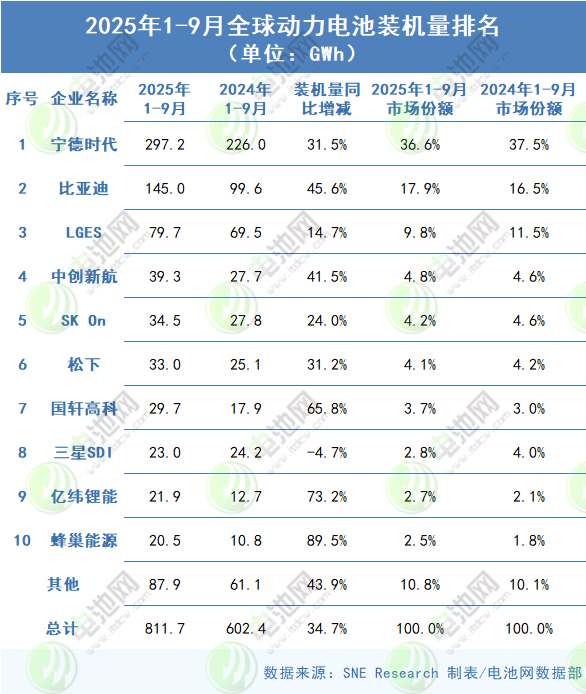
From a market share perspectiveFrom January to September 2025, the performance of the top 10 global power battery installation companies showed clear differentiation. Compared to the same period in 2024, five Chinese companies—BYD, Svolt Energy, Gotion High-Tech, EVE Energy, and CALB—achieved positive growth, with BYD leading with a 1.4% increase. In contrast, Panasonic, SK On, CATL, Samsung SDI, and LGES experienced varying degrees of decline, with LGES seeing the largest drop of 1.7%.
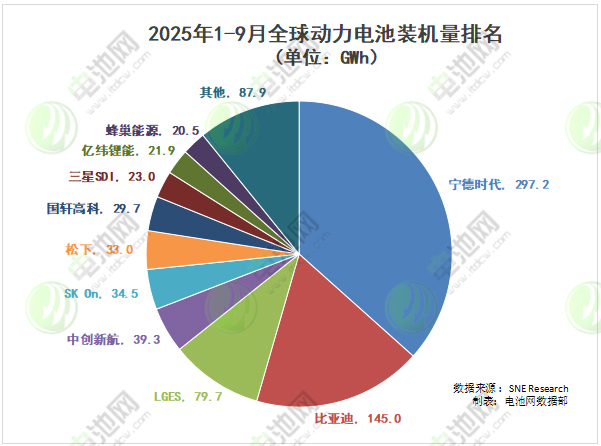
From the perspective of ranking changes.In comparison to the same period in 2024, the ranking of the top 10 global power battery installed capacity companies from January to September 2025 has seen some changes. The top six companies—CATL, BYD, LGES, Zhongxin Innovation, SK On, and Panasonic—maintain their positions. Guoxuan High-tech and Samsung SDI have swapped ranks, now occupying the 7th and 8th positions, respectively. Yiwei Lithium Energy remains in 9th place, while Honeycomb Energy makes its debut on the list at 10th place.
From the year-on-year change in loading volume.From January to September 2025, among the top 10 global power battery installation companies, all but Samsung SDI achieved positive growth. The highest increase was by SVOLT Energy, reaching 89.5%.
Chinese companiesFrom January to September 2025, CATL, BYD, CALB, Gotion High-Tech, EVE Energy, and SVOLT entered the global top 10 rankings for installed capacity of power batteries. The total installed capacity of these six companies amounted to 553.6 GWh, capturing a market share of 68.2%, which is an increase from the 65.5% market share during the same period last year.
Specifically, CATL has retained its position as the global leader, with a cumulative installed capacity of 297.2 GWh from January to September 2025, marking a year-on-year growth of 31.5% and a market share of 36.6%. Although CATL's market share has declined, its installed capacity is still overwhelming: among the top 10 global power battery companies from January to September 2025, the combined installed capacity of the other eight companies, excluding CATL and BYD, is 281.6 GWh.
BYD firmly holds the second place, with an installed capacity reaching 145 GWh, a year-on-year increase of 45.6%, and a market share of 17.9%. It is worth mentioning that BYD's installed capacity surpassed the combined total of the three Korean battery companies (137.2 GWh).
According to the latest data released by BYD, in the first 10 months of this year, the total installed capacity of BYD's new energy vehicle power batteries and energy storage batteries was approximately 230.613 GWh.
China Innovation Aviation's installed capacity reached 39.3 GWh, maintaining the fourth position, with a year-on-year growth of 41.5% and a market share of 4.8%.
Gotion High-Tech's installed capacity reached 29.7 GWh, ranking seventh, with a year-on-year growth of 65.8%, and its market share rose to 3.7%.
EVE Energy's installed capacity is 21.9 GWh, ranking ninth, with a year-on-year growth of 73.2%, and its market share has risen to 2.7%.
As the company with the highest growth rate among the top 10 companies, SVOLT Energy achieved an 89.5% increase, with a vehicle installation volume reaching 20.5 GWh, ranking tenth and raising its market share to 2.5%. On November 5th, Yang Hongxin, Chairman and CEO of SVOLT Energy, stated on social media, "In October, SVOLT Energy's power batteries shipped a total of 28,133 vehicles overseas, equivalent to 1.37 GWh, representing an 18% month-on-month increase, marking a new high for overseas shipments!"
Korean company====From January to September, SK On and LGES both achieved growth in installed capacity, while Samsung SDI experienced a year-on-year decline. The total installed capacity of the three companies reached 137.2 GWh, with a market share of 16.9%, which is a decrease of 3.3 percentage points compared to the same period last year.
LGES maintained its global third position with an installed capacity of 79.7 GWh, marking a year-on-year increase of 14.7%. However, its market share decreased from 11.5% in the same period last year to 9.8%.
SK On's shipment volume reached 34.5 GWh, a year-on-year increase of 24.0%, making it the highest growth among the three Korean battery companies. Its market share slightly decreased to 4.2%, ranking fifth.
Samsung SDI became the only company among the top ten to experience negative growth, with installation volume at 23 GWh, a year-on-year decrease of 4.7%. Its market share fell below 3%, dropping from 4% in the same period last year to 2.8%, ranking eighth.
Japanese companies====Panasonic's installed vehicle capacity rose to 33 GWh, a year-on-year increase of 31.2%, with a market share of 4.1%, which slightly declined year-on-year, ranking sixth.
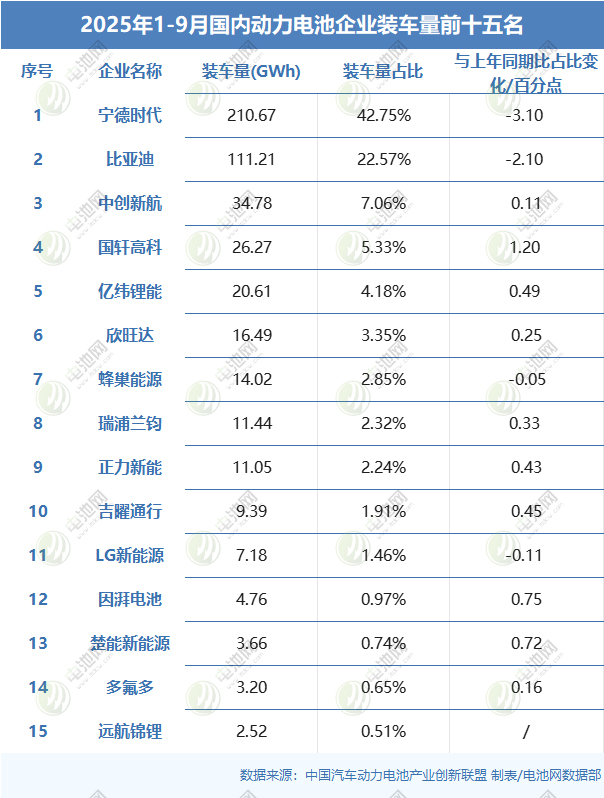
According to data released by the China Automotive Power Battery Industry Innovation Alliance, from January to September, the cumulative installed capacity of power batteries in China was 493.9 GWh, representing a year-on-year increase of 42.5%.
From January to September, a total of 51 power battery companies in China's new energy vehicle market achieved vehicle installation, an increase of 2 companies compared to last year. The top 2, top 5, and top 10 power battery companies' vehicle installation volumes were 321.9 GWh, 403.5 GWh, and 465.9 GWh, accounting for 65.2%, 81.7%, and 94.3% of the total installation volume, respectively. The proportion of the top 10 decreased by 1.6 percentage points compared to the same period last year.
Compared to January-September 2024, in January-September this year, the rankings of the top 9 companies—CATL, BYD, CALB, Gotion High-Tech, EVE Energy, Sunwoda, SVOLT, REPT, and Great Power—remained unchanged. Jiyou replaced Gotion New Energy and swapped rankings with LG Energy Solution, ranking 10th and 11th, respectively. Inpao Battery's ranking rose from 15th to 12th. Do-Fluoride's ranking dropped from 13th to 14th. Chenergy and Yuanhang Jinli made the list, ranking 13th and 15th, respectively.
【Copyright and Disclaimer】The above information is collected and organized by PlastMatch. The copyright belongs to the original author. This article is reprinted for the purpose of providing more information, and it does not imply that PlastMatch endorses the views expressed in the article or guarantees its accuracy. If there are any errors in the source attribution or if your legitimate rights have been infringed, please contact us, and we will promptly correct or remove the content. If other media, websites, or individuals use the aforementioned content, they must clearly indicate the original source and origin of the work and assume legal responsibility on their own.
Most Popular
-
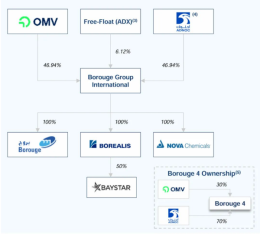
Breakthrough! 13.6-million-ton new giant emerges as world’s fourth-largest polyolefin producer, reshaping industry landscape
-
BASF's $8.7 Billion Zhanjiang Site Fully Operational, Covestro, SABIC, Arkema and Other Plastics Giants Double Down on China
-
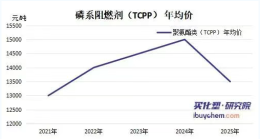
Massive Loss of $960 Million! Wansheng Co., Ltd. Sees Rising Revenue But Declining Profits—Why Did the Phosphorus-Based Flame Retardant Leader Falter?
-
Domestic PBE Breakthrough, Polyolefin Modification Industry to Break the Impasse
-
Deadly Impact: Hormuz Strait Blockade Sparks Shortage of Plastic Raw Materials, Threatening Shutdowns at Japanese and Korean Chemical Plants