



Extrusion Technology Drives the Development of Plastic Circular Economy
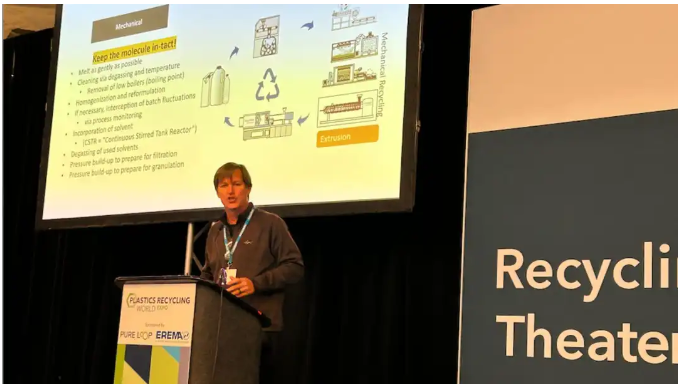
At the AMI Plastics World Expo held in Cleveland, Ohio, Paul Martin from KraussMaffei discussed how advanced extruders drive higher recycling rates and support the circular economy. (Image source: David Hutton)
Key Points
Advanced extruders use modular systems for polymer recycling, with a processing capacity of up to 6,000 pounds per hour.
Twin-screw technology can create a homogeneous melt from various raw materials of different sizes and fragments.
Thermal energy methods for chemical recycling decompose mixed plastics without the need for fine sorting.
The global plastics industry is at a critical turning point, facing immense pressure to reduce waste and adopt sustainable practices. At the heart of this transformation is extrusion technology—a scalable and versatile solution that is revolutionizing polymer recycling.
At the recent AMI Plastics World Expo held in Cleveland, Ohio, KraussMaffei extrusion expert Paul Martin explained how advanced extruders can help the industry achieve higher recycling rates, reduce environmental impact, and move towards a circular economy.
Modular systems enable scalability.
One of the key challenges of polymer recycling is scalability. According to Martin, KraussMaffei's extrusion technology is designed to directly address this issue.
"Our extruder specifications range widely, from very small to very large, allowing us to effectively scale our recycling operations," said Martin. "We have achieved remarkable rates on single-screw extruders—up to 6,000 pounds per hour in certain applications. However, to incorporate more than 15% total recycled material content, we need to scale up further with larger machines and advanced systems."
KraussMaffei's modular extruders are at the forefront of this effort. These systems include advanced auxiliary components such as pelletizing systems, filtration units, and gear pumps, all of which are crucial for handling various polymers and achieving stable quality.
"We collaborate with global partners to seamlessly integrate these technologies," Martin pointed out.
Scalability begins in the laboratory. KraussMaffei operates state-of-the-art laboratories in Germany, the USA, and China, where customers can test various recycling methods.
"We started with laboratory-scale extruders, testing single-screw, twin-screw, co-rotating, and counter-rotating configurations," Martin said, "which allowed us to find the optimal method for each polymer and application."
Mechanical recycling and thermomechanical recycling
Plastic recycling mainly involves two methods: mechanical recycling and thermal mechanical recycling. Although both aim to reduce waste and reuse materials, their processes and applications differ.
Mechanical recycling focuses on preserving the molecular structure of polymers. Its goal is to "maintain molecular integrity" by gently melting polymers, removing contaminants through degassing, and maintaining precise temperature control. Twin-screw extruders play a key role in this process.
"They excel at creating a homogeneous melt from diverse materials (such as fragments of different sizes and colors)," Martin explained, "which ensures the stability of the final product quality."
The process begins with sorting and shredding plastic waste into fragments, followed by cleaning and feeding it into an extruder. Subsequently, the material can be reformed into new products, such as bottles and bottle caps, through injection or blow molding.
"The extruder is particularly effective in transforming batch processes into continuous operations, which is crucial for scaling up," Martin added.
Thermomechanical recycling, on the other hand, combines the recycling and compounding steps into one. This method breaks down the plastic into a melt, adds reinforcing materials such as glass or calcium carbonate, and produces pellets—all steps completed in one process.
"We can decompose plastic into a melt in a process, add reinforcement materials, and produce pellets," Martin explained. This method is particularly effective for polypropylene recycling. Martin emphasized the success story of leading PP recycler PureCycle Technologies located in southern Ohio.
"We spent eight years developing this technology with Procter & Gamble," he noted, "Using co-rotating twin-screw extruders, we achieved a rate of up to 14,000 pounds per hour, producing ultra-pure recycled PP."
PureCycle's modular system is currently being deployed globally, with plans to build plants in Asia, Europe, and other locations in the United States.
"These systems have the potential to significantly increase recycling rates and make a real impact on the industry," Martin pointed out.
Chemical recycling
Although mechanical recycling and thermal mechanical recycling focus on maintaining or modifying the polymer structure, chemical recycling takes a different approach by breaking down the molecules into their basic components. This method can handle mixed plastics without the need for precise sorting.
Chemical recycling involves the application of high levels of thermal and chemical energy to convert polymers into synthesis gas, gas oil, or monomers. For example, PET bottles can be depolymerized through a condensation reaction by adding ethylene glycol to reverse the process.
"We have implemented this technology in more than 800 reference production lines worldwide, achieving large-scale PET recycling," Martin pointed out.
Filtration and Granulation
Filtration is a key step in mechanical and chemical recycling as it removes contaminants and ensures the purity of the final product. KraussMaffei's system integrates advanced filtration technology, including candle filters, to handle high throughput rates.
"Filtering is particularly important for applications such as food-grade packaging, as these applications have uncompromising purity requirements," Martin pointed out. "Our system is designed to meet the highest standards, ensuring that recycled polymers can compete with virgin materials."
Pelletizing is the final step of the process, which transforms the recycled melt into uniform pellets. These pellets can then be used for a wide range of applications, from automotive parts to consumer goods.
Expand the scale of the circular economy
As the plastics industry strives to achieve a circular economy, the importance of scalable recycling technologies cannot be overstated. KraussMaffei's extruders are paving the way for higher recycling rates and reduced reliance on virgin materials.
Martin envisions a future where every piece of plastic is recycled through mechanical or chemical means.
"The goal is to achieve 100% recycling," he added, "We want to use plastic over and over again to minimize waste and environmental impact."
To achieve this vision, the industry must continue to innovate and invest in scalable solutions. While KraussMaffei is leading this trend, other companies such as Erema, Kautex, and PureCycle Technologies are also making significant contributions to the advancement of recycling technologies.
From modular extruders to advanced filtration and granulation technology, KraussMaffei is helping the plastics industry move towards a circular economy—one extruder at a time. By combining innovation with a commitment to sustainability, the company is driving progress in polymer recycling.
"This is not just recycling; it's about rethinking how we use and reuse plastic," Martin concluded, "The technology is already in place, and now is the time for action."
【Copyright and Disclaimer】The above information is collected and organized by PlastMatch. The copyright belongs to the original author. This article is reprinted for the purpose of providing more information, and it does not imply that PlastMatch endorses the views expressed in the article or guarantees its accuracy. If there are any errors in the source attribution or if your legitimate rights have been infringed, please contact us, and we will promptly correct or remove the content. If other media, websites, or individuals use the aforementioned content, they must clearly indicate the original source and origin of the work and assume legal responsibility on their own.
Most Popular
-
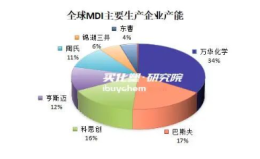
Dow, Wanhua, Huntsman Intensively Raise Prices! Who Controls the Global MDI Prices?
-

Clariant Unveils Cost-Cutting Plan Details, Plans to Shut Down Multiple Plants
-

[Today's Plastics Market] General Materials Weakly Fluctuate, Engineering Materials Steadily Rise
-
New Breakthrough in Domestic Adiponitrile! Observing the Rise of China's Nylon Industry Chain from Tianchen Qixiang's Production
-
Daily Review: Polyethylene Prices Under Weak Consolidation, Sellers Face Significant Pressure to Move Inventory

