



Can the uniaxial tensile mechanical properties of long glass fiber reinforced polypropylene remain stable under fluctuating ambient temperatures?
Against the backdrop of the dual carbon objectives, the automotive industry is increasingly required to meet stringent emissions reduction targets. Studies have shown that for every 10% decrease in vehicle weight, fuel consumption can be reduced by 6% to 8%, and tailpipe emissions can be lowered by 5% to 6%. Thermoplastic composite materials exhibit excellent mechanical properties and recyclability. By incorporating fibers into the thermoplastic composite resin matrix, it is possible to reduce weight while enhancing design flexibility. The injection molding process facilitates the cost-effective production of complex-shaped components in a single step.
The usage and application of long fiber reinforced thermoplastic composites in the automotive industry have been increasing year by year, with LGFPP being one of the most representative materials. Given the wide temperature range of the service environment for automotive composite components, it is necessary to investigate the mechanical properties of materials at both high and low temperatures. Among these, glass fiber reinforced polymers (GFRP) are widely used due to their relatively low cost. Research indicates that enhancing the performance of fiber reinforced polymers when exposed to high temperatures has become one of the challenges in expanding their applications.
This work studied the tensile properties of long glass fiber reinforced polypropylene (LGFPP) in high and low temperature environments, aiming to establish a prediction method for the mechanical properties of thermoplastic composites at different temperatures. Through tensile tests conducted in various temperature environments, the effect of environmental temperature on the mechanical properties of LGFPP was investigated, and its failure mechanisms were analyzed. A homogenized RVE model for LGFPP was established to predict the mechanical response and elastic constants of LGFPP at different temperatures, providing guidance for the adaptability of LGFPP in application environments.
01. Material Properties
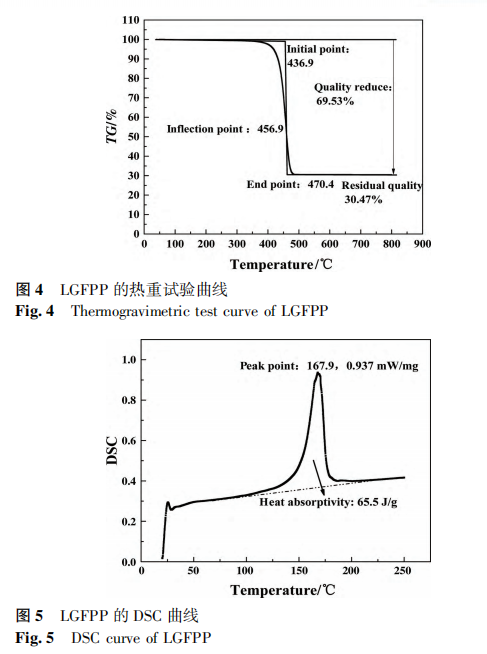
The thermogravimetric test results of LGFPP are shown in Figure 4. When the temperature rises to 700°C, the matrix is completely oxidized, and the remaining substance is glass fiber. The density of the glass fiber is 2.2 g/cm³, and the density of the resin is 0.9 g/cm³. The mass fraction of the glass fiber calculated by Equation (3) is 30.47%, and the volume fraction is 13.3%.

Figure 5 shows the DSC curve of LGFPP, with a melting point of 167.9°C for LGFPP. The calculated specific heat absorption is 65.5 J/g. The presence of a single peak in Figure 5 indicates that the material is un-doped.
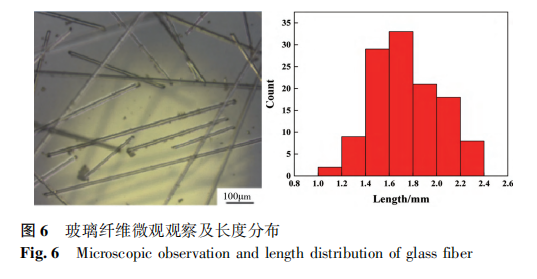
After placing the specimen in the crucible and then into the muffle furnace for calcination, a glass fiber substrate was obtained. From the injection port to the tail end, five pieces of glass fiber were taken at regular intervals for observation and statistics: the results are shown in Figure 6. The average length of the fibers was calculated to be 1.74 mm using ImageJ.
02. Temperature Correlation of Tensile Strength
The tensile test results of LGFPP in high and low temperature environments are shown in Figure 7 and Table 3. Its unidirectional tensile strength decreases with the increase of temperature. As shown in Table 4, the elongation at break of LGFPP increases. Compared with that at 20℃, its unidirectional tensile strength at 40℃, 60℃, 80℃, and 100℃ decreased by 12.45%, 26.38%, 36.55%, and 45.84%, respectively, and the elongation at break increased by 6.8%, 9.9%, 10.8%, and 20.5%, respectively.
The matrix material resin is a thermoplastic material, and as the temperature rises, the molecular movement intensifies, causing it to soften and the elastic modulus to decrease. When the temperature increases, thermal stress is generated at the interface between the fiber reinforcement phase and the matrix phase due to the mismatch in thermal expansion coefficients, which reduces the interfacial performance. Excessively high temperatures can even lead to the formation of cracks within the matrix, weakening the load transfer capability between the glass fibers and the resin, thereby reducing the modulus and strength of LGFPP. When the temperature is below room temperature, the elongation at break of LGFPP decreases, but it is slightly higher at -20°C compared to 0°C. At low temperatures, introducing reinforcing tabs during clamping can mitigate slippage, but cannot completely eliminate it. As shown in Figure 6, slight slippage still occurs during the initial stage of the tensile process at 0°C.
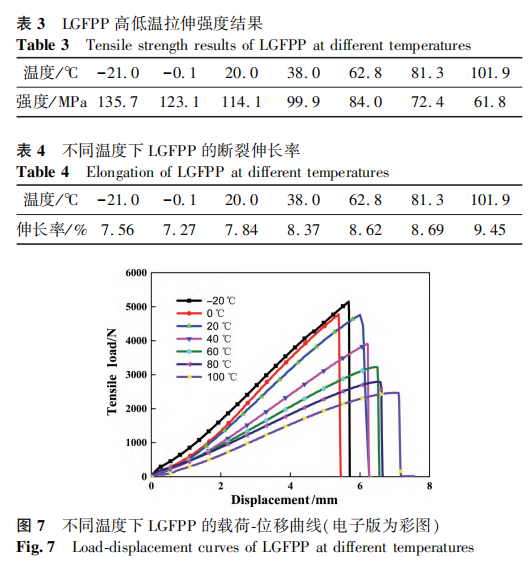
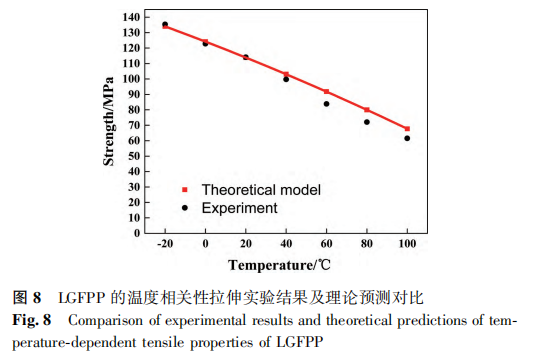
Figure 8 shows a comparison between the experimental and theoretical values of tensile strength, with a maximum error of 9.82%. The two are in good agreement, indicating that the theoretical model provides useful guidance for predicting the uniaxial tensile strength of LGFPP. The main reason for the error at high temperatures is that the theoretical model does not consider the negative impact of stress concentration on mechanical properties as temperature changes. Additionally, the presence of small particles in the polypropylene material can also lead to stress concentration in localized areas. The error at low temperatures is primarily due to the experimental environment exceeding the cold brittle transition temperature of the resin matrix. The low temperature slows down the movement of PP molecular chains, reducing the creep effect at the same stretching rate, which results in a higher tensile strength.
03. Numerical Computation
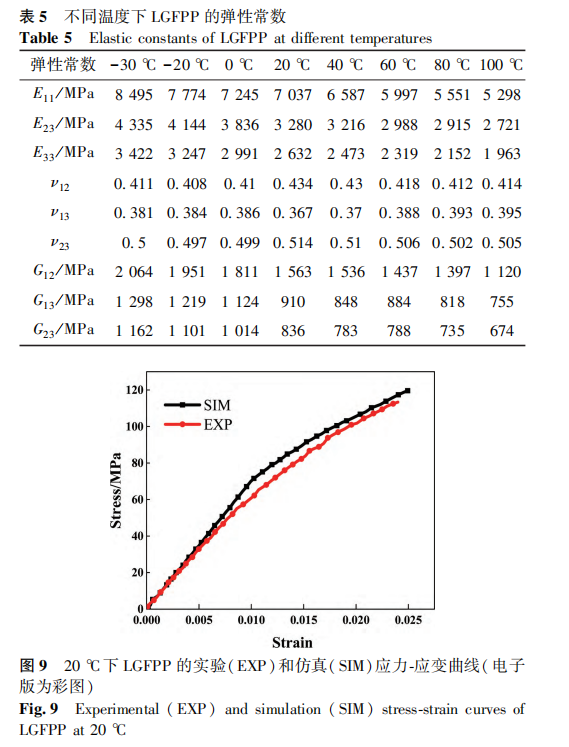
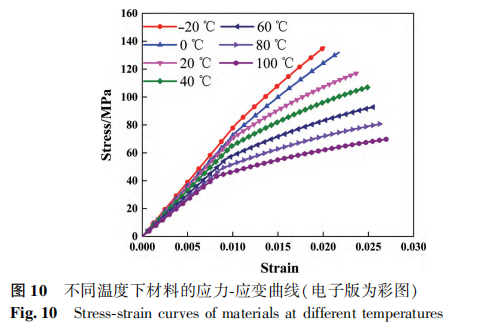
The stress-strain numerical calculations and experimental results of LGFPP at 20 ℃ are compared in Figure 9, with an error of 3%, verifying the effectiveness of the numerical calculations. The numerical calculation results of the unidirectional tensile stress-strain curves and elastic constants of LGFPP from -20 to 100 ℃ are shown in Figure 10 and Table 5, respectively. As the temperature increases, the unidirectional tensile strength of the material decreases, and the failure strain increases; the elastic modulus and shear modulus decrease, with the maximum reduction reaching 46%. However, the Poisson’s ratio does not show a monotonic trend; at room temperature, v12 and v23 are the largest while v13 is the smallest.
04、Microscopic failure mechanisms
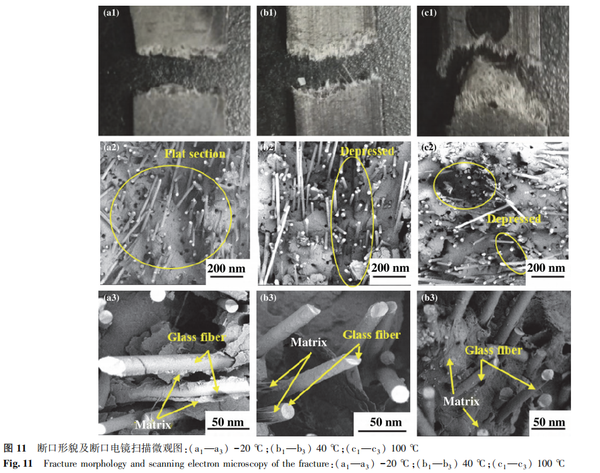
The failure modes of LGFPP and the existing micro-surface damage show significant differences. The typical failure modes are shown in Figure 11.
The typical failure modes of LGFPP at -20℃ are shown in Figure 11a1-a3. The failure is characterized by matrix failure, with a relatively flat fracture surface and minimal fiber pull-out, and the fiber length is short. The matrix exhibits good fiber encapsulation, which is beneficial for load transfer; thus, LGFPP demonstrates higher tensile strength at lower temperatures.
Figure 11b1-b3 shows the typical failure modes of LGFPP at 60°C. The failure manifests as matrix failure, with the fracture surface appearing uneven. The length of fibers pulled out from the fracture surface is longer than at lower temperatures, and the load-bearing capacity of the glass fibers is weakened, leading to a gradual decline in the load-bearing capability. From Figure 11b3, it can be observed that there is viscous resin on the fiber surface, indicating that as the temperature rises, the matrix material softens, and the interfacial properties between the fibers and the matrix significantly deteriorate. This is reflected in the load-displacement curve as a lower failure load and a higher elongation at break.
The typical failure mode of LGFPP at 100℃ is shown in Figure 11c1-c3, where the failure is characterized by matrix failure and fiber pull-out. The length of fiber pull-out noticeably increases, and the proportion of broken fibers at the fracture surface significantly decreases.
From Figure 11c1, it can be observed that as the tensile displacement increases, the interfacial bonding ability between the matrix decreases, and the fibers will pull out some of the matrix together, which is manifested as large-area pits appearing at the matrix interface in Figure 11c2.
From Figure 11c3, it is evident that the encapsulation of the matrix around the pulled-out fibers decreases more significantly, resulting in lower viscous action on the surface of the glass fibers and a noticeable decline in load transfer efficiency.
Conclusion
Compared to 20°C, the unidirectional tensile strength of LGFPP at -20°C increases by 18.93%. When the environmental temperature rises from room temperature to 100°C, its strength decreases by 45.84%.
As the environmental temperature increases, the LGFPP matrix softens, reducing the interfacial bonding strength between the fiber and the matrix. The matrix's viscous effect on the glass fiber surface decreases, gradually shifting from fiber-matrix failure to matrix failure and interfacial failure between the matrix and fibers, leading to a decrease in the load-bearing capacity of the fibers. The softening of the matrix is the primary reason for its reduced load-bearing capacity.
(3) Considering the elastic modulus at different temperatures, a numerical analysis model of LGFPP was successfully established, which agrees well with the experiments. This model predicts the mechanical response and elastic constants of the material at different environmental temperatures, providing guidance for the adaptability of LGFPP in application environments.
【Copyright and Disclaimer】The above information is collected and organized by PlastMatch. The copyright belongs to the original author. This article is reprinted for the purpose of providing more information, and it does not imply that PlastMatch endorses the views expressed in the article or guarantees its accuracy. If there are any errors in the source attribution or if your legitimate rights have been infringed, please contact us, and we will promptly correct or remove the content. If other media, websites, or individuals use the aforementioned content, they must clearly indicate the original source and origin of the work and assume legal responsibility on their own.
Most Popular
-

Mexico Imposes Tariff Up to 36% on Cross-Border E-Commerce Products, Effective January 1, 2026; Plastic Shows Partial Fluctuation Today
-
4.5 Million Tons! Wanhua Chemical Dominates Globally in MDI, Heavy Investment in Battery Materials Spurs New Storm
-

Trump Delays Tariff Increase on Furniture, Cabinets, and Vanities
-
Wanhua Chemical Invests $27.3 Billion, 2026 Investment Map Revealed, $1.1 Billion Bet on Battery Materials
-
Back-to-back major joker moves! covestro’s 1.32 million ton mdi dual-line expansion and hdi acquisition reshape global polyurethane landscape


