60,000 tons polyurethane new material capacity launched! asahi chemical expansion accelerates domestic replacement of high-end adhesive materials
Latest industrial news has come from the Taicang Port Economic and Technological Development Zone: the expansion project of the locally well-known high-tech chemical company Xuchuan Chemical has made new progress. Its expansion project to produce 60,000 tons per year of polyurethane new materials has officially entered the environmental impact assessment acceptance and public notification stage, meaning the project's implementation has taken another big step forward.
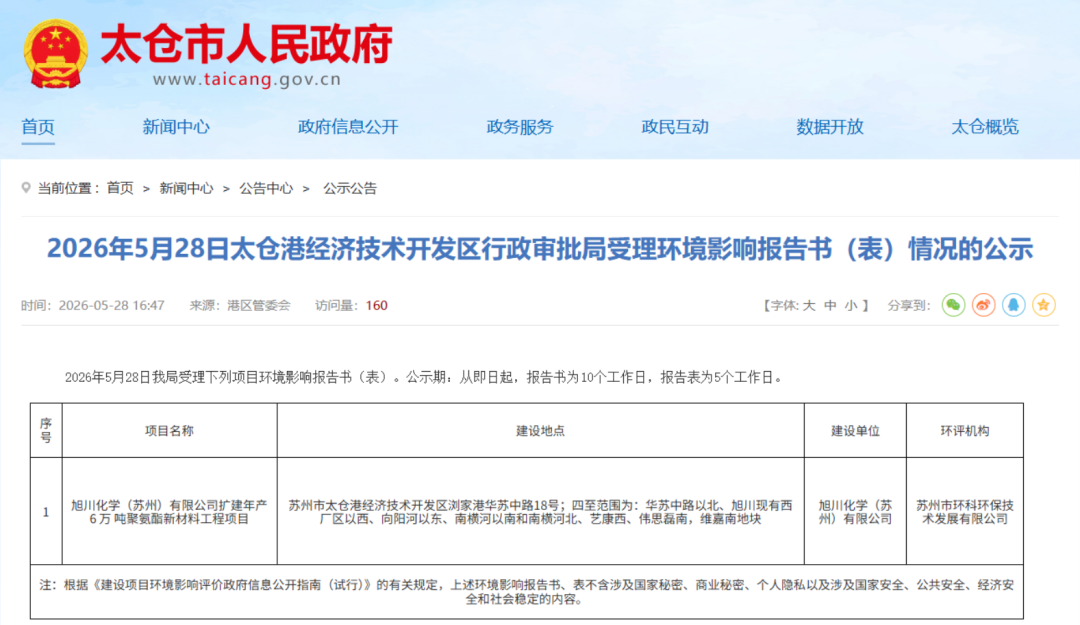
Established in 2007, Xuchuan Chemical has long been deeply engaged in the R&D and mass production of polyester polyols and polyurethane materials, making it a solid backbone enterprise in China’s new materials sector. The company has established two major production sites in the Taicang Port Area; the two bases have clearly defined roles and robust production capacity, laying a strong foundation for subsequent new product iteration and capacity expansion.
The East Factory Area is located at No. 3 Xiexin Middle Road, Taicang Port Area, with an existing approved polyurethane resin production capacity of 80,000 tons; the West Factory Area is located at No. 16 Huasu Middle Road, with a compliant and operational polyurethane new materials production capacity of 270,000 tons. The new expansion project is situated within the mature production capacity of the West Factory Area.
Recently, I visited the Taicang Chemical Industry Park to follow up on the thermoplastic composite bonding sample project. During my discussions with process technicians from local supporting processing plants, I learned that many factories in the industry engaged in automotive interiors and lightweight composite processing have long been troubled by the issues associated with imported hot-melt adhesives. Not only are the procurement cycles lengthy and the supply unstable, but the overall costs also remain high. Many processing plants in the industry are urgently seeking reliable domestic alternatives.
Adhesives are indispensable basic auxiliary materials in industrial manufacturing. From everyday consumer goods to high-end precision components and the forming of composite structures, bonding materials play a vital role. As China’s manufacturing industry undergoes comprehensive upgrading, the environmental drawbacks of traditional high-VOC solvent-based adhesives have become increasingly prominent. Low-toxicity, solvent-free, and water-based environmentally friendly adhesives are likely to represent the mainstream development direction for the entire bonding materials industry in the future.
Environmental regulations across various industries are continuously tightening. Fields such as packaging, furniture, footwear, and automotive interiors are progressively restricting or banning the use of highly polluting solvent-based adhesives. Many conventional EVA hot melt adhesives, due to insufficient heat resistance and chemical corrosion resistance, can no longer meet the stringent standards of high-end manufacturing, and the trend of market elimination is becoming increasingly obvious.
High-performance and environmentally friendly polyurethane hot melt adhesives have thus become the core choice for industry replacement. This material is synthesized by reacting isocyanates and polyols as the main raw materials, with a total polyurethane resin content reaching 100%. It is mostly in paste or solid form at room temperature and can perfectly replace traditional solvent-based polyurethane adhesives. As a key raw material for synthesis, polyester polyol plays a crucial role in the stability and environmental adaptability of the finished adhesive, making it an indispensable material in the production of polyurethane products.
During the previous collaboration on the composite layup subcontracting project for whole vehicle interiors, I personally witnessed many factories encountering production pitfalls. Many automakers introduced new regulations prohibiting the use of highly volatile adhesive materials. After factories hastily switched adhesives, due to inadequate adaptation to the new processes, defective products frequently appeared with issues such as poor layup bonding, uneven adhesion, and localized delamination, resulting in persistently high scrap rates.
The rapid iteration of new energy, precision electronics, and high-end automotive industries continues to raise the performance standards for adhesives. Core indicators such as temperature resistance, weather resistance, and structural bonding strength are being continuously upgraded, thoroughly exposing the performance shortcomings of traditional adhesives. This has created a vast incremental market for domestically produced high-end, environmentally friendly polyurethane hot melt adhesives.
But objectively, the discourse power in the domestic high-end adhesive materials market has long been held by overseas giants. Brands such as Henkel, H.B. Fuller, Bostik, and Sika have for years dominated the high-end segments of the automotive, electronics, and new energy industries, and most domestic companies still lag behind foreign brands by a considerable margin in refined production processes, brand building, and on-site application services.
Several domestic policies related to new materials and the goal of becoming a manufacturing powerhouse are prioritizing support for the development of green, high-performance materials and continuously promoting the localization of critical new materials. Local chemical companies have an inherent geographic advantage, being close to downstream industry clusters and able to quickly respond to customers’ customized needs; their on-site process debugging and after-sales technical support are far more flexible than those of foreign brands.
I previously followed up on a bonding rectification project for new-energy composite structural parts, and my strongest impression was that the difficulty of localizing high-end adhesive materials far exceeded expectations. Many downstream factories want to replace imported adhesives to cut costs and improve efficiency, but it is very hard to find domestically produced products with stable batch-to-batch consistency and matching performance; even slight deviations in process adaptation can trigger bond failures, inadequate temperature resistance, and other quality issues. This is also the core reason why the pace of domestic localization of high-end bonding materials has been slow.
Xuchuan Chemical’s current expansion layout precisely addresses the industry’s domestic production capacity shortfall. The project has a total investment of RMB 384.2 million, adds 52.6 mu of land and 23,593.7 square meters of new building area. All filing procedures were completed by the end of January 2026, and the project’s implementation rests on a fully compliant foundation.
According to the project plan, the expansion will add 60,000 tonnes of polyurethane new-material capacity, with a product matrix precisely aligned to high-end market demand. This includes 13,000 tonnes of high-performance polyester polyols, 3,000 tonnes of polycarbonate polyols, 14,000 tonnes of high‑molecular‑weight polyester polyols, and 30,000 tonnes of high-performance, environmentally friendly polyurethane hot‑melt adhesives. Some polyol feedstock will be produced and consumed in-house, further reducing production costs. Rough estimates indicate that once this capacity comes online it will effectively fill the domestic supply gap for high-end eco-friendly polyurethane adhesives, continue to break the long-standing monopoly of overseas brands, and help secure the supply chains of domestic sectors such as new energy and automotive composite materials.
【Copyright and Disclaimer】The above information is collected and organized by PlastMatch. The copyright belongs to the original author. This article is reprinted for the purpose of providing more information, and it does not imply that PlastMatch endorses the views expressed in the article or guarantees its accuracy. If there are any errors in the source attribution or if your legitimate rights have been infringed, please contact us, and we will promptly correct or remove the content. If other media, websites, or individuals use the aforementioned content, they must clearly indicate the original source and origin of the work and assume legal responsibility on their own.
Most Popular
-

A Look at the Material Suppliers Behind SpaceX
-

Government's Triple Action, Enterprises' Three Arrows in Five Days, Semiconductor Reshuffle! What Signal Does Japan's Chemical Industry Release?
-
Fire breaks out at jiangsu meiside!
-
Name change without tax change: POM Anti-Dumping Duty Rate Inheritance Implemented
-
Ethylene: Production Capacity Accelerates Expansion, Global Industry Landscape Is Being Reshaped