



2025SUV TOP20 Top 20 Best-Selling SUVs In China for 2025
In 2025, China's SUV market is undergoing an unprecedented restructuring driven by the dual forces of the new energy wave and the iteration of consumer demand.
The once orderly market has been disrupted, with a reshuffling of top models and intensified faction differentiation being the most distinct characteristics of this year. Although the Tesla Model Y still holds the title of sales champion, it cannot hide the pressure of declining year-on-year sales, as its former status as a benchmark for new energy vehicles faces severe challenges. In stark contrast, the "fuel duo" of Geely's Xingyue L and Boyue L has risen against the trend, achieving impressive sales growth and making their way to the top of the rankings, showcasing a strong counterattack from the fuel vehicle camp.
The internal landscape of the new energy camp is showing a stark contrast: emerging dark horses like the AITO M8 and Leapmotor C10 have successfully broken through with precise positioning and product strength, while several key models under BYD have experienced a significant drop in sales, reflecting the intense competition in the new energy market.
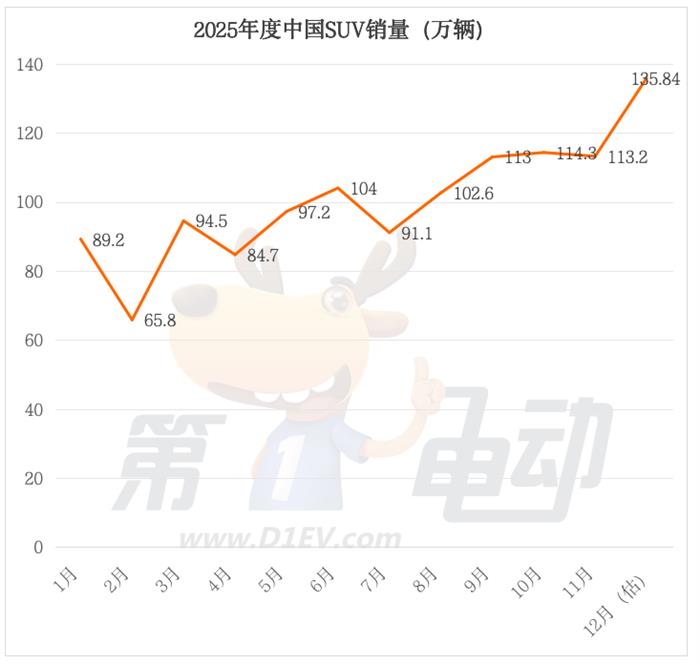
According to data from the China Passenger Car Association, retail sales of passenger cars in China reached 21.464 million units from January to November 2025, a year-on-year increase of 29%. Among them, retail sales in the SUV market reached 10.696 million units, accounting for nearly 50% of the total, a year-on-year increase of 5.7%.
Every December, major car manufacturers typically increase their sales efforts, with total sales generally rising by about 20% compared to November. Based on this, we predict December's terminal sales by multiplying November's retail volume data by a factor of 1.2. It is estimated that the retail volume of SUVs in China will be approximately 1.36 million units in December, and the total volume of SUVs for the year 2025 is expected to be around 12.1 million units, representing a year-on-year growth of approximately 6.6%.
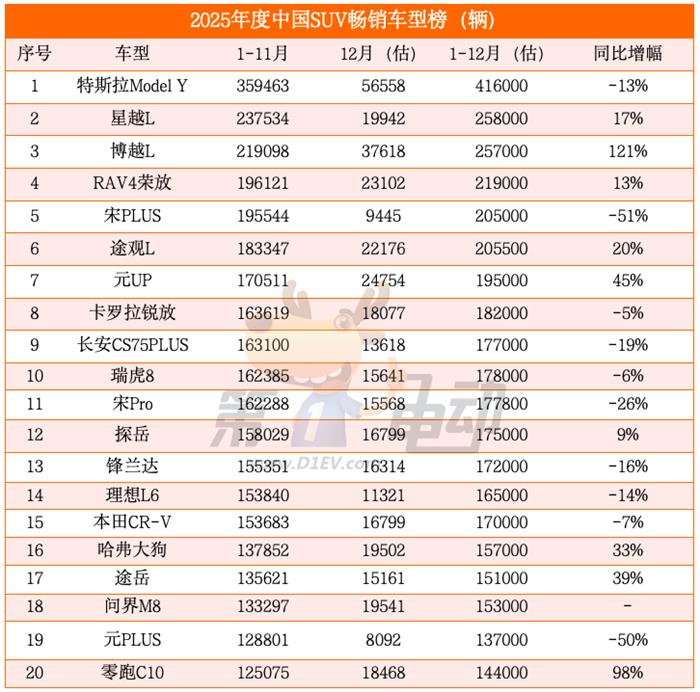
The following 2025 SUV TOP 20 is an estimated figure and may slightly differ from the retail volume that will be disclosed in mid-January next year. Please feel free to point out any inaccuracies.
▍The head pattern is changing: Model Y's defense is under pressure, and Geely's fuel duo is making a comeback.
Tesla Model Y, with an annual sales volume of about 420,000 units, still maintains its champion position, but a 13% year-on-year decline reveals the growth pressure it faces. As a once "benchmark" product in the new energy SUV market, the decline in Model Y's sales is not coincidental. On one hand, the transition period between old and new models has led to a strong sense of consumer hesitation, and delays in the delivery of the refreshed model further suppress short-term demand; on the other hand, the strong encroachment of domestic new energy brands has diminished its product advantages. In the 200,000 to 300,000 yuan price range, many domestic models have surpassed the Model Y in terms of intelligent configurations and range performance. Coupled with differences in brand service experiences, Model Y's market share is being continuously siphoned off.
In stark contrast to Tesla's pressure, Geely Auto has seen a "dual resurgence" with the Xingyue L and Boyue L, which secured the second and third spots on the sales chart with 258,000 and 257,000 units sold, respectively. Their year-on-year growth rates reached 17% and 121%, making them the absolute leaders in the fuel vehicle segment. Amidst the sweeping tide of new energy vehicles in the market, the explosive performance of these two fuel SUVs can be described as "phenomenal."
The underlying reasons are the precise pricing strategy and exceptional product strength, both of which are indispensable. With the terminal discount, the landing price of Xingyue L is just over 160,000 yuan, coupled with luxurious features such as the dual-screen setup and L2-level intelligent driving assistance standard across all models, showcasing its cost-effectiveness advantage. Boyue L has further reduced the starting price to the 90,000 yuan level after discounts, using its mid-sized SUV dimensions and configurations to directly target the compact market, successfully attracting many budget-conscious family users.
▍ Camps are clearly divided: there are mixed feelings about new energy, while the core strength of fuel vehicles remains.
In 2025, the new energy SUV segment shows a significant divergence. On one side, the AITO M8 and Leapmotor C10, with sales of approximately 150,000 and 140,000 units, respectively, have strongly entered the top 20 list, becoming two rising dark horses among new forces. On the other side, BYD's main models, such as Song PLUS and Yuan PLUS, have seen their sales halved, with year-on-year declines exceeding 50%.
The Leapmotor C10, priced between 122,800 and 142,800 yuan, achieves an upgraded positioning in the mid-size SUV segment. It features an impressive 2,825 mm wheelbase and expandable trunk space of up to 835 liters, while also incorporating configurations such as an 8295 cockpit, lidar, and advanced intelligent driving systems that were previously only available in models priced above 200,000 yuan. Additionally, it offers both range-extended and pure electric power options, with the range-extended model boasting a comprehensive range of 1,190 kilometers and the pure electric version equipped with an 800V high-voltage fast charging platform, effectively addressing users' range anxiety. Within just 16 months of its launch, the cumulative delivery volume has exceeded 150,000 units, demonstrating the significant appeal of "high-end configurations made accessible to the masses" through market data.
The success of the Wenjie M8 is attributed to its precise high-end positioning, with a price range of 359,800 to 449,800 yuan covering the mid-to-large SUV segment. Its flexible layout of 5-door 5-seater and 6-seater configurations caters to both family and business scenarios. Equipped with the HarmonyOS intelligent cockpit and a dual-motor all-wheel-drive system, it offers both intelligence and performance. After the release of the pure electric version, it received over 10,000 pre-orders within 24 hours, making it a significant sales contributor to the brand.
The decline in sales of BYD's models reflects the intensified competition in the new energy market. Song PLUS, once a leading new energy SUV, now faces price challenges from fuel competitors like Geely's duo and is besieged by products from numerous emerging brands. The lack of major updates since its launch four years ago has led to diminished novelty, compounded by the previous price war causing old owners to defend their rights, damaging brand value and user trust, ultimately dragging down sales performance.
In addition, the Yuan UP has become a bright spot in the BYD camp with a year-on-year increase of 45%. Its precise positioning as a compact SUV and affordable price have successfully tapped into the urban commuting demand, confirming that there are still differentiated opportunities for new energy vehicles in niche markets.
Although the traditional fuel vehicle segment is generally facing pressure from the transition to new energy vehicles, its core remains solid. Apart from Geely's two strong performers, the Volkswagen Tiguan L and Toyota RAV4 ranked fourth and sixth on the sales list with 205,500 and 219,000 units sold, respectively, marking year-on-year increases of 20% and 13%. These joint venture fuel SUVs are still favored by consumers who prioritize practicality and reliability, thanks to their mature power technology, stable product quality, and extensive after-sales network.
▍The concentration of the TOP20 market is declining, and the main vehicles of BYD and Tesla are under pressure.
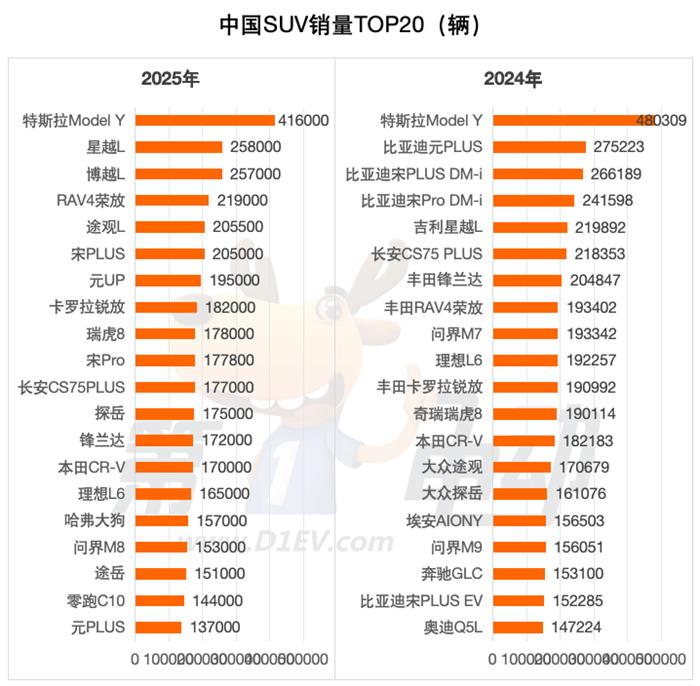
Compared to the list of best-selling SUV models in China in 2024, the Chinese SUV market experienced a dramatic change in 2025.
In the 2025 SUV sales TOP 20 list, new energy models only occupy 8 positions, a decrease of 1 position compared to 2024, with a total sales volume of approximately 3.9 million units, down 6% from 4.15 million units in 2024. The core reason for this change in data is the significant decline in sales of several key models under BYD.
In 2024, the BYD Yuan PLUS, Song PLUS DM-i, and Song Pro DM-i consistently ranked at the top of the charts, but in 2025 their rankings plummeted: Yuan PLUS dropped to 19th place, and Song Pro fell to 11th place. Delving into the reasons behind this, one factor is the diversion effect caused by the iteration of BYD's internal product lineup, such as the launch of the Seagull 06, which directly captured some orders from the Song series. Additionally, the strong rise of competing models like Geely also directly impacted their market share.
The dramatic "reshuffle" in the top ten rankings is a direct reflection of the market's transformation. In 2024, models such as Yuan PLUS, Song Pro, Toyota Corolla Cross, Wuling M7, and Li Xiang L6 all dropped out of the top ten, while models like Corolla Ruifang, Yuan UP, Tiguan L, Chirey 8, and Boyue L successfully made it into the list with outstanding performances.
Notably, among the five new models that entered the top ten, traditional fuel vehicles occupy four spots. This phenomenon fully demonstrates that fuel vehicles still possess undeniable core competitiveness in the current market and have not exited the mainstream stage due to the wave of new energy transformation.
The bottom ten of the ranking has also undergone a restructuring. Former regulars such as Aion AION Y, Wuling M9, Mercedes-Benz GLC, and Audi Q5L have unfortunately dropped off, while models like Tuyue, Wuling M8, Leap C10, and Haval Big Dog have successfully entered the TOP 20 thanks to precise market positioning and outstanding terminal performance.
In terms of brand ownership, the market advantage of domestic brands has been further consolidated. In the 2025 TOP20 list, domestic brands such as Geely, BYD, Changan, Chery, Haval, and Leapmotor have a total of 12 models included, an increase of 1 model compared to 2024. On the other hand, the number of joint venture brand models included has decreased from 8 to 7. However, there are also highlights among joint venture brands, with the Toyota RAV4 standing out prominently, rising from 8th place in 2024 to 4th place in 2025, achieving sales of 219,000 units and becoming the "star performer" among joint venture brands. Meanwhile, classic joint venture models such as Honda CR-V and Volkswagen Tiguan L barely remained on the list, but their sales have shown varying degrees of decline, with their market competitiveness continuing to weaken.
Comparing the sales data of the past two years, the Chinese SUV market is showing three significant trends. Firstly, although the process of electrification continues to advance, fuel and hybrid models still have a solid market presence. In the 2025 rankings, while new energy models still hold important positions, the rise of hybrid and fuel models such as the Xingyue L and Boyue L demonstrates that, in the context of incomplete charging infrastructure and unresolved range anxiety, there is still a huge demand for hybrid models that balance economy and convenience. This is especially evident in third- and fourth-tier cities and long-distance travel scenarios, where the advantages of fuel and hybrid models remain apparent.
Secondly, mid-to-large SUVs and family-oriented models have become new focal points of competition. With the increase in the number of multi-child families, the diversified travel needs of families are driving car manufacturers to accelerate their layout in niche markets. Models such as AITO M7, M8, Li Auto i8, and Leapmotor C16 have been launched, featuring spacious interiors, multi-seat layouts, and smart configurations to meet the travel needs of multi-child families.
Thirdly, intelligence and cost-effectiveness have become core competitive factors. The success of Leapmotor C10 proves this trend—it offers high-end features such as the Qualcomm SA8295P flagship chip and lidar in the 130,000 RMB price range, achieving a breakthrough in "affordable high-end configuration," precisely targeting the needs and pain points of young consumers.
The 2025 China SUV bestseller list is both a summary of the past year's market competition and an inspiration for the future development of the industry. Fuel vehicles have not exited as quickly as expected, but have held their ground by relying on precise product positioning and technological upgrades. Meanwhile, new energy models are undergoing rapid reshuffling in fierce competition, with only brands possessing core technology and exceptional product strength able to stand out.
As 2026 approaches, with the continued hot sales of "new rising stars" like Xiaomi YU7, the all-new Wenjie M7, Haishi 06, and Titanium 7, they are set to become the key forces in transforming the SUV market in 2026.
【Copyright and Disclaimer】The above information is collected and organized by PlastMatch. The copyright belongs to the original author. This article is reprinted for the purpose of providing more information, and it does not imply that PlastMatch endorses the views expressed in the article or guarantees its accuracy. If there are any errors in the source attribution or if your legitimate rights have been infringed, please contact us, and we will promptly correct or remove the content. If other media, websites, or individuals use the aforementioned content, they must clearly indicate the original source and origin of the work and assume legal responsibility on their own.
Most Popular
-
Breakthrough! 13.6-million-ton new giant emerges as world’s fourth-largest polyolefin producer, reshaping industry landscape
-
Massive Loss of $960 Million! Wansheng Co., Ltd. Sees Rising Revenue But Declining Profits—Why Did the Phosphorus-Based Flame Retardant Leader Falter?
-
BASF's $8.7 Billion Zhanjiang Site Fully Operational, Covestro, SABIC, Arkema and Other Plastics Giants Double Down on China
-

Deadly Impact: Hormuz Strait Blockade Sparks Shortage of Plastic Raw Materials, Threatening Shutdowns at Japanese and Korean Chemical Plants
-
Domestic PBE Breakthrough, Polyolefin Modification Industry to Break the Impasse


