ZhuanSu Index: Cost-Driven Support Weakens, Polyolefins Futures and Spot Prices Hover Near Highs in Short Term
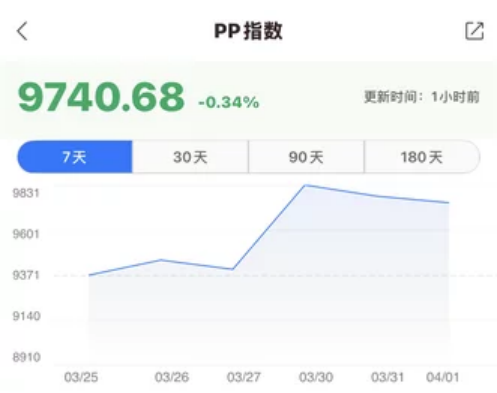
The South China PP Price Index stands at 9740.68 points, up 370.09 points or 3.95% from last week. Among the grades, homopolymer raffia increased by 400, fiber by 350, copolymer by 550, thin-wall by 450, and homopolymer by 500.
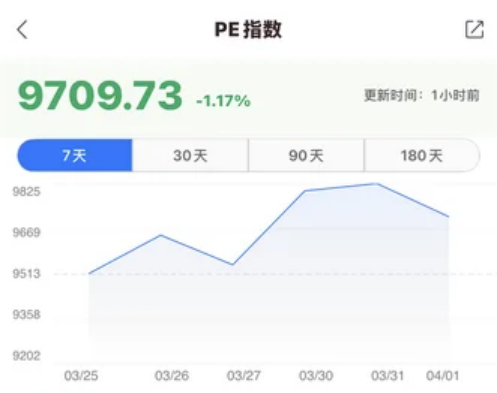
South China PE Price Index: 9,709.73 points, up 196.24 points (2.06%) week-on-week, with LDPE up 200, LLDPE up 200, and HDPE up 150.
This week, polyolefin prices surged and then retreated, with significant fluctuations throughout the week. Prices remained high in the first half of the week, supported by the continued escalation of the Middle East geopolitical conflict. In the second half of the week, the U.S. released signals of a ceasefire, leading to a cooling of concerns over the conflict escalation, and the market saw a sharp decline. Geopolitical factors driving the cost side remained the main variable this week, but the trend has shifted from a one-way rise to a high-level oscillation and retreat. The comprehensive spring maintenance in domestic areas has continued to reduce supply, but downstream demand recovery remains weak, with strong resistance to high prices, and social inventories have not decreased but instead increased, showing a situation of strong cost but weak fundamentals.
In terms of costs, during the first half of the week, ongoing geopolitical tensions in the Middle East persisted, with Iran formally passing a bill to charge vessels passing through the Strait of Hormuz. Market concerns over potential oil supply disruptions intensified, keeping international oil prices high, with Brent crude trading above $105 per barrel. The deep backwardation in profit margins for oil-based polyolefins provided strong cost support for prices. However, the situation took a sharp turn in the second half of the week. On March 31, U.S. President Trump signaled a potential end to military action against Iran within two to three weeks, quickly cooling market fears of escalating conflict. Profit-taking by long positions increased, leading to a broad decline in the energy and chemical sectors. Meanwhile, the weakening prices of coal-related products also caused a downward shift in the cost base for coal-based olefins.
From the supply side, in terms of production capacity, the domestic spring maintenance has been fully launched. The PP production capacity utilization rate for this week is 66.6%, a decrease of 0.4% from the previous week and 9.9% from the same period last year. The daily output decreased by 0.52 million tons. The PE production capacity utilization rate for this week is 73.1%, a decrease of 1.2% from the previous week and 6.9% from the same period last year. The weekly output decreased by 3.17 million tons. Multiple facilities, including Sinopec, PetroChina, Sino-Korean Petrochemical, and Maoming Petrochemical, have reduced their output or are under maintenance. The import side is also tight, with reduced imports of PP from Iran and reduced Middle East imports for PE. It is expected that imports in April will decrease by more than 20% compared to the previous month. The widening price difference between domestic and international markets has driven export diversion. Inventory continues to decrease, with PP production enterprise inventory at 49.37 million tons, a weekly decrease of 32.5%, and port inventory down by 11.6% from the previous week. PE social inventory is 44.62 million tons, a weekly decrease of 5.8 million tons, and a year-on-year decrease of 18.4 million tons. Low inventory provides strong support for prices.
On the demand side, downstream demand has peaked during this week’s peak season, with demand now driven primarily by immediate needs and increased resistance to higher prices. The average weekly operating rates for PP downstream sectors—woven plastic bags and BOPP—stood at 46.2%, up 7% week-on-week; however, procurement remains strictly demand-driven, with weak willingness to build inventories. For PE downstream sectors—agricultural mulch film and packaging film—the average weekly operating rate was 35%, up 13.4% week-on-week; however, as the spring farming season draws to a close, demand for mulch film is gradually peaking, while packaging film demand remains stable at baseline levels. Elevated raw material prices are squeezing downstream processors’ profit margins, leading to widespread “buy-as-needed” procurement practices and insufficient transaction follow-through, thereby exerting clear downward pressure on polyolefin market prices.
The polyolefin market price is expected to maintain a high-level, broad-range fluctuation next week. On the cost side, the Middle East situation is easing at the margin, shipping risks in the Strait of Hormuz are declining, and the geopolitical premium is gradually dissipating; OPEC+ began increasing production by 206,000 barrels per day as of April 1, while U.S. shale oil and non-OPEC+ supplies continue to rise, easing the previously tight global supply situation and weakening cost support. On the supply side, the spring maintenance peak persists, polyolefin plant operating rates remain low, imports are relatively tight, and inventories are at low levels—providing support to prices. On the demand side, the peak season has peaked; agricultural film demand is gradually weakening, downstream demand is primarily driven by necessities, and resistance to high prices is intensifying, resulting in subdued procurement and limiting upward price movement.
【Copyright and Disclaimer】This article is the property of PlastMatch. For business cooperation, media interviews, article reprints, or suggestions, please call the PlastMatch customer service hotline at +86-18030158354 or via email at service@zhuansushijie.com. The information and data provided by PlastMatch are for reference only and do not constitute direct advice for client decision-making. Any decisions made by clients based on such information and data, and all resulting direct or indirect losses and legal consequences, shall be borne by the clients themselves and are unrelated to PlastMatch. Unauthorized reprinting is strictly prohibited.
Most Popular
-
Massive Loss of $960 Million! Wansheng Co., Ltd. Sees Rising Revenue But Declining Profits—Why Did the Phosphorus-Based Flame Retardant Leader Falter?
-
Breakthrough! 13.6-million-ton new giant emerges as world’s fourth-largest polyolefin producer, reshaping industry landscape
-
BASF's $8.7 Billion Zhanjiang Site Fully Operational, Covestro, SABIC, Arkema and Other Plastics Giants Double Down on China
-
Deadly Impact: Hormuz Strait Blockade Sparks Shortage of Plastic Raw Materials, Threatening Shutdowns at Japanese and Korean Chemical Plants
-
Domestic PBE Breakthrough, Polyolefin Modification Industry to Break the Impasse