Yu Kai, Guarded the 100 Billion Horizon
"We are not afraid of high R&D investment."
The founder and CEO of Horizon, Yu Kai, said at the 2025 performance sharing meeting.
Yu Kai believes that this is an inevitable move for Horizon. Only through continuous R&D investment, constantly improving Horizon's AI foundation model, and building a solid moat, can L4/L5 level autonomous driving be brought into households.
Losses are nothing to fear for Yu Kai.
Because compared to Yu Kai's grand narrative, it's lighter than a feather.
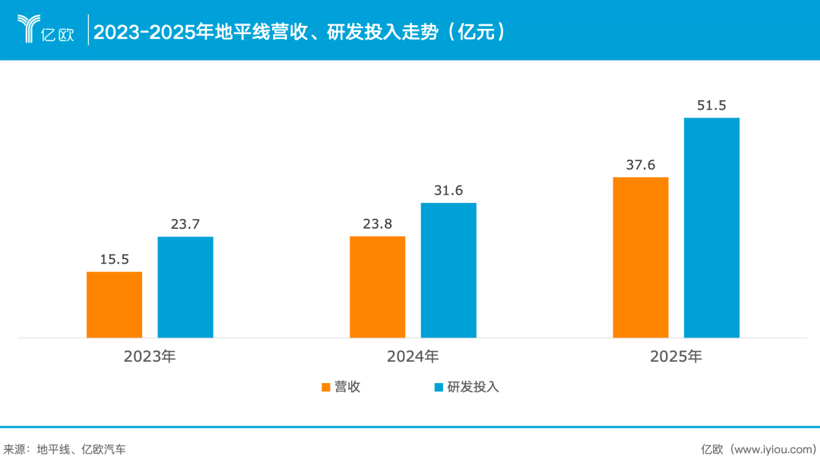
In 2025, in the rapidly growing high-end autonomous driving market of domestic brands, Horizon, with a 14.4% market share, is almost tied for second place with Huawei, which has a 15.2% market share, together with Nvidia forming the first tier of the market.
The combined market share of the three companies is as high as 89%, with a significant concentration at the top, which Yu Kai describes as having formed a "one superpower and two strong" market landscape.
The report shows that Horizon's chip solution shipments for 2025 exceeded 4 million units, representing a 38.8% year-over-year increase. Among them, shipments of mid-to-high-end intelligent driving chip solutions reached 1.8 million units, nearly five times that of the same period in 2024, accounting for 45% of total shipments and contributing to over 80% of the revenue from product and solution businesses.
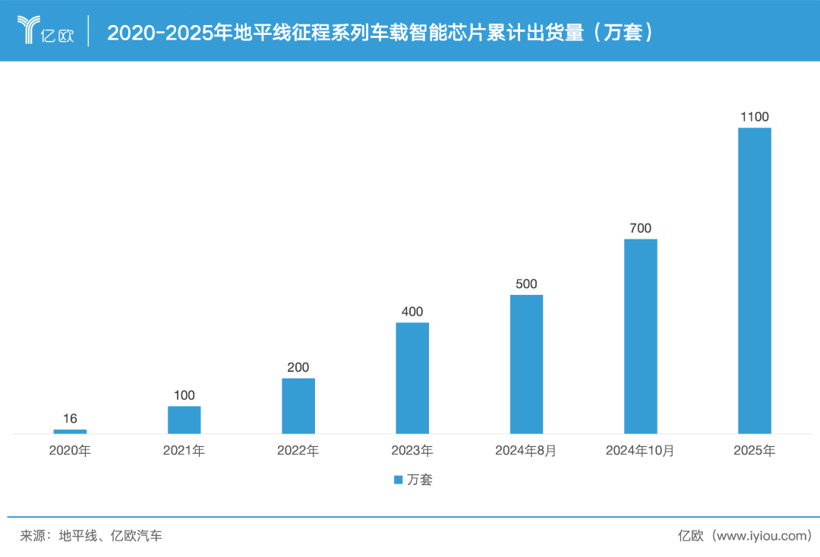
Yu Kai stated at the performance sharing meeting, "Over 95% of our chip shipments are completed through co-delivery with our ecosystem partners, which fully highlights our position as the king of the industry ecosystem and also proves the success of our open ecosystem strategy."
Ten Years of Intelligent Driving: From "Manual Workarounds" to Mainstream Feature
If we rewind time to 2015, autonomous driving was just a concept full of imagination.
That year, Tesla rolled out the first version of Tesla Autopilot.
Looking back today, the system's capabilities were actually very limited—it could only perform basic lane keeping and cruise control, and didn't even have an automatic lane-changing function.
But it was still a milestone, as it was the first time that made ordinary consumers realize—cars could truly drive themselves, at least partially.
A few months later, China's first public road test of autonomous driving was successfully conducted. The initiator of the project at that time was Yu Kai, who was then in charge of the autonomous driving project at Baidu.
However, the industry starting point that seems technologically advanced today was actually quite "primitive" at that time.
In order to make vehicle lane recognition more stable, the team will repaint the lane markings at night; to avoid branches interfering with sensors, they will also trim the branches beside the road in advance. Someone even proposed a somewhat absurd idea: designing a special suit that allows pedestrian recognition algorithms to identify 100% of pedestrians.
Yu Kai later summarized that period in just one sentence:
If intelligence is insufficient, manual intervention will make up for it.
Ten years later, the intelligent driving industry has changed beyond recognition.
In 2025, the penetration rate of intelligent driving assistance in China's passenger car market reached 68%, with high and mid-level NOA vehicles accounting for 43% of smart car sales. In just one year, this figure doubled. In other words, for every three cars sold in the Chinese market, one has NOA capability.
More importantly, this surge has not been confined solely to the luxury car market but has occurred in the mainstream price segment under RMB 200,000. This segment accounts for 65% of China's auto market sales and represents the true foundation for technological adoption. At the beginning of 2025, the NOA penetration rate in this segment was only 5%, but by year-end it had exceeded 50%.
Intelligent driving is transitioning from a selling point to a standard feature.
And the horizon is exactly at that turning point.
According to Horizon's financial reports, the advanced driving assistance solutions based on the Journey 6 series chips have captured 44% of the market in the mainstream segment below 200,000 yuan, achieving the top market share in the first year of mass production; in the autonomous driving assistance systems (ADAS) market for domestic brands, Horizon continues to lead the industry with a 47.7% market share.
At the same time, in the mid-to-high-end intelligent driving market, Horizon, Huawei, and NVIDIA have formed a top-tier concentration, with the three companies accounting for nearly 90% of the market. This means that the intelligent driving supply chain has entered a stage of top-tier consolidation.
Behind this is Yu Kai's long-standing strategy of competing where there is no competition.
The Horizon did not enter from the most expensive flagship model, but rather entered the most price-sensitive and largest market first, thus taking the initiative in the stage of intelligent driving popularization.
Over a decade, the Chinese intelligent driving industry has experienced several intense cyclical fluctuations.
Early technological breakthroughs sparked such enthusiasm that many believed "Level 3 autonomous driving will be realized next year." Yet, after the capital tide receded, numerous companies collapsed in the ensuing winter. Cycles of technological breakthroughs, industry bubbles, capital retreats, and industrial normalization have alternated repeatedly, causing the entire sector to experience roller-coaster-like volatility.
In such an environment, some companies rise rapidly, while many others fade away.
Yet Horizon has always adhered to one principle: staying at the table.
In a long-term card game, the most important thing is not to be dealt a good hand at the beginning, but to keep sitting at the table and continuing to play.
For Horizon, short-term leadership is not important; what truly matters is to continuously participate in this long-term competition.
When machine driving starts to approach human level
In recent years, the most significant change in intelligent driving technology has come from a new technical approach—end-to-end models.
This route was first promoted by Tesla, led by Musk, especially after the release of Tesla Full Self-Driving V12, the end-to-end model has gradually become the core trend in the industry.
In 2024, Yu Kai and his team specifically traveled to the United States to experience the FSD system. Their firsthand experience across complex urban environments—from New York and Boston to the West Coast—strengthened their confidence in this technological approach.
FSD demonstrates distinct capabilities: it relies almost entirely on no high-definition maps and requires no complex functional mode switching; the system can make decisions in complex road environments that closely resemble human driving logic.
This experience led Yu Kai to decide to fully allocate development resources to the end-to-end architecture.
The HSD launched by Horizon is precisely the result of this technological approach. The media even referred to it as the "Chinese version of FSD."
If chip shipments represent a scale change, then HSD is Horizon Robotics’ true strategic inflection point.
In 2025, Horizon launched the full-scenario urban driving assistance system HSD, which was mass-produced in models priced at 150,000 RMB. Within just over a month, the shipment volume exceeded 22,000 units, becoming China's first mass-produced end-to-end intelligent driving system.
But what truly matters is not the shipment volume, but user behavior.
According to Yu Kai, in the models equipped with HSD, the top-tier version sales account for as high as 83%. The traditional "pyramid" sales structure of the automotive industry has been disrupted, with consumers actively opting for higher-tier intelligent driving. Meanwhile, during the Spring Festival, the proportion of HSD intelligent driving mileage reached 41%, approaching that of human driving mileage.
The machine begins to take over driving. More importantly, users are willing to let the machine take over.
At the earnings conference, Yu Kai made a judgment: when the proportion of intelligent driving mileage exceeds 50%, machine-dominated driving will become irreversible; users will be willing to subscribe to Horizon’s Full Self-Driving (HSD) solution, and Horizon’s business model will also undergo a transformation.
This means that intelligent driving will move from a one-time hardware sale to a continuous service charging phase.
This is also why Yu Kai repeatedly emphasizes "staying in the game."
Intelligent driving is not a one-time technological contest, but a competition of long-term operational capabilities. As users’ driving behaviors change, the industrial structure will also be reshaped accordingly.
From functional configuration to user dependencies; from hardware products to software services. HSD is driving this transformation.
Horizon is preparing for the next stage.
If 2025 marks the beginning of widespread adoption of intelligent driving, then in 2026, Horizon Robotics is preparing for the next phase.
Yu Kai previously outlined three key directions at a media briefing:
High-end intelligent driving systems are penetrating lower-tier markets, MPI has significantly increased, and cockpit-driving fusion architecture is adopted.
The price continues to decline.
A city NOA solution based on a single Journey 6M chip will enter the 70,000 to 100,000 yuan vehicle market. This means that high-level intelligent driving will further move from mainstream markets to the mass market, becoming a "national function" in reality.
Next is the technological capability leap.
HSD aims to achieve a 10-fold improvement in MPI takeover mileage, from dozens of kilometers to hundreds of kilometers, and eventually reach tens of thousands of kilometers. When the takeover frequency drops to once a year, L4 level capability will have commercialization foundation.
Finally, there are architectural changes.
Horizon proposes a cockpit and driving integration intelligent agent solution, launching Agentic CAR SoC and an intelligent agent operating system, enabling vehicles to evolve from driving tools into intelligent agents. This architecture not only integrates the cockpit and intelligent driving but also significantly reduces system costs and creates new user experiences.
In Yu Kai’s view, the true revolution in intelligent driving is not taking place in high-end luxury vehicles, but rather entering ordinary households.
In the past few years, advanced driving assistance systems were typically found only in vehicles priced above 300,000 yuan. However, with the maturation of technology and reduction in costs, the industry is entering a new phase: the democratization of intelligent driving.
In 2025, Horizon Robotics began mass production of its HSD system, with the first vehicles equipped being the Exeed ET5 and Deepal L06. Within just eight weeks of launch, the system had been activated in over 25,000 units.
Meanwhile, the cumulative shipment of Horizon's Journey series chips has exceeded 10 million units, and it has established cooperative relationships with more than 40 car manufacturers, promoting the mass production of over 270 vehicle models.
On March 13, the iCAR V27 officially launched, marking the first deployment of Horizon HSD in the new "boxy hardcore" SUV segment. This 5-meter-class family-oriented hardcore SUV breaks the traditional stereotype of "heavy off-roading, light intelligence," establishing a distinctive competitive edge.
This means that China's intelligent driving industry is moving from the technology exploration phase to the large-scale production phase.
Next, Horizon has set an even more ambitious goal: bringing advanced driver assistance systems into vehicles priced at the 100,000 RMB level.
Currently, advanced driver assistance systems are already entering vehicles priced between RMB 130,000 and RMB 150,000, and Horizon Robotics plans to further bring urban NOA capabilities down to vehicles priced between RMB 70,000 and RMB 100,000 by 2026.
If this goal is achieved, the intelligent driving capability of a car in the 100,000 RMB range in the future might surpass the level of cars priced at 300,000 RMB today.
This will also completely change the competitive logic of the automotive industry.
For the next few years, Yu Kai's goal is clear: within the next 3 to 5 years, make the HSD system achieve a mass production of ten million units, and gradually move towards L4-level autonomous driving capability.
At the same time, through technological advancements, the average mileage in urban driving is improved, so that users only need to take over the vehicle once a year.
Yu Kai quoted a rewritten sentence:
Let the machine be the machine, and let the human be the human.
This sentence is not only a technical ideal, but also a corporate spirit.
Horizon does not pursue short-term leadership but aims to change the industrial structure through the popularization of technology. Compared to pursuing single breakthroughs, Yu Kai emphasizes more on long-term ecology and large-scale implementation.
According to the development goals set by Yu Kai for Horizon, they can be divided into three stages: the first stage is to prove the feasibility of the technology; the second stage is to prove the feasibility of scale; the third stage is to reshape the industry rules.
Horizon is entering the second phase.
He is more concerned with another matter:
Always at the table.
【Copyright and Disclaimer】The above information is collected and organized by PlastMatch. The copyright belongs to the original author. This article is reprinted for the purpose of providing more information, and it does not imply that PlastMatch endorses the views expressed in the article or guarantees its accuracy. If there are any errors in the source attribution or if your legitimate rights have been infringed, please contact us, and we will promptly correct or remove the content. If other media, websites, or individuals use the aforementioned content, they must clearly indicate the original source and origin of the work and assume legal responsibility on their own.
Most Popular
-
Deadly Impact: Hormuz Strait Blockade Sparks Shortage of Plastic Raw Materials, Threatening Shutdowns at Japanese and Korean Chemical Plants
-
BASF's $8.7 Billion Zhanjiang Site Fully Operational, Covestro, SABIC, Arkema and Other Plastics Giants Double Down on China
-
Massive Loss of $960 Million! Wansheng Co., Ltd. Sees Rising Revenue But Declining Profits—Why Did the Phosphorus-Based Flame Retardant Leader Falter?
-
LG Chem Shuts Down Yeosu Unit 2, Sparking Chain Shutdowns Across South Korea’s Petrochemical Industry
-
BASF Delivers First Batch of Innovative Cathode Materials for Semi-Solid-State Batteries to Weilan New Energy