



U.S.-Iran Divergences Heighten Geopolitical Tensions! International Oil Prices Rebound After Early Weakness, Rising For A Second Straight Day, While Plastic Futures Diverge
I. Overnight Crude Oil Market Dynamics
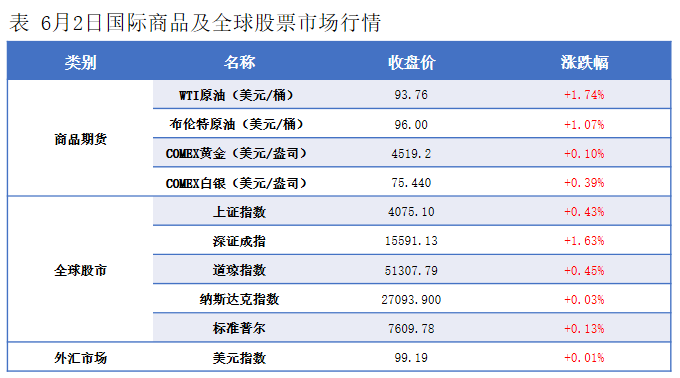
With the Iran-U.S. talks stalling and market concerns over supply risks intensifying, international oil prices rose. The NYMEX crude oil July contract settled at $93.76 per barrel, up $1.60, or +1.74% month-on-month; the ICE Brent crude August contract settled at $96.00 per barrel, up $1.02, or +1.07%. China’s INE crude oil July 2026 contract rose by 21.3 to 606.1 yuan per barrel, and fell by 2.5 to 603.6 yuan per barrel in night trading.
Market Outlook
On Tuesday, oil prices first fell and then rose. During the Asian and European sessions, they once plunged by more than 2%, giving back most of Monday’s gains as Trump stepped in promptly in an effort to cool the situation. However, in overnight trading, oil prices returned to a rebound pattern and ultimately recovered their intraday losses. Although a strong wait-and-see mood still prevails in the crude oil market, the need for a rebound in oil prices has gradually come to dominate the rhythm of fluctuations.
Multiple data sets from third-party institutions show that China’s crude oil imports in May fell by around 6 million barrels per day compared with March. Kpler’s shipping-tracking data show that China’s average daily seaborne crude oil arrivals in May 2026 plunged to 6.36 million barrels, the lowest level in nearly a decade and the weakest since October 2016. The decline in China’s crude oil imports has, to some extent, eased the upward pressure on oil prices caused by supply shortages, and China’s role in smoothing oil-price fluctuations should not be underestimated. In addition, relatively high oil prices and a weaker economic outlook are translating into lower demand for transportation fuels, which is also partly offsetting the price-supporting effect of tightening supply conditions on oil prices. However, the drawdown in global crude inventories is drawing increasing attention from more and more institutions. On Tuesday, a senior official from the International Energy Agency’s oil industry and markets division said that if oil shipments through the Strait of Hormuz cannot resume, the decline in oil inventories will continue into the summer, and global oil stocks could fall to very low levels or even historic lows before the summer demand peak arrives. This means oil prices still face strong upward momentum. If the US-Iran deal fails to make a breakthrough in the near term and the strait cannot reopen to navigation, then relying on hopes for peace alone will be insufficient to prevent oil prices from eventually continuing their upward move.
Although Trump is trying to keep the negotiations going, geopolitical maneuvering continues to create uncertainty, and investors’ attention is gradually shifting toward factors unfavorable to a peace deal. The United States and Iran continue to strike commercial vessels, the blockade shows little sign of easing, the reopening of navigation through the Strait of Hormuz has been delayed again, inventories continue to decline, and the supply-demand imbalance is set to persist further. Oil prices have rebounded from the lower end of the high-level range, so pay close attention to timing and strengthen risk control.
II. Macroeconomic Dynamics
On the 1st, U.S. President Trump stated in an interview with ABC that he believes an agreement will be reached with Iran "within the next week" to extend the ceasefire and reopen the Strait of Hormuz.
According to Iranian media reports on the 2nd, senior officials from the Iranian military and the Islamic Revolutionary Guard Corps said that Iran has not yet used its full military capabilities, is prepared for all possible scenarios, and will continue to maintain the highest level of combat readiness.
French Foreign Minister Barrot said in an interview with the country’s media on the 2nd that Israel’s military operations in Lebanon were “without any legitimate justification.”
Preliminary data released by Eurostat on the 2nd showed that, driven by accelerating service prices and persistently high energy costs, the eurozone inflation rate rose to 3.2% in May this year, up from 3.0% in April.
NVIDIA announced that NVIDIA Spectrum-X Ethernet silicon photonics technology is now in full production. Compared with networks using traditional transceivers, Spectrum-X Ethernet silicon photonics technology delivers 5x greater energy efficiency, 5x higher AI uptime, and 1.3x faster deployment.
SK Group Chairman Chey Tae-won said on June 2 that SK Hynix plans to double its wafer production capacity within five years. He said the bottleneck in memory chip production capacity could persist until 2030.
III. Plastics Market Futures Dynamics
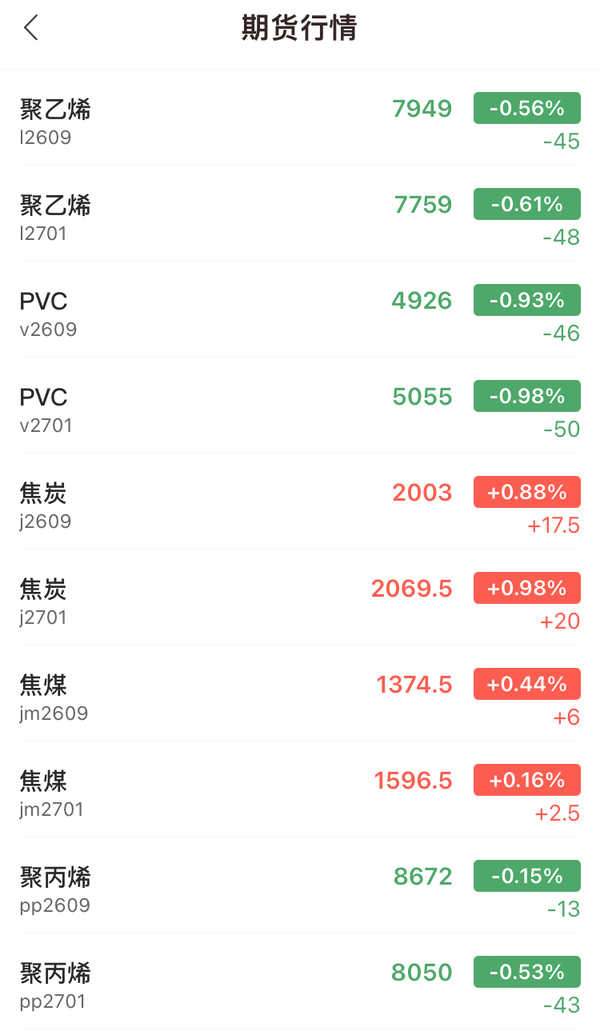
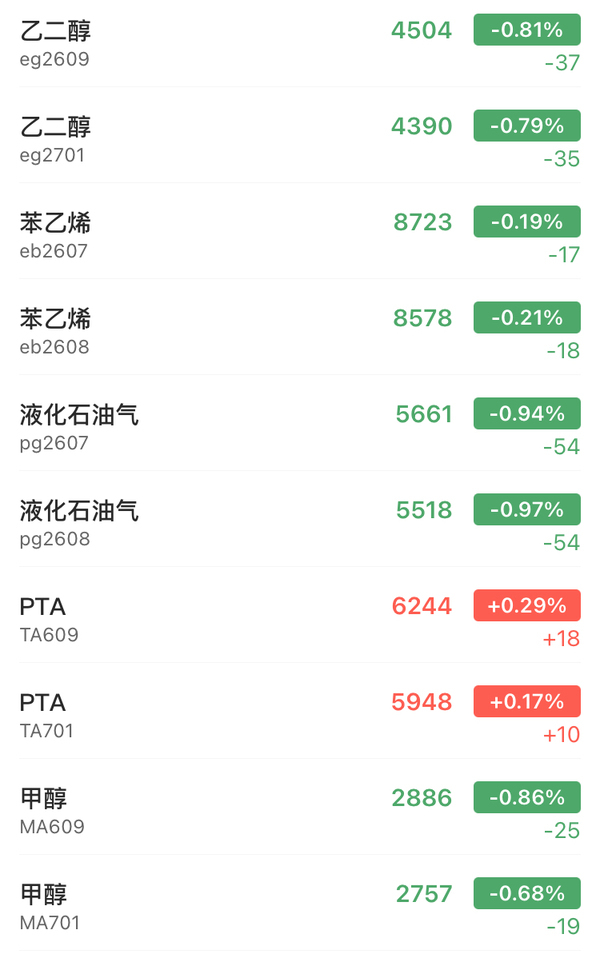
International oil prices initially fell and then rose, closing higher for the second consecutive day! Domestic plastic futures main contracts fluctuated within a narrow range.
The Plastics 2609 contract was quoted at 7,949 yuan/ton, down 0.56% from the previous trading day.
The PP2609 contract was quoted at 8,672 yuan/ton, down 0.15% from the previous trading day.
The PVC2609 contract is priced at 4926 yuan/ton, down 0.93% from the previous trading day.
The styrene 2607 contract was quoted at 8,723 yuan/ton, down 0.19% from the previous trading day.
IV. Market Forecast
PE: At the beginning of this month, the downstream plastics processing sector entered its off-season, dragging on demand. Factories have tightened their raw material procurement budgets and are generally resistant to buying at high prices. Essential purchasing volumes have fallen significantly compared with last month, and the overall supply-demand fundamentals have weakened simultaneously. In the circulation sector, merchants are under obvious pressure. Most are prioritizing rapid inventory reduction and cash flow recovery, and are flexibly lowering quotes to promote sales. The market as a whole has fluctuated downward, with transactions largely concentrated in discounted supplies, while high-priced cargo is basically met with no interest. In addition, many small and medium-sized traders previously stocked up at relatively high costs, leaving them caught between lowering prices at a loss and holding out only to see goods remain unsold, further intensifying the wait-and-see sentiment in the market. Taking all factors into account, PE prices are unlikely to break out of their current weak and volatile pattern in the short term. The cost floor formed by geopolitically driven factors can prevent prices from falling deeply, but there is still no clear signal of a recovery in end-user demand. Without substantive positive support, spot prices are expected to remain at low levels in a range-bound pattern for the near term, with limited room for either gains or losses.
PP: On the supply side, several Middle Eastern countries continue to implement substantial production cuts, while shipping capacity through the Strait of Hormuz has yet to fully recover, further tightening crude oil supply and providing solid cost support for the chemicals market. Meanwhile, bearish factors continue to weigh on the market: the ceasefire agreement between the U.S. and Iran remains in effect for now, Asian refinery operating rates are generally weak, and expectations of further Federal Reserve rate hikes continue to suppress the overall upward momentum of commodities. Regional conflict has escalated again, with Israel continuing military operations in Lebanon, disrupting the previous ceasefire balance. In response, Iran has suspended indirect talks with the United States and, together with regional allies, has moved to control key shipping routes through the Strait of Hormuz and the Bab el-Mandeb, demanding that Israel cease military operations in the war zone and withdraw from occupied areas. Rising geopolitical risks have directly pushed up crude oil prices, concentrating bullish support on the cost side. Subsequently, signals from the U.S. aimed at maintaining stability slightly eased market panic. At present, the polypropylene market is characterized by a clear pattern of strong costs and weak demand. Downstream sectors have entered the traditional off-season for consumption, end-user companies remain cautious in their purchasing, and most buying is limited to restocking for immediate needs, resulting in generally subdued trading activity in the market. Overall, in the short term, polypropylene prices are expected to maintain a firm but range-bound trend. Cost support driven by geopolitical events will continue to underpin the market floor, but weak end-user demand is unlikely to improve quickly and will continue to limit the room for a sharp price increase.
PVC: The current fundamentals provide limited momentum. On the demand side, the impact on price highs is evident: domestic demand has not expanded significantly, while export orders are largely maintaining only a basic volume. On the supply side, although maintenance shutdowns and the low operating rate of ethylene-based production can provide some support against further price declines, they are insufficient to form strong upward support. In the absence of any external driving factors, the overall PVC spot market is likely to remain in a narrow range in the short term, awaiting a new direction.
【Copyright and Disclaimer】This article is the property of PlastMatch. For business cooperation, media interviews, article reprints, or suggestions, please call the PlastMatch customer service hotline at +86-18030158354 or via email at service@zhuansushijie.com. The information and data provided by PlastMatch are for reference only and do not constitute direct advice for client decision-making. Any decisions made by clients based on such information and data, and all resulting direct or indirect losses and legal consequences, shall be borne by the clients themselves and are unrelated to PlastMatch. Unauthorized reprinting is strictly prohibited.
Most Popular
-

A Look at the Material Suppliers Behind SpaceX
-
Ethylene: Production Capacity Accelerates Expansion, Global Industry Landscape Is Being Reshaped
-
Eastman France PET Depolymerization Plant: Project "Alive," But Construction Paused
-

Amer Sports Releases 2025 Sustainability Report, Apparel And Footwear Recycled Material Proportion Reaches 19.3%
-

Microlight medical secures hundreds of millions in financing, targets global intelligent intervention market


