



Eastman France PET Depolymerization Plant: Project "Alive," But Construction Paused
Recently,Eastman Circular Solutions Managing Director Eric Dehouck said in an interview at PRSE that the company’s PET depolymerization project in Normandy, France, is “alive, more than ever,” but construction has been put on hold as the company waits for clearer regulatory guidance and commitments from customers.
— 1 —
France project: Land permit completed, construction suspended.
The planned investment for this projectOver 1 billion euros, was originally scheduled to go into operation in 2026, but French media later reported that it is expected to be postponed to 2027/2028. The project is designed in two phases: the initial phase will process 110,000 tonnes of waste plastics annually, rising to 200,000 tonnes once fully completed.
According to Eric Dehouck, the project’s permits, land acquisition, and engineering design have all been completed, but construction is currently on hold. The reason is that the company is waiting for greater regulatory clarity and customer commitments.
Dehouck noted that supporting investment in Europe’s recycling infrastructure requires three key regulatory safeguards: a mass balance approach, regional rules favoring EU waste, and effective enforcement. At the same time, he welcomed France’s newly introduced incentives to encourage the use of locally recycled plastics, viewing them as a strong signal that could spur other parts of Europe to adopt similar measures.
In February this year, France’s Council of State (Conseil d’État) formally dismissed appeals by four environmental associations against a 2024 decree. The decree classified Eastman’s project as a “project of major national interest,” allowing certain planning and environmental rules to be modified to expedite site selection. The Council of State’s decision confirmed that the definition of the recycling industry is clear, aligned with decarbonization goals, and consistent with the EU Packaging and Packaging Waste Regulation (PPWR) and France’s circular economy rules.
— 2 —
Technical core: Methanol decomposition, yield over 85%
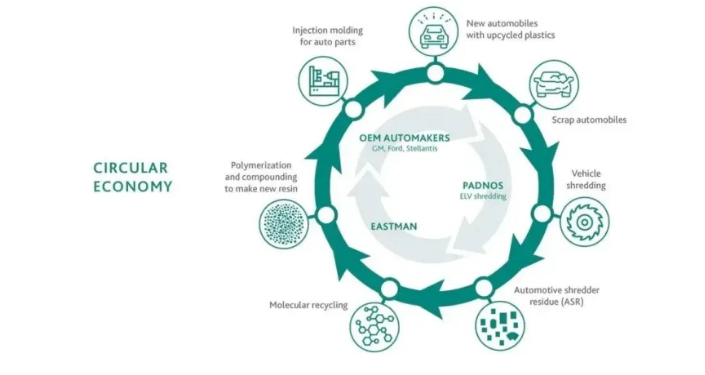
Eastman’s polyester renewal technology is centered on methanolysis, a process that depolymerizes waste PET plastics into dimethyl terephthalate (DMT) and ethylene glycol (EG), achieving a high conversion rate of over 85% into food-grade new materials. The resulting products surpass those from mechanical recycling in terms of purity, appearance, and performance. The recycling process specifically involves shredding the plastic waste, filtering out impurities, and depolymerizing it at high temperatures with methanol. A mass balance approach is used to blend the recycled content with virgin materials, ensuring the quality of the final product. Eastman’s feedstock mainly consists of PET that cannot be handled by mechanical recycling, especially PET that is contaminated, multi-layered, or does not meet color requirements.
— 3 —
Global capacity layout: three factories, different progress.
Eastman plans to build three global chemical recycling plants, one of which has already started operations and two of which are at different stages.
The first chemical recycling plant is operating in Kingsport, Tennessee, USA., with a production capacity of110,000 tons/year (250 million pounds)It is currently the largest facility of its kind in the world. In the first quarter of 2025, the facility achieved record-high uptime and production, bolstering the company's profits; it is expected to contribute $75 million to $100 million in 2025.
A second molecular chemical recycling plant located in Normandy, France, is under construction.Phase I of the plant is planned to involve an investment of US$1 billion and is expected to start operations in 2027–2028, with an annual waste plastic processing capacity of 110,000 tonnes; after Phase II is fully completed, annual throughput could reach 200,000 tonnes. It will primarily supply chemically recycled raw materials to companies such as LVMH, Estée Lauder, Clarins, Procter & Gamble, Danone and L'Oréal.
The third factory is located in Longview, Texas, USA.The total investment in the methanolysis plant is US$1.2 billion, with equipment installation scheduled for completion in 2028. Once operational, it will be able to process 110,000 metric tons of hard-to-recycle waste plastics annually. In May 2025, the U.S. Department of Energy withdrew the US$375 million federal subsidy pledged under the Biden administration, but the head of Eastman’s site made it clear that the project would continue to move forward, which is also fully aligned with the current federal government’s strategic goals of reshoring manufacturing and achieving energy independence.
Despite chemical recycling technologies involving higher capital investment, Eastman considers it a "both sensible and profitable" business strategy. Eastman also acknowledged that the current facilities are only the tip of the iceberg.Large-scale development has only just begun.
(Reference)Source: sustainableplastics, polimericanews, Polymer Recycling and Reuse)
【Copyright and Disclaimer】The above information is collected and organized by PlastMatch. The copyright belongs to the original author. This article is reprinted for the purpose of providing more information, and it does not imply that PlastMatch endorses the views expressed in the article or guarantees its accuracy. If there are any errors in the source attribution or if your legitimate rights have been infringed, please contact us, and we will promptly correct or remove the content. If other media, websites, or individuals use the aforementioned content, they must clearly indicate the original source and origin of the work and assume legal responsibility on their own.
Most Popular
-

A Look at the Material Suppliers Behind SpaceX
-
BASF, Selling Again!
-
BASF Cuts Core Business As It Exits All Non-Core Operations, Triggering A New Round Of Industry Restructuring
-
Eastman France PET Depolymerization Plant: Project "Alive," But Construction Paused
-
Mitsubishi Chemical Plans To Split Petrochemical Business By 2028


