



Tariff Soars 100 Percent! Trump Signs! Tariff Hammer Strikes Imported Medicines, US Medicine Policy Targets What?
On April 2nd local time, a message from Washington shocked the global pharmaceutical industry: the U.S. government will impose a 100% tariff on some imported medicines. The White House announced on the same day that President Trump had signed a document, invoking Section 232 of the 1962 Trade Expansion Act, to impose this so-called "nuclear weapon" level of tariff measures on imported patented drugs and pharmaceutical ingredients.
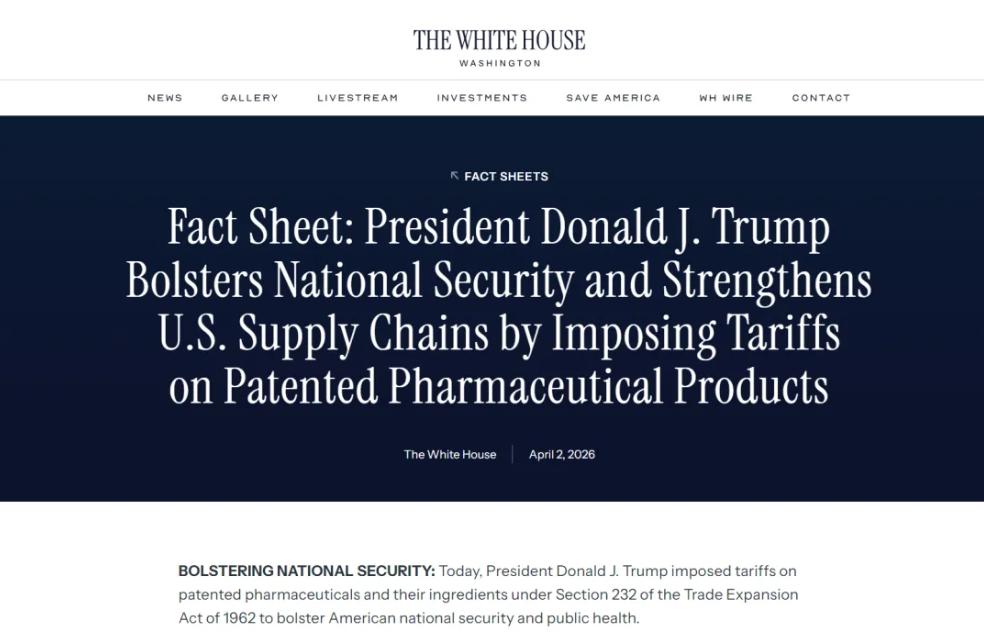
Image source: Screenshot from the White House official website
This is not a simple act of trade protection. A careful analysis of the announcement reveals that its core logic is not merely a "America First" style tariff barrier, but a carefully designed "maximum pressure" negotiation strategy—the White House has also provided a path for exemption or reduction of these punitive tariffs, with only one condition: pharmaceutical companies must reach an agreement with the White House on drug prices and industry repatriation.
New Target Range of Section 232: From Steel and Aluminum to Pills
Section 232 of the Trade Expansion Act of 1962 holds a unique place in the U.S. trade policy toolkit. This provision authorizes the Department of Commerce to investigate imports that may "threaten national security" and allows the President to impose measures such as adjusting tariffs or quotas. Historically, the most prominent application of this clause has been the imposition of tariffs on steel and aluminum products, based on the rationale that excessive reliance on imported steel and aluminum could undermine the foundation of U.S. defense industrial capacity.
Today, the Trump administration has extended this logic to the pharmaceutical sector. The underlying rationale is clear: the United States’ excessive reliance on overseas sources for critical medicines and pharmaceutical ingredients constitutes a “national security risk.” The fragility of supply chains exposed by the COVID-19 pandemic—during which the U.S. faced widespread shortages ranging from masks and ventilators to essential medications—provides a stark real-world illustration of this concern.
Image source: Visual China
According to the announcement, the affected items are not only finished patent drugs, but also pharmaceutical ingredients, that is, active pharmaceutical ingredients and intermediates. This means that whether it is the patent products of the original research companies or the active ingredients relied upon by generic drug manufacturers, all will face a 100% tariff barrier if produced outside the United States.
Dual Bullseye: Drug Pricing and Supply Chain
Carefully reading the announcement’s description of the “exemption pathway” reveals the Trump administration’s true intent. The 100% tariff is not the goal itself, but rather leverage to compel pharmaceutical companies to come to the negotiating table. The White House aims to achieve breakthroughs on two core issues through this extreme threat.
The first issue is drug pricing. The United States has the world's largest pharmaceutical market and is also one of the developed countries with the highest drug prices. Successive U.S. administrations have attempted to control drug prices, but all have faced strong resistance from the pharmaceutical industry. During his first term, Trump signed an executive order aiming to tie Medicare drug prices to lower prices in other countries, but with limited success. Now, he has shifted tactics: using the threat of tariffs to directly jeopardize market access for imported drugs in exchange for concessions from pharmaceutical companies on pricing.
The second is the return of industries. The announcement clearly states "to encourage pharmaceutical companies to reach an agreement with the White House on the return of industries." This means that the U.S. government hopes to promote the return of pharmaceutical production capacity to the U.S. If companies commit to building factories and expanding domestic production capacity in the U.S., they can be exempted from tariffs. This is a classic "carrot and stick" approach: not returning will face a 100% tariff, while returning can continue to enjoy access to the U.S. market.
Global Pharmaceutical Supply Chain Turbulence and Restructuring
This policy, once implemented, will have a profound impact on the global pharmaceutical industry structure. The United States is the world's largest pharmaceutical importer, and the global pharmaceutical supply chain is highly globalized. For example, approximately 70% of active pharmaceutical ingredients (APIs) in the U.S. are imported, with a significant portion coming from China; in the generic drug sector, India is the main supplier; and in the patented drug sector, numerous multinational pharmaceutical companies from Europe and Asia are deeply involved in the U.S. market.
A 100% tariff means that for a pharmaceutical company producing patented drugs in Europe and exporting them to the U.S. market, the price of its products in the U.S. will double, or its profits will be entirely wiped out. In either case, the current business model will no longer be sustainable.
Large multinational pharmaceutical companies will face difficult choices. Some may opt to invest in and build manufacturing facilities in the United States to relocate production domestically and avoid tariffs. However, this requires time, capital, and complex supply chain restructuring—not an immediate solution. Others may choose to absorb the tariff costs and pass them on to U.S. consumers—but this is precisely the loophole the White House aims to close through “drug price negotiations.”
For major suppliers of active pharmaceutical ingredients and generic drugs such as China and India, this policy has a more direct impact. If the door to the U.S. market is shut by a 100% tariff, pharmaceutical exports from these countries would suffer severe damage. However, the "exemption path" mentioned in the announcement also leaves a glimmer of hope for these countries' pharmaceutical companies — if they can establish factories in the U.S. or reach some kind of agreement with the U.S., they may still retain access to the market.
Risk and Uncertainty
Whether this policy can be effectively implemented and achieve the expected results remains uncertain.
First, there is the legal challenge. The applicability of Section 232 is framed around "national security." Whether equating pharmaceutical supply chain security with the defense industrial needs of steel and aluminum can withstand judicial review remains questionable. Past Section 232 tariffs have already faced multiple legal challenges.
Next is the difficulty of implementation. The pharmaceutical supply chain is extremely complex, with a single drug potentially involving raw materials, intermediates, and finished products from multiple countries. How to determine the "origin" of a drug? How to prevent companies from avoiding tariffs through simple assembly or packaging operations? These are thorny issues in practical operations.
The third is the risk of retaliation. The U.S. is an important buyer in the global pharmaceutical market, but not the only one. If the U.S. imposes punitive tariffs on imported drugs, trading partner countries are likely to take retaliatory measures, targeting American agricultural products, industrial goods, or intellectual property-intensive industries.
Lastly, there is the economic cost. Tariffs are ultimately paid by importers, and these costs are passed along the supply chain. If pharmaceutical companies choose not to repatriate or lower prices, then 100% of the tariffs may ultimately be passed on to American patients and the healthcare system, thus driving up drug prices—this is contrary to the stated goal of the White House.
The Trump administration dropped a bombshell on the global pharmaceutical industry by imposing 100% tariffs on pharmaceuticals. This is a high-stakes gamble: the upside is reshaping America's pharmaceutical industry, lowering drug prices, and securing supply chain safety; the downside is a fractured global pharmaceutical supply chain, worsening drug shortages, and an escalation of trade wars.
For pharmaceutical companies, this is no longer a question of “whether to respond,” but rather “how to respond.” The White House has laid out a path that is both clear and harsh: either sit down at the negotiating table and make commitments on pricing and production capacity, or face a 100% tariff penalty. The outcome of this will profoundly reshape the global pharmaceutical industry’s landscape over the next decade. For American consumers, however, the only question that ultimately matters is: “Will drug prices go down?” The answer to that, however, is likely still some time away.
【Copyright and Disclaimer】This article is the property of PlastMatch. For business cooperation, media interviews, article reprints, or suggestions, please call the PlastMatch customer service hotline at +86-18030158354 or via email at service@zhuansushijie.com. The information and data provided by PlastMatch are for reference only and do not constitute direct advice for client decision-making. Any decisions made by clients based on such information and data, and all resulting direct or indirect losses and legal consequences, shall be borne by the clients themselves and are unrelated to PlastMatch. Unauthorized reprinting is strictly prohibited.
Most Popular
-
Massive Loss of $960 Million! Wansheng Co., Ltd. Sees Rising Revenue But Declining Profits—Why Did the Phosphorus-Based Flame Retardant Leader Falter?
-
Breakthrough! 13.6-million-ton new giant emerges as world’s fourth-largest polyolefin producer, reshaping industry landscape
-
BASF's $8.7 Billion Zhanjiang Site Fully Operational, Covestro, SABIC, Arkema and Other Plastics Giants Double Down on China
-
Deadly Impact: Hormuz Strait Blockade Sparks Shortage of Plastic Raw Materials, Threatening Shutdowns at Japanese and Korean Chemical Plants
-
Domestic PBE Breakthrough, Polyolefin Modification Industry to Break the Impasse


