Orange Nylon Aging, 90 Percent of People Choose Wrong Antioxidant
Friends who make orange nylon or PBT parts have probably encountered this headache-inducing problem:
After placing the samples in an 85°C/85% RH chamber or a 120°C oven for several hundred hours, the orange color fades, darkens, and even turns gray upon removal.
Why does the color, which was bright and vivid right after production, "fade away" after aging?
This problem has troubled many people, but few have truly figured it out.To answer "what antioxidant to add, how to add it, and how much to add," we need to start with the root cause.。
1.Why does orange color tend to run so easily?
To clarify one thing: when orange fades, it's not necessarily a problem with the pigment; more often, it's the entire material system that can't withstand high temperatures.
Nylon (PA6/PA66) or PBT undergoes chain scission and oxidation during thermal oxygen aging at 120-130°C, leading to the formation of colored groups (such as quinone compounds). These by-products alter the base color of the material, and when combined with orange pigments, result in a lighter, darker, grayish color, or even a complete color deviation.
What’s more problematic is that nylon itself is highly hygroscopic. If the aging environment involves humidity (such as in an 85°C/85% RH test), hydrolysis further accelerates degradation. The molecular weight decreases, the surface becomes rougher, diffuse reflection of light changes, and consequently, the perceived color shifts.
So,Preserving the essence of color lies in maintaining the stability of the molecular chain.。
2.How to choose antioxidants? Three steps.
Step 1: Primary Antioxidant—Hindered Phenols
Hindered phenolic antioxidants serve as the “first line of defense,” scavenging free radicals and interrupting oxidative chain reactions. Common trade names include1098、3114、1010 。
1098It is a nylon-specific primary antioxidant with high molecular weight, excellent resistance to extraction, and long-lasting performance, making it particularly suitable for long-term thermal aging applications.
3114PBT is widely used in this application and can effectively delay the decline in mechanical properties and color changes at high temperatures.
Recommended addition: 0.2%-0.5%
Step 2: Auxiliary Antioxidants – Phosphite Esters
Phosphite antioxidants serve as the “second line of defense,” decomposing hydroperoxides to prevent them from further initiating free-radical chain reactions. More importantly, they significantly improve color stability during processing.
P-EPQClariant is a highly efficient auxiliary antioxidant containing dual phosphorus, with a thermal decomposition temperature >350°C and excellent stability above 300°C; it exhibits a pronounced synergistic effect when compounded with hindered phenolic antioxidants.
608(Revonox 608) is one of the phosphite antioxidants with a higher temperature resistance, with a molecular weight of 852 and a melting point >225°C. It is particularly suitable for high-temperature processing and long-term thermal aging protection of engineering plastics such as nylon, high-temperature nylon, and PBT.
Suggested addition: 0.1%-0.3%
Step Three: The "Secret Weapon" for Special Occasions
Composite Antioxidant AO9: Specifically designed for light/bright colored polymers, with fast free radical trapping speed. It is especially suitable for occasions where phosphorus-containing auxiliary antioxidants cannot be used (such as bromine-antimony flame retardant systems), and it has outstanding color protection effects on nylon and polyester.
Copper Salt StabilizerNylon's high-efficiency thermal stabilizer, suitable for long-term high-temperature service above 130°C. However, the drawback is that it may cause dark discoloration, and careful evaluation is needed for bright colors.
Inorganic Stabilizer H10-APowdered form, resistant to yellowing during processing and thermal aging; suitable for reinforced nylon and reinforced polyester; significantly improves discoloration issues in dyed products.
3.Core Principle: Compound Synergy
Single antioxidants are difficult to simultaneously processing stability and long-term thermal aging stability. The industry consensus is:Primary antioxidant + secondary antioxidant combinationto generate a synergistic effect where “1 + 1 > 2.”
Recommended Combination (for Vibrant Orange Nylon/PBT):
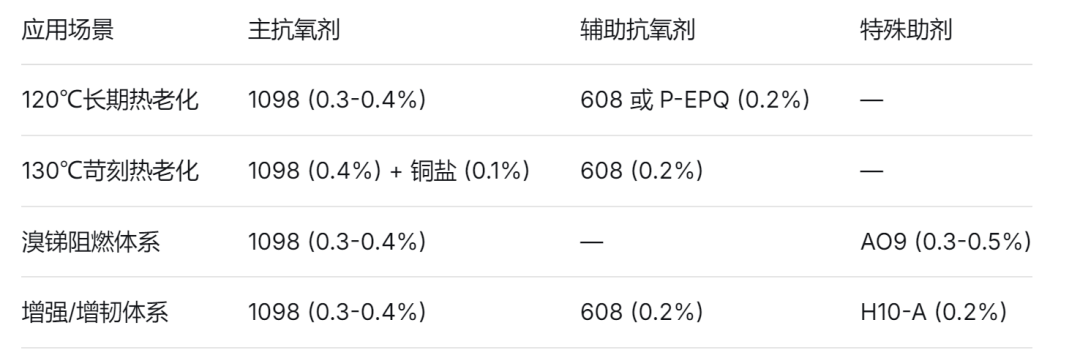
Key ReminderPigments—especially organic orange pigments—themselves must also be heat-resistant and weather-resistant. If the pigment cannot withstand these conditions, even the strongest antioxidant cannot compensate.
4.Experimental verification: Don’t trust feelings—trust data.
The formula has been finalized and must pass the experimental verification.。
Thermal aging test: 120°C or 130°C oven, sampling at 500h, 1000h, using a color difference meter to measure ΔE (CIE Lab system). ΔE<1 is difficult to discern with the naked eye, ΔE<3 is generally acceptable.
Mechanical Property MonitoringTensile strength and impact strength retention rates reflect the extent of matrix degradation.
Microstructure AnalysisFTIR monitoring of amide peak changes, GPC for molecular weight distribution.
5.Action List
Want the bright orange nylon or PBT to not fade during heat aging at 120-130°C, keep these points in mind:
Primary antioxidant select 1098 or 3114, lay a solid foundation
Auxiliary antioxidant: 608 or P-EPQheat-resistant and hydrolysis-resistant
Special occasions add AO9 or copper saltTargeted reinforcement
The pigment itself needs to be heat-resistant., don't use cheap azo orange
Test before productionThe 1,000-hour thermal aging data speaks for itself.
Orange is difficult to achieve, but it can withstand degradation as long as the right antioxidant is selected.
【Copyright and Disclaimer】The above information is collected and organized by PlastMatch. The copyright belongs to the original author. This article is reprinted for the purpose of providing more information, and it does not imply that PlastMatch endorses the views expressed in the article or guarantees its accuracy. If there are any errors in the source attribution or if your legitimate rights have been infringed, please contact us, and we will promptly correct or remove the content. If other media, websites, or individuals use the aforementioned content, they must clearly indicate the original source and origin of the work and assume legal responsibility on their own.
Most Popular
-
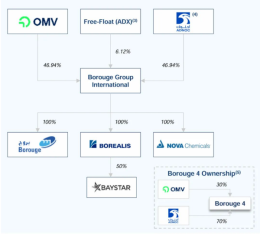
Breakthrough! 13.6-million-ton new giant emerges as world’s fourth-largest polyolefin producer, reshaping industry landscape
-
Domestic PBE Breakthrough, Polyolefin Modification Industry to Break the Impasse
-

Deadly Impact: Hormuz Strait Blockade Sparks Shortage of Plastic Raw Materials, Threatening Shutdowns at Japanese and Korean Chemical Plants
-
BASF Delivers First Batch of Innovative Cathode Materials for Semi-Solid-State Batteries to Weilan New Energy
-
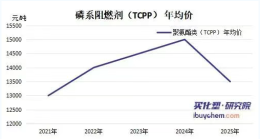
Massive Loss of $960 Million! Wansheng Co., Ltd. Sees Rising Revenue But Declining Profits—Why Did the Phosphorus-Based Flame Retardant Leader Falter?