



Modified plastics sector strengthens against the trend! geopolitical easing pressures raw material side, industry long-term logic unchanged
On June 16, the modified plastics sector delivered a strong performance in the A-share market, with the sector index reaching 7,842.581 points, up 2%, on trading volume of 4.394 billion yuan and a turnover rate of 2.84%. Among individual stocks, Polymer Chemical surged 12.68% to 55.71 yuan, Orinko Advanced Plastics rose 4.75% to 12.57 yuan, Jundingda gained 4.53% to 66.90 yuan, and Pret advanced 3.91% to 13.30 yuan. Against the backdrop of overall pressure on the chemical sector, the modified plastics sector’s counter-trend strength was particularly notable.
I. The raw materials side encounters a “black swan,” and cost support has noticeably weakened.
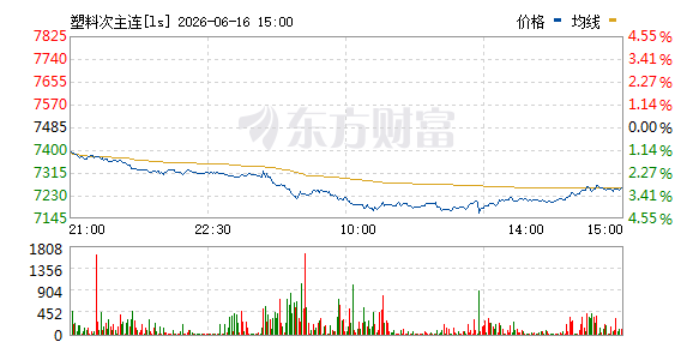
In stark contrast to the strong performance of the modified plastics sector, the upstream raw material market is undergoing significant adjustments. On June 16, most domestic commodity futures closed lower, with the chemical sector experiencing widespread declines. Among them, the plastic 2609 contract fell by 2.91%, closing at a low, with trading volume increasing by 48,000 lots; the PP 2609 contract dropped even more sharply by 4.30%. Methanol and propylene both fell over 5%, while polypropylene, ethylene glycol, and asphalt dropped over 4%, and styrene and plastics fell nearly 4%.
The direct trigger for this round of decline is the easing of geopolitical tensions. The U.S. and Iran have reached an agreement on the final text of a peace deal, and expectations for the reopening of the Strait of Hormuz have risen, leading international oil prices to drop to their lowest levels in months. As crude oil serves as the source for the chemical industry chain, its price collapse has directly weakened the cost support for products such as polyolefins. Guosen Futures pointed out that after the easing of the U.S.-Iran situation, crude oil prices plummeted, weakening chemical cost support and putting short-term upward pressure on polyolefins. Meanwhile, expectations for supply chain recovery have strengthened, and there is a strong fear of declines in downstream markets, causing spot prices to loosen and decline.
In the spot market, PE prices mostly declined. In North China, LLDPE fell by RMB 20–230/mt, while LDPE dropped by RMB 120–230/mt. In East China, some LLDPE prices declined by RMB 50–150/mt. In South China, some LDPE prices fell by RMB 50–250/mt, and HDPE dropped by RMB 50–300/mt. Downstream factories showed weak buying interest, and actual transactions saw little increase in volume.
2. Frequent Industry Hotspots, Accelerated Premiumization and Domestic Substitution
While the raw material side is under pressure, the structural benefits within the modified plastics industry continue to be released.
The localization of LCP materials has reached a milestone.On June 15, HuiTong New Materials Co., Ltd. and Nanjing Qingyan Polymer New Materials Co., Ltd. officially signed a strategic cooperation agreement. The two parties will engage in in-depth cooperation in the R&D, production, and market application of high-end liquid crystal polymer (LCP) materials. With the rapid development of 5G communications, new energy vehicles, and consumer electronics, LCP materials, which offer high-frequency and high-speed transmission characteristics, are experiencing explosive growth. However, high-end LCP resins have long relied on imports. This cooperation connects the entire industrial chain from “core resin synthesis” to “high-end modified applications,” and is expected to break the monopoly of overseas giants in the high-end LCP sector.
The nylon industry is focusing on “new quality productive forces.”On June 11–12, the 2026 China Plastics (Yuyao) New Materials Industry Development Conference and the 1st Nylon Summit Forum were held, bringing together more than 200 experts, scholars, and corporate representatives to discuss the theme “Collaboration · Breakthrough · Linking the Future — Reshaping New Quality Productivity in the Nylon Industry.” The forum focused on three directions: upgrading modification technologies, expanding emerging applications, and advancing green and low-carbon transformation. The topics covered the entire industrial chain, from upstream raw materials and modification technologies to functional additives and end-use applications. At present, the nylon modification industry is facing challenges such as overcapacity in upstream raw materials, cost fluctuations, and intensifying homogenized competition in midstream technologies, while emerging sectors such as new energy vehicles, humanoid robots, and 5G/6G communications are placing higher demands on material performance.
Technological breakthroughs and patent achievements are emerging.Research on high-performance thermosetting materials has been published in *Nature Materials*, offering a new approach to solving the fundamental challenge that thermosetting plastics are difficult to recycle. Double Star New Materials has been granted a utility model patent for “a preparation system for functional masterbatch used in ultra-thin PET shrink film.”
III. Policy-driven and demand-supported, the long-term logic remains solid
Although the raw material side is under short-term pressure, the long-term growth logic of the modified plastics industry remains unchanged.
At the policy level, the updated 2026 version of the Catalogue for the Promotion and Application of Key New Materials issued by the Ministry of Industry and Information Technology added 12 categories of modified plastic-related products. Products included in the catalogue are eligible for supportive policies such as tax reductions and project subsidies. The new national standard, General Performance Requirements for Modified Plastics, officially implemented in 2026, sets clearer specifications for flame-retardant ratings, heat resistance temperatures, and environmental indicators. Modified plastics have been designated as a key area under the country’s “Seven Strategic Emerging Industries” and “Made in China 2025” initiative.
On the demand side, the trend toward automotive lightweighting is opening up broad opportunities for modified plastics. Recent CCTV reports show that over the past 12 years, the average curb weight of new passenger cars in China has surged by nearly 400 kilograms, with some flagship new energy vehicle models weighing as much as 3.8 tons. Since January this year, the new national standard “Limits for Energy Consumption of Electric Vehicles” has been implemented, and the new technical standards for purchase tax incentives in 2026 will also set strict thresholds for overweight models. An industry-recognized figure is that for every 100 kilograms of weight reduction in a vehicle, energy consumption per 100 kilometers decreases by around 7.5%. As the weight-reduction potential of metallic materials approaches its physical limit, modified plastics and composite materials are entering an era of rigid demand, moving from “supporting roles on the margins” to “core mainstays.” It is expected that by 2026, the amount of modified plastics used per vehicle will rise to 210 kilograms, and total demand for modified plastics in the automotive industry will reach approximately 5.98 million tons.
From an industry-wide perspective, the domestic modified plastic market is expected to continue its upward trend in scale by 2026, with significant demand pull effects from downstream sectors such as new energy, home appliances, and automobiles. The revenue growth rate for the entire industry is expected to remain in a reasonable range of over 8%. The annual total production of modified plastics in China has surpassed 23 million tons, and the overall market transaction scale has exceeded 420 billion yuan.
IV. Short-term disruptions do not alter the long-term trend
Overall, the contrarian strength of the modified plastics sector on June 16 reflects the market’s recognition of the industry’s long-term value. The raw material cost pressure brought about by the easing of short-term geopolitical tensions is more of a sentiment-driven impact. From a medium- to long-term perspective, driven by policy support, technological breakthroughs, and expanding downstream demand, the modified plastics industry is accelerating its move toward higher-end development and domestic substitution. Domestic suppliers with core technological barriers, which have taken the lead in completing automotive-grade certification and achieving scaled mass production and delivery, are expected to occupy a dominant position in the next round of industry reshuffling.
Editor: Winnie
【Copyright and Disclaimer】This article is the property of PlastMatch. For business cooperation, media interviews, article reprints, or suggestions, please call the PlastMatch customer service hotline at +86-18030158354 or via email at service@zhuansushijie.com. The information and data provided by PlastMatch are for reference only and do not constitute direct advice for client decision-making. Any decisions made by clients based on such information and data, and all resulting direct or indirect losses and legal consequences, shall be borne by the clients themselves and are unrelated to PlastMatch. Unauthorized reprinting is strictly prohibited.
Most Popular
-

A Look at the Material Suppliers Behind SpaceX
-

Government's Triple Action, Enterprises' Three Arrows in Five Days, Semiconductor Reshuffle! What Signal Does Japan's Chemical Industry Release?
-
Next-generation motors of new energy vehicles: Single-Round Thousand Horsepower, Replacing Brakes, How Powerful Are They?
-
Ethylene: Production Capacity Accelerates Expansion, Global Industry Landscape Is Being Reshaped
-
Fire breaks out at jiangsu meiside!


