March Brings Price Hikes, April Brings Shutdowns? Chemical Giants in South Korea and India Halt Production Amid Raw Material Shortages
Chemical industry emergency warning! Just survived the price hike in March, now April brings a more deadly shutdown wave!
Following a global surge in chemical product prices, a string of bad news has emerged—multiple major chemical companies in India and South Korea have successively announced production halts, with the core cause being raw material shortages, delivering another severe blow to the global chemical supply chain!
First, look at India! Deepak Phenolics has officially announced that due to a shortage of raw materials, its core plant has been fully shut down.
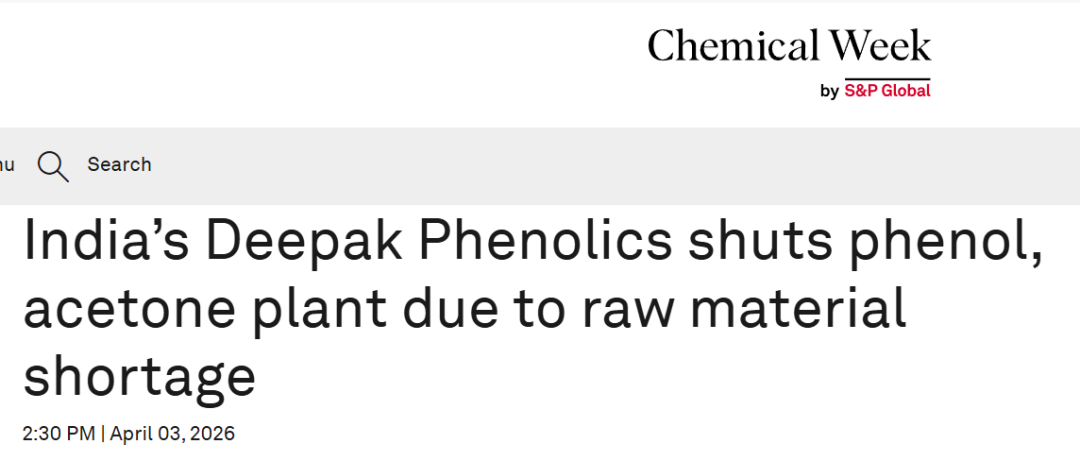
Due to a shortage of raw materials, Deepak Phenolics in India has shut down its phenol and acetone plants.
A source close to the company revealed on April 2,Starting April 3, its phenol and acetone plant in Dakhla will cease operations.It is reported that the factory has an annual capacity of 330,000 tons of phenol and 220,000 tons of acetone, making it one of the core capacities in India's phenol-acetone sector. Its shutdown will directly exacerbate the global supply gap.
In fact, there were signs of this shutdown early on!
As early as March 7, the company had issued a warning stating that "the ongoing situation in the Middle East and the disruption of ship traffic in the Strait of Hormuz" could affect the product supply from the Dajie factory. The core reason behind this is that its key raw material suppliers, such as for propylene, have invoked the force majeure clause, directly leading to all products from the factory, including phenol, acetone, isopropanol (with an annual capacity of 60,000 tons), and alpha-methyl styrene (AMS), being comprehensively affected.
And all of this stemmed from thein March! It seems there was a small oversight. Here is the corrected translation: And all of this stemmed from thein March! Corrected version: And all of this stemmed from thein March! Final corrected version: And all of this stemmed from the crazy surge in chemical prices in March!
According to the latest data from Platts, a subsidiary of S&P Global Energy, the CFR price of phenol in India jumped by $210/ton in one week, reaching $1,410/ton as of March 31. At the same time, due to global supply concerns triggered by the Middle East situation, the CFR price of acetone in India also surged by $230/ton, reaching $1,480/ton.
What's even more worrying is that this round of price hikes is not an isolated case, as the wave of shutdowns has spread to South Korea!
On March 25, news emerged that South Korea's largest petrochemical company, LG Chem, plans to shut down its No. 2 naphtha cracker (NCC) unit with an annual capacity of 800,000 tons at its Yeosu core plant this week, due to the disruption of naphtha supply caused by the blockade of the Strait of Hormuz. Not only LG Chem, but multiple petrochemical companies in South Korea, including Lotte Chemical and YNCC, have also reduced their operating rates to the minimum. The market is generally concerned that a chain of shutdowns may occur by mid-April, with unimaginable consequences.
Fundamentally, the root cause of all this lies in the Middle East’s geopolitical conflicts—impacted by which, the global chemical industry is experiencing a widespread force majeure wave: raw material supply disruptions and reduced operating rates or shutdowns of production facilities have become commonplace, and factory closures in India and South Korea are merely the tip of the iceberg of the global supply chain crisis.
Alert Upgrade: Price Hikes in March, Shutdown in April—Wider Price Increases Likely After Production Halts!
Phenol ketone, naphtha, and other key raw materials are essential for industries such as pesticides, pharmaceuticals, plastics, and synthetic fibers. Shortages in their supply will ripple through the entire supply chain, impacting numerous downstream sectors. Against the backdrop of tight global chemical market supply-demand dynamics, prices of various chemical products may rise further. Relevant companies should proactively secure inventory and implement risk mitigation plans to guard against potential supply chain disruptions.
【Copyright and Disclaimer】The above information is collected and organized by PlastMatch. The copyright belongs to the original author. This article is reprinted for the purpose of providing more information, and it does not imply that PlastMatch endorses the views expressed in the article or guarantees its accuracy. If there are any errors in the source attribution or if your legitimate rights have been infringed, please contact us, and we will promptly correct or remove the content. If other media, websites, or individuals use the aforementioned content, they must clearly indicate the original source and origin of the work and assume legal responsibility on their own.
Most Popular
-
Breakthrough! 13.6-million-ton new giant emerges as world’s fourth-largest polyolefin producer, reshaping industry landscape
-
Domestic PBE Breakthrough, Polyolefin Modification Industry to Break the Impasse
-
Deadly Impact: Hormuz Strait Blockade Sparks Shortage of Plastic Raw Materials, Threatening Shutdowns at Japanese and Korean Chemical Plants
-

BASF Delivers First Batch of Innovative Cathode Materials for Semi-Solid-State Batteries to Weilan New Energy
-
Massive Loss of $960 Million! Wansheng Co., Ltd. Sees Rising Revenue But Declining Profits—Why Did the Phosphorus-Based Flame Retardant Leader Falter?