India Issues Final Ruling In Anti-Dumping Case On China’s “TPU Paint Protection Film”!

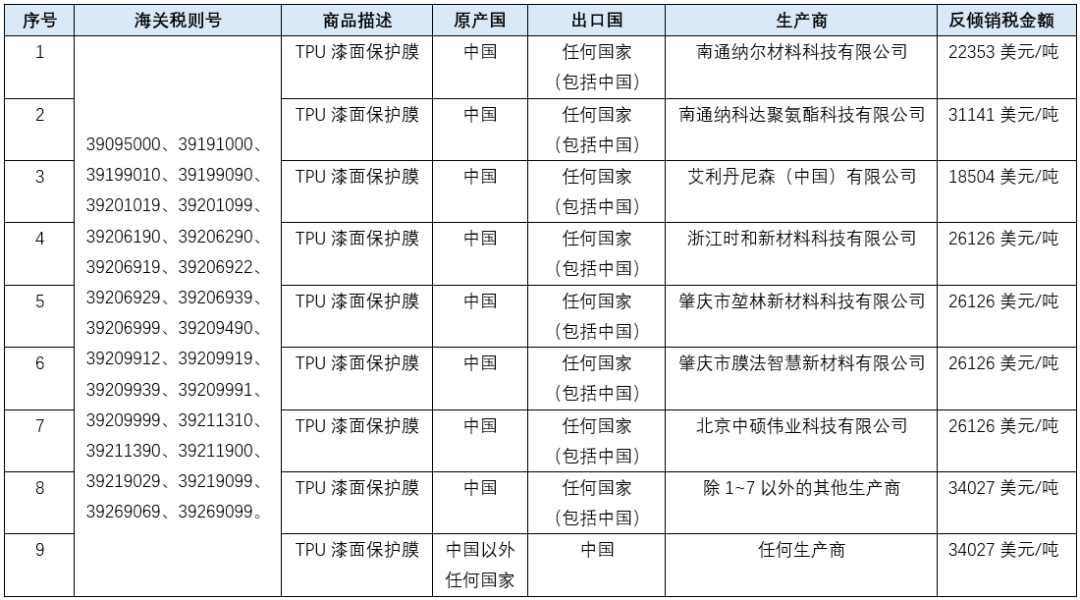
After a year, on June 12, 2026, the Directorate General of Trade Remedies (DGTR) under India’s Ministry of Commerce released its final anti-dumping determination regarding “thermoplastic polyurethane (TPU)-based surface/paint protection films” originating in or exported from China. It recommended the imposition of anti-dumping duties for a period of five years, ranging from USD 18,504/ton to USD 34,027/ton.
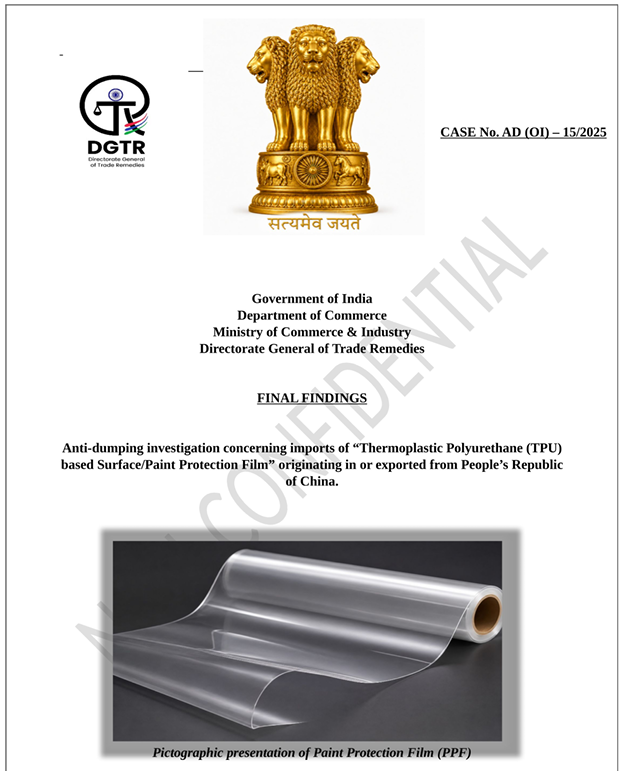
According to the disclosure, the anti-dumping case was initiated on June 16, 2025. The Directorate General of Trade Remedies (DGTR) under India’s Ministry of Commerce received an application filed by the domestic industry, Garware Hi-Tech Films Limited, requesting the initiation of an anti-dumping investigation into thermoplastic polyurethane (TPU)-based surface/paint protection films (hereinafter referred to as the “product under consideration,” “TPU PPF,” or the “subject goods”) originating in or exported from China.
The Directorate General of Trade Remedies (DGTR) of the Ministry of Commerce of India reviewed the application and found preliminary evidence indicating that the exported products from the countries involved were sold at dumped prices, causing corresponding harm to the domestic industry. Therefore, on June 16, 2025, the DGTR announced the initiation of an investigation into this anti-dumping case to examine the existence, extent, and impact of the alleged dumping of the investigated products, and to recommend the imposition of anti-dumping duties sufficient to eliminate the harm caused to the domestic industry.
It is worth noting that this is the first time the Indian anti-dumping investigation has targeted China's TPU paint protection film in this industry.
Below, we will provide a detailed interpretation of the dumping margins and related details involved in this anti-dumping case concerning TPU paint protection film.
The dumping investigation period in this case is from January 1, 2024 to December 31, 2024; the injury investigation period is from April 1, 2021 to December 31, 2024, divided into four phases: April 1, 2021–March 31, 2022; April 1, 2022–March 31, 2023; April 1, 2023–March 31, 2024; and January 1, 2024–December 31, 2024.

The product concerned is “thermoplastic polyurethane (TPU)-based surface/paint protection film” originating in or exported from China. The product concerned is a transparent or colored, flexible polymer film with self-healing properties, applied to the exterior surfaces of crafts or vehicles to protect the surface/paint from scuffs, scratches, road debris, and other forms of damage. As a protective layer, the product can absorb impact forces and prevent damage to the original paint surface.
01
BASF requested that six categories of products be excluded from the scope of the product under investigation, namely: TPU PPF with high optical clarity; TPU PPF with ultra-low haze; TPU PPF with long-lasting UV resistance; TPU PPF with chemical resistance; TPU PPF with precise elasticity; and TPU PPF with high strength. BASF argued that products not manufactured by the domestic industry in India should be excluded from the scope of the product under investigation. Relying on the concept of “like product,” the DGTR Manual, and relevant precedents, BASF contended that the domestic industry in India cannot claim injury with respect to products it does not produce.
BASF further argued that its branded products are priced higher, offer longer warranty support, have different quality parameters, use premium TPU resin, and are targeted at a distinct customer group, including luxury vehicle owners. BASF submitted laboratory evidence (QUV test reports) comparing samples of the domestic industry’s products with samples of the imported products, which allegedly demonstrated substantial technical differences between the two in parameters such as elastic modulus, adhesion, stain resistance, and UV aging performance (ΔE value, gloss retention, and haze).
Zhejiang Shihe New Materials Technology Co., Ltd. raised an objection essentially identical to BASF’s, stating that its exported products belong to the high-end/branded market segment and are sold with stronger quality assurance support and premium raw material inputs.
The Directorate General of Trade Remedies (DGTR) of the Ministry of Commerce of India defines "like products" as products that are identical or similar in all respects to the product under investigation, or in the absence of such products, another product that, while not identical in all respects, has closely similar characteristics to the product under investigation. It further points out that merely describing the product based on brand positioning, warranty commitments, focus on usage, width, color, surface effects, thickness, or enhanced performance claims by the respondent is insufficient to support their exclusion from the product under investigation. Based on the existing record, the imported products closely resemble the domestic products in relevant characteristics, and the request for exclusion based on performance attributes has not been substantiated.
After reviewing the laboratory materials and technical claims submitted by stakeholders regarding the performance attributes (high optical clarity, ultra-low haze, long-lasting UV durability, chemical resistance, precision elasticity, and high strength TPU PPF) of the products, it is concluded that these belong to the performance grades and specifications within the TPU-based PPF product line, rather than being independent and distinct products.
Nantong Narl Material Technology Co., Ltd. requires that TPU PPF, colored TPU PPF, and TPU PPF for sunroofs with a thickness exceeding 200 microns be excluded. At the same time, it claims that these belong to different product categories, requiring different manufacturing processes, raw materials, and technical expertise.
Avery Dennison (China) Co., Ltd. requests that colored TPU-based surface/paint protection films and TPU-based surface protection films with a width of 1.83 meters be excluded, on the grounds that the petitioner only produces transparent films, and that 1.83-meter-wide films require different machinery and equipment, handling methods, and installation and application processes.
The Directorate General of Trade Remedies (DGTR) of the Ministry of Commerce of India has determined that the interested parties did not provide evidence to show that these products are produced through completely different processes, sold in completely different markets, or cannot be used interchangeably with other TPU-based PPF in surface/paint protection. The small batch products themselves could encourage circumvention through marginal changes such as width, color, or thickness. Therefore, the exclusion request based on color, 1.83-meter width, and thickness over 200 microns is unsupported by the required evidence.
Regarding TPU PPF for sunroofs, interested parties have claimed that sunroof PPF has infrared and ultraviolet blocking properties. However, the domestic industry in India has submitted comments stating that its TPU-based PPF is likewise suitable for sunroof applications. Therefore, ordinary TPU-based PPF can be used for sunroofs, and the claimed additional properties do not constitute a separate product. Accordingly, exclusion is not warranted.
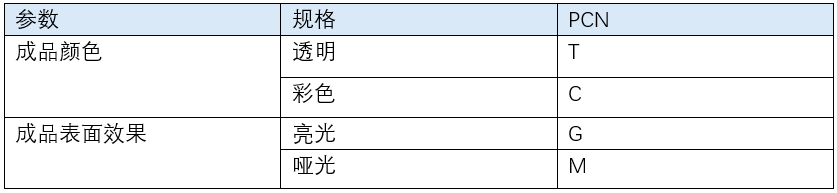
3M objected to the scope of the products involved in this case and to the PCN classification. It further stated that there is a significant price difference between matte PPF and gloss PPF (approximately 10% to 30%), and therefore the import volume, normal value, export price, CIF price, and injury indicators should be examined separately according to the PCN classification.
Avery Dennison (China) Co., Ltd. pointed out that a fair comparison must be made between the defective products involved and the products involved with different warranty periods, and it is required to establish separate PCNs for the defective products and the products distinguished by warranty period, as their prices, cost structures, technical performance, and market positioning vary due to grade and warranty period.
The interested parties argued that products with different warranty periods use different types of TPU resin, adhesive formulations, and protective coatings. It was alleged that domestic industry mainly sells products with 5-year and 8-year warranties, while imported products are mainly covered by 3-year and 5-year warranties, and that any comparison ignoring these differences is not a “like-for-like” comparison.
India’s Directorate General of Trade Remedies (DGTR) determined that the practice of classifying the subject goods into different PCNs originates from the WTO Anti-Dumping Agreement and may be adjusted based on differences in physical characteristics, provided that it is demonstrated that such differences affect price comparability; therefore, the approach adopted in this case is appropriate.
Regarding the products concerned by defect grade, the interested parties did not provide any objective and verifiable standard that would enable the customs authorities or the Authority to distinguish, for the purpose of a systematic comparison, between “prime” and “substandard” grades. Furthermore, warranty is a commercial/marketing decision and may vary from one company to another, even for the same or similar products; therefore, it cannot serve as a uniform and objective basis for establishing PCNs.
Nantong Nakoda Polyurethane Technology Co., Ltd., Nalinwei International Trade (Guangzhou) Co., Ltd., and Beijing Zhongshuo Weiye Technology Co., Ltd. request a clear and explicit confirmation that the TPU base film does not fall within the scope of the products involved in the case.
The Directorate General of Trade Remedies (DGTR) of India has determined that, with regard to TPU base film/uncoated TPU film, the Indian domestic industry and interested parties have all agreed that uncoated TPU film alone is not included within the scope of the product under investigation. Therefore, uncoated TPU base film/uncoated TPU film that does not constitute TPU base surface/paint protection film is not within the scope of the product under investigation.
The Directorate General of Trade Remedies (DGTR) of the Ministry of Commerce and Industry, India, has noted that the investigation has been initiated and all interested parties have been notified, providing domestic industry, exporters, importers, and other stakeholders with ample opportunity to submit affirmative information regarding dumping, injury, and causation. In accordance with the provisions of the Anti-Dumping Rules, an investigation into dumping, injury, and causation has been initiated and conducted, and it is considered necessary to impose anti-dumping duties to offset the dumping and injury. Therefore, the DGTR of the Ministry of Commerce and Industry, India, deems it necessary and recommends the imposition of anti-dumping duties on the investigated products originating from the investigated countries.
In accordance with the lower tax rate rule, it is recommended that the anti-dumping duty to be levied be equal to the lower of the dumping margin and the injury margin, in order to eliminate the damage to the domestic industry. Accordingly, the Directorate General of Trade Remedies (DGTR) of the Ministry of Commerce of India has recommended the imposition of anti-dumping duties on thermoplastic polyurethane (TPU) based surface/paint protection films originating in or exported from China, for a period of 5 years starting from the date of notification by the Ministry of Finance of India.
【Copyright and Disclaimer】The above information is collected and organized by PlastMatch. The copyright belongs to the original author. This article is reprinted for the purpose of providing more information, and it does not imply that PlastMatch endorses the views expressed in the article or guarantees its accuracy. If there are any errors in the source attribution or if your legitimate rights have been infringed, please contact us, and we will promptly correct or remove the content. If other media, websites, or individuals use the aforementioned content, they must clearly indicate the original source and origin of the work and assume legal responsibility on their own.
Most Popular
-

A Look at the Material Suppliers Behind SpaceX
-

Government's Triple Action, Enterprises' Three Arrows in Five Days, Semiconductor Reshuffle! What Signal Does Japan's Chemical Industry Release?
-

Next-generation motors of new energy vehicles: Single-Round Thousand Horsepower, Replacing Brakes, How Powerful Are They?
-
Ethylene: Production Capacity Accelerates Expansion, Global Industry Landscape Is Being Reshaped
-
Fire breaks out at jiangsu meiside!