How starsea graph achieved rmb 3 billion in revenue in two months and surpassed rmb 20 billion in valuation
After completing a nearly 1 billion yuan Series B financing in February, StarSea Map recently secured another nearly 2 billion yuan in a Series B+ round. Within just two months, this three-year-old company has raised a total of nearly 3 billion yuan, with its valuation doubling and surpassing the 20 billion yuan mark.
Even in the highly capital-intensive embodied intelligence sector, such a pace and scale are rarely seen.
So, what sets Star Atlas apart? The answer can be broken down into three dimensions: the structural upgrade of a full-ecosystem capital, the differentiated choice of technical routes, and the strategic leap from the developer market to the productivity market.

Image source: Xinghai Map
Behind the upgraded capital lineup, the IPO window is approaching.
Compared to its Series B financing, the most visible change in StarSea Graph’s Series B+ round is the comprehensive expansion of its investor lineup: this round has simultaneously attracted industrial capital, leading long-term funds, national-level funds, and top-tier PE firms—four distinct types of investors.
On the industrial capital front, Walden International, Lens Technology, Silicon Core Investment, Times Bole, and AECC Fund have entered the arena. Among them, Lens Technology will also engage in deep collaboration with Xinghai Tu in hardware supply chain and large-scale mass production.
Long-term patient capital includes Xiuyuan Capital, Hongzhang Investment, and Yu Hai Capital; national team funds include Financial Street Capital, JINPU Investment, Beijing Science & Technology Innovation Investment, and Guoyuan Equity Investment; and first-tier private equity firms such as China International Capital Corporation (CICC) Capital’s funds, Pu Hua Capital, Hongtai Fund, and GF Qianhe also participated in the investment.
In leading embodied intelligence projects, this "full ecosystem" combination investment has become the norm.
The underlying logic is not complicated: the R&D cycle for embodied intelligence is long, requires substantial capital investment, and faces numerous uncertainties in technology transfer and commercialization. A single type of capital often fails to meet a company’s comprehensive needs across different development stages.
In comparison, the diversification of capital structure not only provides companies with sufficient financial reserves but more importantly, it builds a strategic support network covering multiple dimensions such as technology R&D, supply chain integration, market expansion, and policy resources.
Industrial capital can bring to enterprises the integration of upstream and downstream resources in the industrial chain, technological synergy, and support in market channels, helping to achieve breakthroughs in hardware R&D, production manufacturing, and supply chain management.
Long-term institutional investors can provide stable capital support for enterprises with their strong financial resources and long-term perspective.
The involvement of the national fund not only reflects the country's strategic emphasis on cutting-edge fields such as embodied intelligence, but also provides enterprises with policy endorsement and resource allocation, helping them better align with national strategic needs and access critical resources.
While first-tier PE firms, with their rich investment experience, extensive network, and deep understanding of capital markets, can provide professional guidance and support in areas such as business model optimization, corporate governance improvement, and future capital operations.
Notably, Xinghaitu's recent two rounds of financing, totaling RMB 3 billion, were conducted after the company had already completed its shareholding restructuring.
In January 2026, StarSeaMap completed its industrial and commercial registration change, formally converting from a “limited liability company” to a “joint-stock company (foreign-invested, unlisted),” and concurrently renamed itself “StarSeaMap (Beijing) Artificial Intelligence Technology Co., Ltd.”, becoming the first company in the embodied intelligence sector to complete shareholding reform in 2026.
According to relevant Chinese regulations, a limited liability company cannot list directly. After the share reform, the enterprise meets the basic requirements for accessing the capital market in terms of equity structure, governance standards, and information disclosure. This not only removes the obstacle of subject qualification for subsequent IPO listing, but also lays a institutional foundation for introducing strategic investors, implementing equity incentives, and conducting mergers and acquisitions.
Xinghai Map explicitly stated that this share reform aims to optimize the company's governance structure and establish a more standardized and robust modern corporate governance framework, providing institutional support for sustained technological innovation, talent incentive mechanisms, and deeper strategic partnerships.
Given that shareholding reform is generally seen as a precursor to an IPO, Starhai Tu's series of large-scale financings and its significant valuation jump this year have also been viewed as having a Pre-IPO character.
Model + Data,The moat of the star map
Behind the capital's enthusiasm for Xinghaitu lies its clear commercialization roadmap and the gradual emergence of phased achievements.
Aiming to build a "general embodied intelligent brain" as its core goal, StarSea Map is dedicated to promoting the innovation of embodied intelligence technology through the deep coupling of world models and VLA, combined with a real-scene embodied data engine.
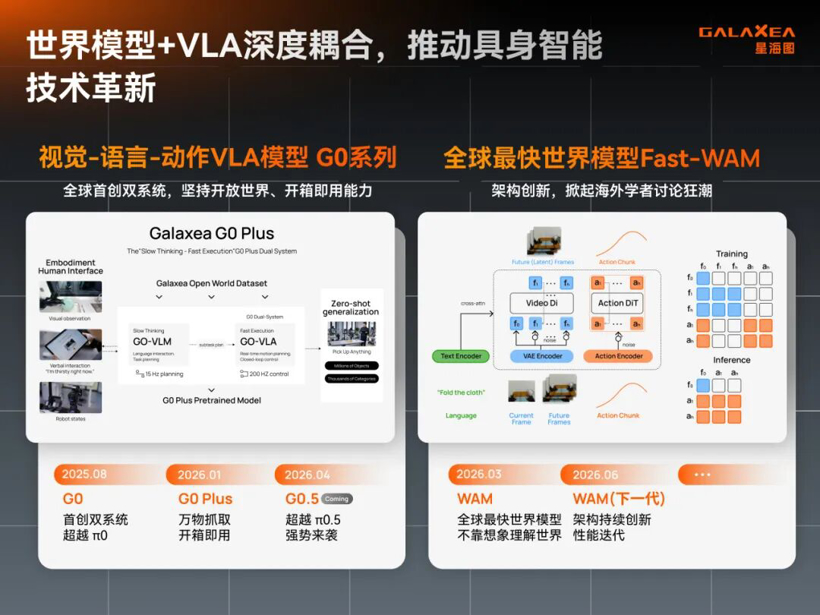
Image source: Sea of Stars Map
In the view of Starry Sky Map, visual-language-action (VLA) models and the World Action Model (WAM) are co-originated and symbiotic. By leveraging massive data from real open scenarios, integrating intuitive physical world cognition with precise task execution, it can endow robots with general intelligence to understand the world and manipulate everything.
Specifically, in terms of the VLA model, StarMap has developed the Visual-Language-Action VLA model G0 series, and continues to open-source and iterate. The G0 model adopts a "dual system (System 1 and System 2)" architecture, with "slow thinking, fast execution" at its core, drawing inspiration from the division of labor between the cerebral cortex and cerebellum operating at different frequencies in biological evolution, achieving optimal energy utilization efficiency.
In actual operation, the dual-system architecture divides robot control into two modules: high-level cognition and low-level action. The high-level G0-VLM is a vision-language model responsible for parsing natural language task instructions, performing multimodal reasoning, and decomposing them into executable sub-tasks—functioning equivalently to the reasoning and decision-making capabilities of “System 2.”
The lower-level G0-VLA is a vision-language-action model that executes specific actions at a high frequency and performs closed-loop control, corresponding to the rapid response capability of “System 1.” The two operate asynchronously, thereby achieving both global planning intelligence and high responsiveness in local execution.
Since its official launch in August 2025, Xinghai Tu has open-sourced the G0 model, the out-of-the-box G0 Plus, the vertical-domain G0 VLA model tailored for garment folding, and the G0 Tiny lightweight model optimized for edge-side deployment—over the past six months. The upcoming G0.5 model will soon be released, endowing robotic foundation models with genuine universal deployment capabilities.
In the field of world models, Xinghaitu recently launched Fast-WAM, touted as the “world’s fastest” world model. Unlike mainstream World Action Models (WAMs), which follow the “imagine first, then act” paradigm, Fast-WAM fundamentally overturns the entrenched notion that “future video generation is mandatory” through a radical reconstruction of the model’s underlying architecture—demonstrating conclusively that physical understanding can be fully decoupled from high-latency generation, thereby significantly enhancing world model inference speed.
It is reported that Fast-WAM requires only 190 milliseconds for a single-step inference, achieving an order-of-magnitude breakthrough compared to the traditional WAM, which operates on the scale of 800 milliseconds.
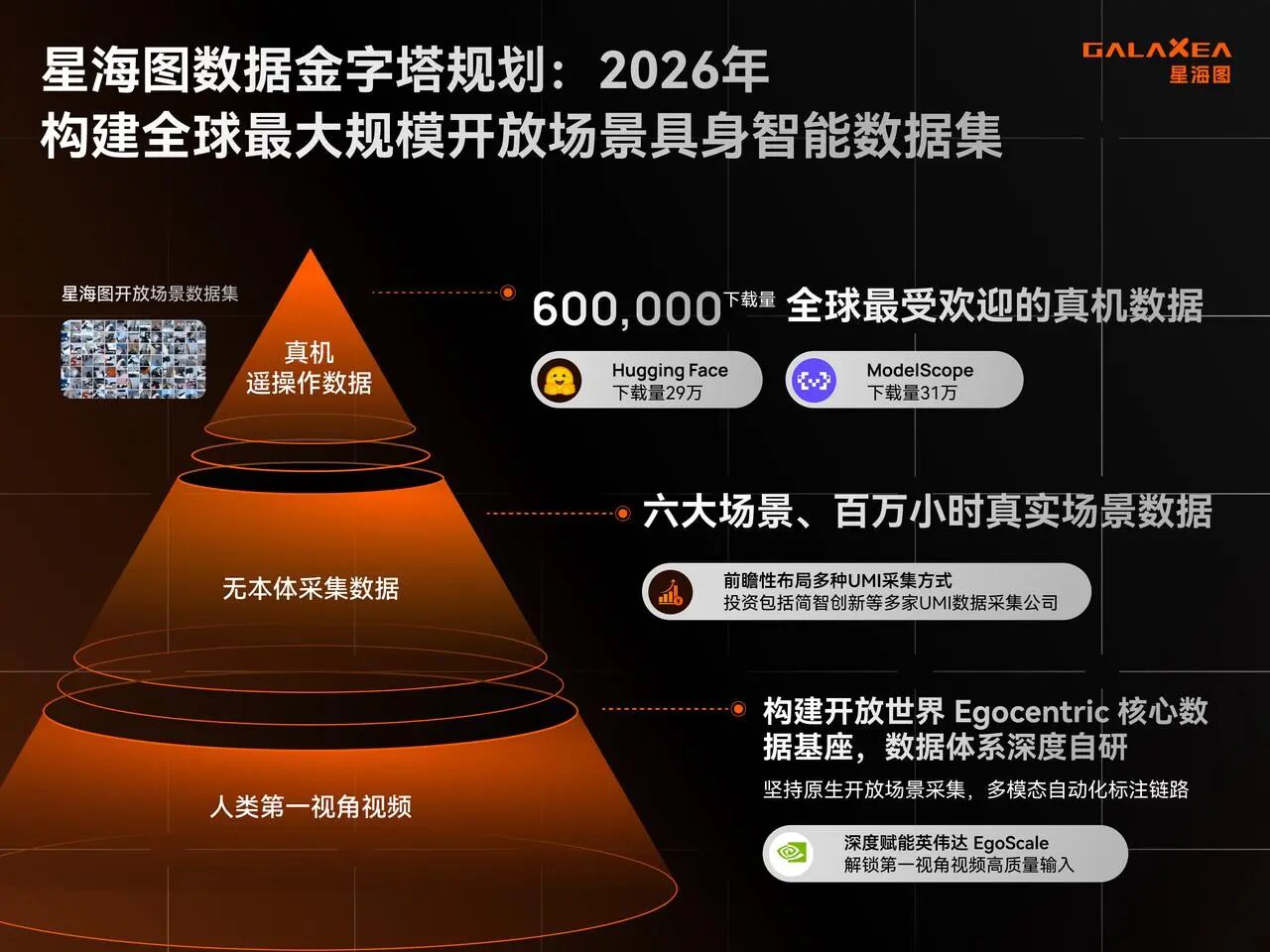
Image source: Starry Sea Map
Given the advancement of embodied intelligence, embodied robots need to continuously interact with the physical world to learn and optimize their behavior. This relies on large-scale, high-quality, and diverse real-world interaction data. Xinghai Tu has also established a no-ontology data approach based on UMI data and human first-person perspective (egocentric) data, further building a data closed-loop system for embodied intelligence that covers multiple scenarios, multiple tasks, and multi-modalities.
Currently, StarSea Graph’s data system has deeply empowered world-class embodied large models such as NVIDIA’s EgoScale and Ant Group’s Lingbot-VLA, becoming an indispensable underlying infrastructure for the industry.
Building on this, Xinghai Tu will further construct the world’s largest real-world embodied dataset this year, continuously driving the evolution of embodied foundation models with millions of hours of real-world scene data.
Nevertheless, while this “model + data” dual-pronged approach has built an imitable moat for StarSea Robotics, the company has concurrently established a comprehensive hardware support system—centered on three key technical directions: wheeled dual-arm platforms, dexterous manipulation, and full-body motion control. This hardware system includes joint modules, the DEXO dexterous hand, standardized integrated robot platforms, and a complete developer toolchain, all aimed at enhancing overall capabilities and maintaining strong competitiveness in commercial deployment.
Market-oriented TransformationFrom "Developer's First Choice" to "Productivity Benchmark"
In the embodied intelligence industry, what truly tests a company's mettle is not just whether its technology can move beyond the lab, but whether it can establish a sustainable business model in real-world scenarios.
In this regard, the StarSea Map’s trajectory exhibits a “developer market + productivity market” dual-driven characteristic.
In the developer market, StarMap has established an absolute leading advantage. By deeply integrating "hardware platform for intelligent systems" with the EDP model development platform, StarMap has served more than 150 top global embodied intelligence developer partners, including Fei-Fei Li's team at Stanford University, Physical Intelligence (PI), NVIDIA, Huawei, and others, becoming the universal foundation for global embodied intelligence research and development.
Among them, Physical Intelligence has launched the π0.5 open-world generalization model based on the Xinghaitu R1 Lite platform, and Li Fei-Fei's team has released a full-body mobile manipulation robot kit solution based on the Xinghaitu R1 robot platform.
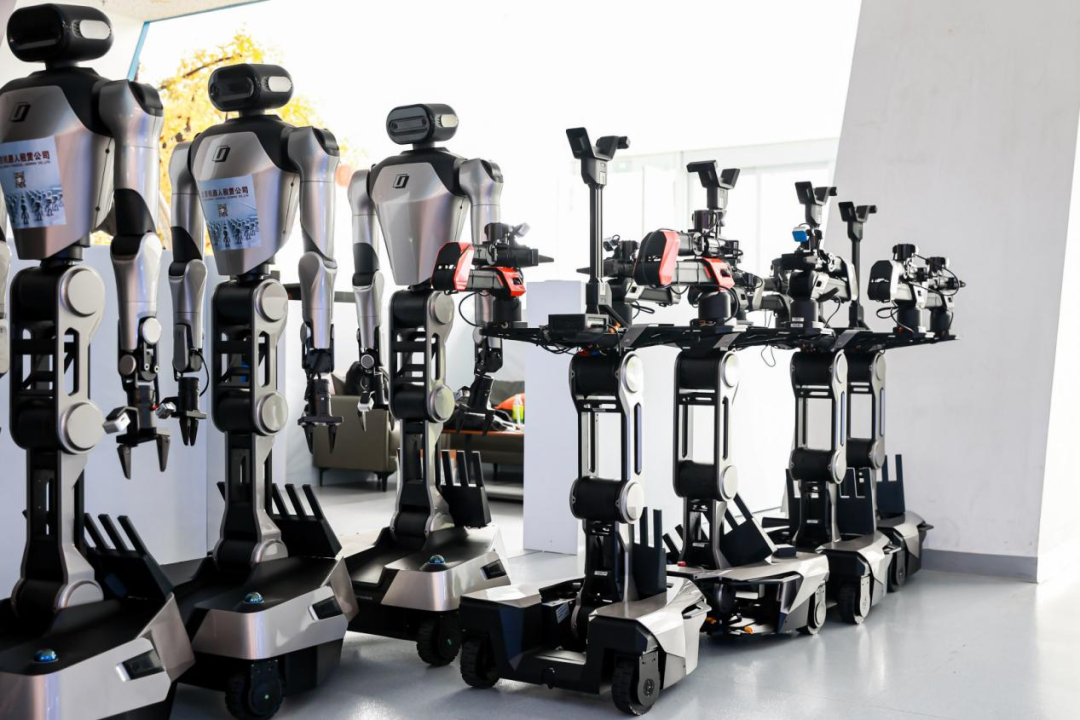
Image source: Xinghai Map
In the productivity market, focusing on five core scenarios—material handling and mobility, grasping and placement, packaging and sealing, fabric folding and stacking, and equipment interconnection—Xinghai Tu has successfully executed orders at the scale of thousands of units and has established deep collaborations with industry-leading enterprises in industrial material handling, logistics sorting, and commercial display.
Currently, StarSea Map is continuously expanding the boundaries of its applications. In March this year, StarSea Map showcased its R1 Pro robot at Beijing E-Tech Zone’s world’s first intelligent health-care robotics elderly care station, where the robot completed a clothing-folding task in real time on-site.
Behind this seemingly simple action lies the verification of the robot’s generalization capability in real-life scenarios—from industrial production lines to home-based elderly care, Xinghaitu is addressing diverse intelligent needs across different scenarios using the same technological foundation.
Looking ahead to 2026, with the full maturity of supply chain and scenario capabilities, StarMap plans to launch mass production on a scale of ten thousand units.
A valuation of 20 billion is not the end, but a countdown for a company to move from "telling stories" to "delivering results."
The completion of the B+ round of financing has undoubtedly provided StarSea Map with ample cash reserves. However, a valuation of 20 billion yuan also means higher market expectations. From a thousand-unit order to ten thousand units in mass production, from the highest market share in the developer market to the large-scale replication in productivity scenarios, each of these hurdles requires systematic capabilities in technology, supply chain, sales, and service to overcome. This means that for StarSea Map, the real test has just begun.
【Copyright and Disclaimer】The above information is collected and organized by PlastMatch. The copyright belongs to the original author. This article is reprinted for the purpose of providing more information, and it does not imply that PlastMatch endorses the views expressed in the article or guarantees its accuracy. If there are any errors in the source attribution or if your legitimate rights have been infringed, please contact us, and we will promptly correct or remove the content. If other media, websites, or individuals use the aforementioned content, they must clearly indicate the original source and origin of the work and assume legal responsibility on their own.
Most Popular
-
Massive Loss of $960 Million! Wansheng Co., Ltd. Sees Rising Revenue But Declining Profits—Why Did the Phosphorus-Based Flame Retardant Leader Falter?
-
Breakthrough! 13.6-million-ton new giant emerges as world’s fourth-largest polyolefin producer, reshaping industry landscape
-

BASF's $8.7 Billion Zhanjiang Site Fully Operational, Covestro, SABIC, Arkema and Other Plastics Giants Double Down on China
-
Deadly Impact: Hormuz Strait Blockade Sparks Shortage of Plastic Raw Materials, Threatening Shutdowns at Japanese and Korean Chemical Plants
-

Domestic PBE Breakthrough, Polyolefin Modification Industry to Break the Impasse