



How Do Plastic Colorants Stealthily Affect The Effectiveness Of Antioxidants And Stabilizers?
If plastic colorants are not properly matched with antioxidants and light stabilizers, it can lead to premature fading or discoloration of colored plastic products, and can also accelerate the photo-oxidative aging of the colored plastics. This results in deterioration of the appearance and physical-mechanical properties of the products, causing them to lose their original function and value prematurely.
Effect of Colorants on the Efficacy of Antioxidants and Light Stabilizers
01
Effect of Colorants on the Performance of Antioxidants
Chrome yellow is an opaque inorganic colorant that can be used in thermoplastics such as polyolefins, polystyrene, and acrylic resins. It has strong tinting strength, excellent hiding power, and outstanding resistance to water and solvents. However, because chrome yellow is a lead-containing compound composed of lead chromate or basic lead chromate together with lead sulfate, when used together with sulfur-containing antioxidants such as DLTP, DSTP, 1035, and 300, it undergoes a chemical reaction under the high-temperature conditions of plastic processing, forming black lead sulfide. This affects the appearance of plastic products and also greatly reduces the effectiveness of the antioxidants in preventing thermal oxidative aging. Therefore, chromium-containing colorants should not be used together with sulfur-containing antioxidants.
In pigmented polypropylene, certain colorants can chemically react with low-molecular-weight hindered phenolic antioxidants, thereby weakening the effectiveness of the antioxidants. Table 1 shows the effect of some colorants on the performance of low-molecular-weight phenolic antioxidants in polypropylene, which can be divided into three categories:
Table 1 | Effect of Colorants (0.5%) on the Thermal Oxidative Stability of Polypropylene Containing Phenolic Antioxidants
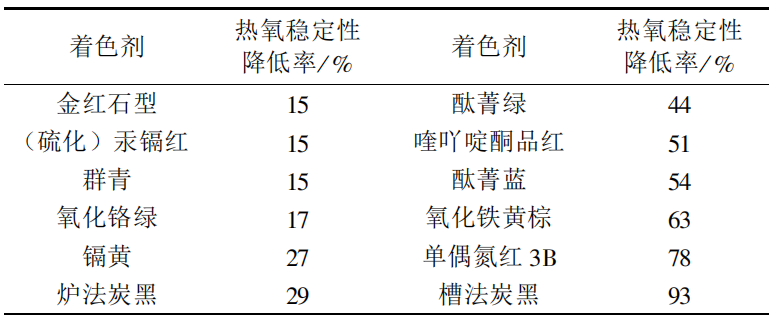
Severe impact: furnace carbon black, Pigment Red 3B, quinacridone magenta, phthalocyanine blue, iron oxide yellow-brown.
Moderate impact: Phthalocyanine Green, furnace carbon black, ultramarine, chromium oxide green;
Slightly affected: cadmium yellow, (sulfide) cadmium red, rutile type titanium dioxide.
Carbon black is a black coloring agent that can be used in a variety of plastic materials and products, and it is also the largest-volume black colorant. It can also serve as a light stabilizer for plastic materials. In addition to its weakening effect on the effectiveness of certain phenolic antioxidants in polypropylene, carbon black can also react with antioxidant BHT in low-density polyethylene, causing BHT to almost completely lose its effectiveness, while the light-stabilizing effect of carbon black itself is also greatly reduced.
The outdoor exposure life of low-pressure polyethylene sheets containing 1% channel black and 0.1% BHT is only about 40% of that of low-pressure polyethylene sheets containing only 1% channel black. For plastic materials such as polyethylene and polypropylene, when carbon black is used as a colorant or light stabilizer, an appropriate antioxidant must be selected. Otherwise, not only will the effectiveness of the antioxidant be reduced, but the outdoor light stability of the colored plastic products will also be decreased.
When titanium dioxide and pearlescent pigments are used together with the monophenolic antioxidant BHT in certain resins, they can cause white products to turn yellow, resulting in product quality issues.
02
The Effect of Colorants on the Effectiveness of Light Stabilizers
Colorants affect the effectiveness of light stabilizers in colored plastic products mainly in two ways.
First, colorants containing heavy metal elements or impurities such as copper, manganese, and nickel are photoactive and photosensitive, catalyzing and accelerating the photoaging of plastic materials. Phthalocyanine blue containing free copper and impurities can promote the photoaging of polypropylene; iron oxide red can reduce the effectiveness of benzotriazole, benzophenone, and organic nickel salt light stabilizers in polypropylene by more than 20%; for polyethylene, the use of colorants such as titanium dioxide, ultramarine, chromium oxide green, cobalt green, and iron oxide red can exacerbate photoaging.
Certain molecular structure colorants can interact with light stabilizers, directly weakening the effectiveness of the light stabilizers. Acidic colorants can render hindered amine light stabilizers ineffective; in polypropylene, azo red and yellow can interact with hindered amine light stabilizers, while azo condensation red BR and azo condensation yellow 3G can reduce the effectiveness of hindered amine light stabilizers by approximately 25% and 50%, respectively.
Table 2 shows the effects of different coloring agents on the light stability of high-density polyethylene containing benzotriazole light stabilizer (UV-328). As can be seen from Table 2, Chrome Yellow significantly improves the light stability of high-density polyethylene, while Phthalocyanine Green and Ultramarine have slight improvements or no significant effects, and Cadmium Yellow decreases the light stability of high-density polyethylene.
Table 2 | Effect of different colorants on the photostability of high-pressure polyethylene film containing benzotriazole
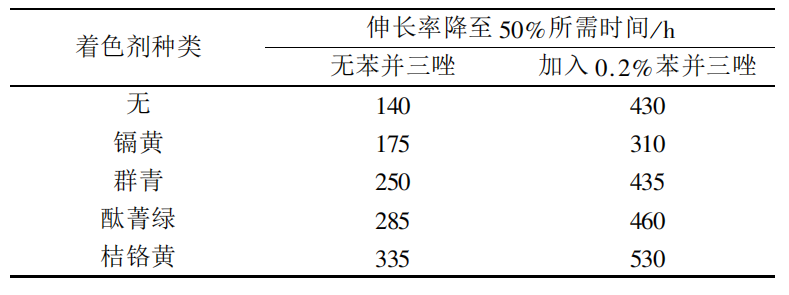
Steinlin F and Sear W were melt-spun with different colorants (1%), antioxidant 1010 (0.1%), light stabilizer 770 (0.5%), and polypropylene at 285°C, and then drawn 4 times to obtain fibers of 80 denier/24 filaments. The fibers were subjected to xenon lamp exposure testing.
At the point when strength had decreased by 50%, the radiation doses received by the samples were compared. The results indicate that polypropylene fibers colored with the organic pigments yellow, red, and orange, despite the addition of antioxidants and light stabilizers, exhibit lower stability than uncolored polypropylene fibers.
The Role of Antioxidants and Light Stabilizers in Colored Plastics
For colored plastic products, one function of antioxidants and light stabilizers is to eliminate the destabilizing effect of colorants and protect the plastic resin; a second function is to protect the colorants by protecting the resin; and a third function is to directly protect the colorants. For example, colorants such as fluorescent pigments are sensitive to ultraviolet light and have poor lightfastness, so benzophenone or benzotriazole ultraviolet absorbers should be added during use to protect them.
01
The role of antioxidants
Color masterbatch is a high-concentration colored pellet made from colorants, carrier resins, dispersants, coupling agents, surfactants, and enhancers. Using color masterbatch to produce colored plastic products is a widely adopted method in the plastic products manufacturing industry.
Generally speaking, the carrier resin used in the production of masterbatches has a lower molecular weight and a higher melt flow rate than the base resin used for producing products. The carrier resin undergoes initial heating during the production of the masterbatch and is then subjected to re-extrusion heating during the production of plastic products. This causes the carrier resin to first undergo thermal degradation and mechanical degradation, which in turn accelerates the aging process of the colored plastic products. Although the proportion of the carrier resin in the masterbatch is small in the colored plastic products, it has already undergone thermal oxidation after being subjected to secondary or more heating. Therefore, it is essential to add antioxidants when producing masterbatches and when using them to produce colored plastic products.
Resistance to thermo-oxidative aging is a fundamental anti-aging function for general plastic materials, while resistance to photoaging is an enhanced function built upon this foundation. To improve the light stability of colored plastic products, it is first necessary to enhance their thermo-oxidative stability. In certain plastic products colored with ultraviolet-absorbing pigments, the addition of suitable antioxidants in appropriate amounts can increase the light stability of the products severalfold.
The data in Table 3 indicate that, in high-pressure polyethylene, the use of chrome yellow, iron oxide red, or antioxidant 2246 alone cannot improve the light stability of polyethylene.
Table 3 | Synergistic Effects of Antioxidants and UV-Absorbing Pigments in High-Density Polyethylene
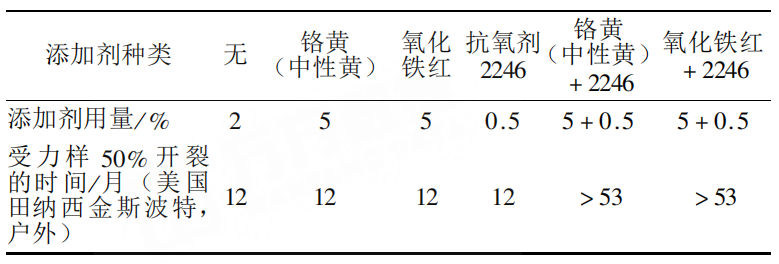
When chrome yellow or iron oxide red is used together with antioxidant 2246, the light stability of high-pressure polyethylene is improved by more than three times. The essential role of antioxidant 2246 in this experiment is to enhance the thermal oxidative stability of high-pressure polyethylene, which objectively manifests as an enhancement of the light stability of high-pressure polyethylene.
02
Role of light stabilizers
UV-absorbing light stabilizers are commonly referred to as ultraviolet absorbers. Based on their molecular structures, ultraviolet absorbers can be divided into benzophenone types and benzotriazole types. This class of light stabilizers works by using its own molecular structure to convert the light energy irradiated onto colored plastic products into heat energy, thereby preventing the molecular structure of the colorant (such as the conjugated double-bond chromophore of organic colorants) from being damaged by light energy, and preventing photo-oxidation reactions in the plastic material. Ultraviolet absorbers are light stabilizers that can directly protect the appearance and color of colorants and colored plastic products.
Most colorants, especially inorganic pigments, can provide a certain degree of light stability when used alone in plastic products. However, for colored plastic products intended for long-term outdoor use, relying solely on colorants to enhance the light stability of the products is insufficient. Only by using light stabilizers can the light aging rate of colored plastic products be effectively suppressed or slowed down, significantly improving their light stability.
Hindered amine light stabilizers (HALS) are a class of organic amine compounds with steric hindrance effects. Owing to their ability to decompose hydroperoxides, quench excited singlet oxygen, capture free radicals, and regenerate their active groups cyclically, they are highly effective in preventing photoaging and are the most widely used plastic light stabilizers both domestically and internationally.
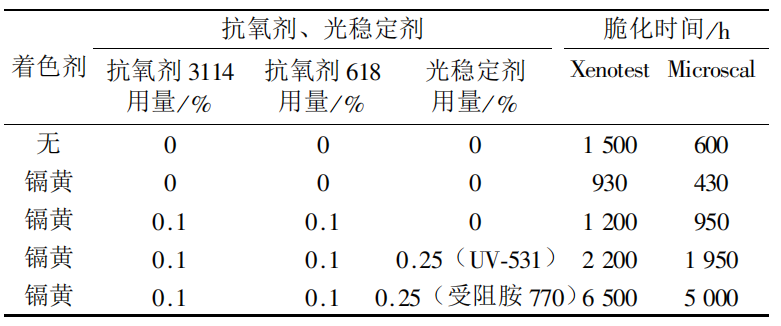
Table 4 indicates that appropriate light stabilizers, or suitable antioxidant/light stabilizer combination systems, can improve the light and oxidative stability of colored plastic products for outdoor use by several times. For plastic products colored with photoactive or photosensitive colorants (such as cadmium yellow and uncoated rutile titanium dioxide), in view of the colorants’ catalytic effect on photoaging, the amount of light stabilizer added should be increased accordingly.
Table 4 | Embrittlement data of recycled polypropylene sheet box materials
When producing colored plastic products, the selection of colorants, antioxidants, and light stabilizers, as well as the determination of their addition levels, should take into account the influence of the colorants on the effectiveness of the antioxidants and light stabilizers. Tests should be conducted to determine the effects and synergistic performance of the combined use of these three additives on the color and aging resistance stability of the products.
For colorant, antioxidant, and light stabilizer combinations or systems determined through testing or practical application, if the base resin, processing technology and conditions, product shape, and service environment of the colored plastic product remain unchanged, any change in the type of antioxidant or light stabilizer, or any slight change in the color, type, dispersion, quality, additive amount, or any other factor of the colorant, may all trigger major quality problems in the colored plastic product.
【Copyright and Disclaimer】The above information is collected and organized by PlastMatch. The copyright belongs to the original author. This article is reprinted for the purpose of providing more information, and it does not imply that PlastMatch endorses the views expressed in the article or guarantees its accuracy. If there are any errors in the source attribution or if your legitimate rights have been infringed, please contact us, and we will promptly correct or remove the content. If other media, websites, or individuals use the aforementioned content, they must clearly indicate the original source and origin of the work and assume legal responsibility on their own.
Most Popular
-

A Look at the Material Suppliers Behind SpaceX
-
Government's Triple Action, Enterprises' Three Arrows in Five Days, Semiconductor Reshuffle! What Signal Does Japan's Chemical Industry Release?
-
Next-generation motors of new energy vehicles: Single-Round Thousand Horsepower, Replacing Brakes, How Powerful Are They?
-
Ethylene: Production Capacity Accelerates Expansion, Global Industry Landscape Is Being Reshaped
-
Fire breaks out at jiangsu meiside!


