



Geopolitical hurricane recedes! pmma market in iran falls from surge, awaiting cycle reversal
The situation in the Middle East has recently taken a dramatic turn.According to Xinhua News Agency, the United States and Iran have confirmed that they have reached a memorandum of understanding to end the conflict that has lasted for more than 100 days. The formal signing ceremony is scheduled to be held on June 19 in Geneva, Switzerland.The US and Iran have completed the online signing, Trump has ordered the immediate lifting of the maritime blockade, and Pakistani Prime Minister Shahbaz described it as "a historic step towards peace witnessed by the world."
News that the Strait of Hormuz is expected to reopen has quickly spread to global commodity markets.During the New York trading session on June 15, WTI crude oil futures fell by more than 5% at one point, hitting a low of $78.45, and briefly dropped below the $80 mark for the first time in three months.Brent crude also fell nearly 5% to around $83 a barrel. However, Wall Street generally cautions that easing pressure does not mean the end of high oil prices—the resumption of normal trade for more than 500 vessels stranded in the Gulf could still take weeks or even months. Analysts noted that confidence rebuilding among shipowners, insurers, and refiners will be a gradual process, while Iran has made it clear that “traffic management and services will no longer be the same as before.”
For China’s PMMA industry chain, the hurricane-like geopolitical storm has left behind a six-month report card filled with surges and cliff-like drops.
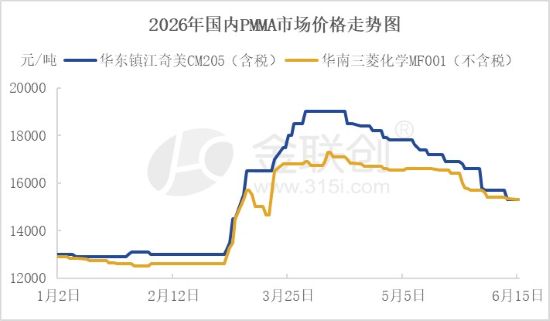
In the first half of 2026, driven by macroeconomic sentiment, the domestic PMMA market as a whole experienced a roller-coaster trend of sharp rises and falls.Taking East China market Zhenjiang Chimei CM205 as an example, the quoted price range is 12,900-19,000 yuan/ton, with an average price of 15,450 yuan/ton, down 11.80% year-on-year.From January to the end of February, the overall market fluctuated within a range, edging up mildly from RMB 12,900/mt to RMB 13,000/mt, with little volatility.The real turbulence began in early March: after the outbreak of the US-Iran war, PMMA prices skyrocketed, rising from 13,000 yuan/ton to 19,000 yuan/ton in just one month, with a monthly increase of 6,000 yuan/ton, experiencing extreme daily fluctuations of 500 to 1,000 yuan/ton during this period.。
However, macro sentiment can only drive temporary price fluctuations and cannot change the long-term logic of fundamentals.In mid-April, the geopolitical premium began to dissipate, and the market returned to the fundamentals of supply and demand, entering a continuous downward trend.After entering June, the downward trend accelerated further. According to monitoring by SunSirs,On June 15, the PMMA average spread continued to widen negatively, indicating that the market is accelerating its decline.In East China, the mainstream negotiated price of PMMA pellets has fallen back to the range of RMB 12,500–15,600/ton.
Behind sharp price surges and plunges lie profound changes in industry fundamentals, mainly reflected in the following three dimensions:
The operating rate has plummeted.In February, the overall operating rate of the domestic PMMA industry was still around 83.57%; by June, this figure had dropped to 59.29%, a sharp decline of 24.28 percentage points in operating load, resulting in a monthly production decrease of approximately 10,000 tons. This halving of the operating rate not only reflects the lack of confidence among companies in the market outlook but also highlights the weakness in effective demand support in the first half of the year.
The import-export landscape is showing strong external demand but weak domestic demand.From January to April 2026, China's total PMMA imports were 49,100 tons, a slight decrease of 5,300 tons year-on-year, representing a decline of 9.7%, which is a significant narrowing compared to previous periods. During the same period, total exports reached 24,000 tons, an increase of 1,800 tons year-on-year, with a growth rate of 8.11%. In April, the export volume even reached a historic high. The global supply chain restructuring caused by geopolitical conflicts unexpectedly opened a rare window for China's PMMA exports.
The "double kill" effect of costs and demand is gradually becoming evident.As of June 15, the mainstream price of MMA in East China is between 12,300 and 12,400 yuan/ton. With the decline in oil prices, aromatics products such as pure benzene and propylene are facing downward pressure, and the fundamentals of acetone are already weak, so the drop in oil prices will further compress the cost bottom line of MMA. Meanwhile, the downstream PMMA is in the traditional off-season, with limited new orders from end factories and a continued decline in spot purchasing willingness.
Looking towards the longer-term future, the pressure on the PMMA market in the second half of the year will only intensify. Shandong Zhemei's optical-grade PMMA project, with an annual capacity of 80,000 tons, is set to be fully operational by February 2026, with plans to increase capacity by another 80,000 tons, which is expected to push its domestic market share beyond 20%. Zhejiang Petrochemical also has plans for an 18,000 tons/year PMMA facility. The concentrated release of new production capacity will exacerbate the already fragile supply-demand balance.
In the second half of the year, the domestic PMMA industry is likely to remain dominated by supply-demand imbalances as the core factor driving price trends.Cost-side support is unlikely to effectively offset the downward pressure caused by both weak supply and weak demand, and the pricing center remains under sustained pressure. Taking Zhenjiang Chimei CM205 in the East China market as an example, the overall quoted price is expected to range between RMB 13,200 and 15,000 per ton, including tax. The only variable lies in whether the traditional peak-demand season of “Golden September and Silver October” can bring about a temporary recovery—but even if a short-term rebound occurs, it is unlikely to alter the overall weak market trend.
The signing of the US-Iran understanding memorandum marks a phased conclusion to the conflicts in the Middle East. However, the geopolitical conflicts have not only caused temporary fluctuations in prices for the PMMA industry but also served as a panoramic stress test for the entire supply chain's fragility. As the market rapidly adjusts from a surge, the real challenges facing the industry have become evident: when macro sentiment wanes, when cost support collapses, and when supply and demand adversities follow one after another.The PMMA industry has already reached the starting point of a new cycle.
Editor: Winnie
【Copyright and Disclaimer】This article is the property of PlastMatch. For business cooperation, media interviews, article reprints, or suggestions, please call the PlastMatch customer service hotline at +86-18030158354 or via email at service@zhuansushijie.com. The information and data provided by PlastMatch are for reference only and do not constitute direct advice for client decision-making. Any decisions made by clients based on such information and data, and all resulting direct or indirect losses and legal consequences, shall be borne by the clients themselves and are unrelated to PlastMatch. Unauthorized reprinting is strictly prohibited.
Most Popular
-

A Look at the Material Suppliers Behind SpaceX
-

Government's Triple Action, Enterprises' Three Arrows in Five Days, Semiconductor Reshuffle! What Signal Does Japan's Chemical Industry Release?
-

Next-generation motors of new energy vehicles: Single-Round Thousand Horsepower, Replacing Brakes, How Powerful Are They?
-
Fire breaks out at jiangsu meiside!
-
Ethylene: Production Capacity Accelerates Expansion, Global Industry Landscape Is Being Reshaped


