Five Ministries Jointly Issue Major Announcement! Upstream Carbon Reduction Pressures Drive A Full-Chain Transformation, Bringing An Invisible Test To The Plastic Industry
On June 15, 2026, the National Development and Reform Commission and four other departments issued a notice on the "Three-Year Action Plan for Key Industries' Energy Conservation and Carbon Reduction Transformation."Focusing on nine industries—steel, electrolytic aluminum, cement, flat glass, oil refining, ethylene, synthetic ammonia, methanol, and coal-fired power—comprehensive energy-saving and carbon-reduction retrofits will be implemented over three years. The notice makes clear that by the end of 2028, the share of production capacity in key industrial sectors reaching the current energy efficiency benchmark level will increase by an average of 20 percentage points, production capacity below the energy efficiency baseline level will be basically eliminated, and cumulative energy savings of more than 100 million tonnes of standard coal and carbon dioxide emission reductions of more than 200 million tonnes will be achieved.
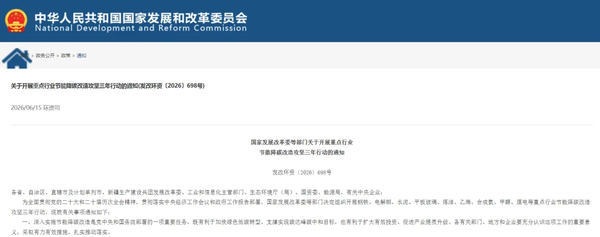
At first glance, the term "plastic" does not appear in the nine key industries listed in this notice.But if you understand the production origins of plastics, you will immediately realize that the “oil refining, ethylene, synthetic ammonia, and methanol” listed in the notice are precisely the most core chemical raw materials that form the starting point of plastic’s life cycle.From petroleum and natural gas to plastic products, there is a clear chain of material transformation: crude oil is refined into feedstocks such as naphtha and olefins; naphtha is then cracked to produce monomers such as ethylene and propylene; these monomers are polymerized into commodity plastics such as polypropylene and polyethylene, which are then processed into a wide range of plastic products. The top of this chain—refining and ethylene production—is precisely the core target of this round of upgrading.
Source Carbon Reduction: The Plastic Decarbonization Path Starting with Petroleum and Methanol
Ethylene is known as the “mother of petrochemicals,” and about 75% of petrochemical products worldwide are derived from ethylene.Polyethylene is the most widely used general-purpose plastic in the world. In the newly issued Notice, the ethylene industry has been designated as one of the first priority sectors for transformation and upgrading. It clearly states that efforts should be made to “promote energy-saving and carbon-reduction retrofits for core refining processes such as crude distillation, catalytic cracking, reforming, coking, and hydrogen production and hydrogenation, as well as for units producing aromatics, olefins, and ethylene glycol, and to promote advanced process technologies such as high-efficiency catalytic cracking flue gas turbines.” It also requires that crude distillation units with a capacity below 10 million tons per year and naphtha cracking units for ethylene production with a capacity below 800,000 tons per year should accelerate retrofit and upgrading.
Moreover, as another major artery serving as an alternative to traditional plastic manufacturing processes—The coal chemical industry pathway was also explicitly mentioned in this round of policy.The methanol and synthetic ammonia industries have been included in the retrofitting list. The notice explicitly calls for promoting energy-saving and carbon-reduction upgrades to equipment such as coal gasifiers, steam reformers, and high-pressure synthesis towers, and requires facilities including natural gas-based methanol plants with an annual capacity below 300,000 tons and coal-based methanol plants with an annual capacity below 1 million tons to accelerate their upgrading and transformation.
Methanol is a key intermediate product in the coal-to-olefins route. Taking large-scale coal chemical projects such as Yanchang Yulin Energy and Chemical as examples, 1.8 million tons of methanol are converted through the methanol-to-olefins process into plastic products such as polyethylene and polypropylene. The traditional coal-to-methanol route is a typical high-carbon-emission process, because large amounts of carbon dioxide are released when coal is converted into methanol. Once both the upstream methanol production and downstream ethylene cracking links simultaneously begin energy-saving upgrades, they will provide the most fundamental driving force for reducing the carbon footprint of the entire plastics value chain.
The Real Dilemma of the Plastics Industry: Large Scale but Urgent Need for Low-Carbon Transformation
In 2025, more than 24,000 above-designated-size enterprises in China’s plastic products industry generated RMB 2.2 trillion in revenue, with total profits exceeding RMB 100 billion. However, behind the spotlight lie many challenges: the industry’s average profit margin was only 4.8%, meaning that for every RMB 100 product sold, companies ultimately earned less than RMB 5 in profit. Meanwhile, structural overcapacity remained prominent, with capacity utilization below 74%. Energy-saving upgrades for ethylene and methanol on the raw-material side will inevitably lead to fluctuations and adjustments in upstream raw material costs, leaving the plastic products industry facing the deeper challenge of restructuring its cost base.
More critically, China’s plastics industry is under carbon-reduction pressure not only at the manufacturing end. According to data from the National Bureau of Statistics, China’s plastic products output reached 81.84 million tonnes in 2023, with total energy consumption of about 120 million tonnes of standard coal and indirect carbon emissions exceeding 300 million tonnes. Wang Qi, an academician of the Chinese Academy of Engineering, pointed out that the cumulative global volume of waste plastics has reached as high as 9.2 billion tonnes, of which only 9% can be recycled and reused. From synthesis, processing, and application to waste disposal, reducing emissions across the entire life cycle of plastics has become an unavoidable challenge for the whole industry.
Two pathways: low-carbon manufacturing at the source + end-of-life recycling and circularity
It is precisely in recognition of the breadth and depth of plastics’ carbon footprint that, starting in the second half of 2025, the National Development and Reform Commission has, through another major policy, set its sights on another emissions-reduction pathway for the plastics industry—Circular Recycling and Green Alternatives。
On October 14, 2025, the National Development and Reform Commission officially issued the document."Special Management Measures for Central Budgetary Investment in Energy Conservation and Carbon Reduction"The measure clearly includes circular economy projects that help reduce carbon emissions within the key support scope, supports the construction of large-scale standardized recycling stations and green sorting centers, and supports the recycling and utilization of renewable resources. It also specifically proposes to “support the production, application, and promotion of biodegradable plastics and recyclable express packaging products.” Relevant projects may receive approved total investment.20%investment subsidies from the central budget.
The effectiveness of policy guidance has initially become evident. Jiangsu Hengze New Materials Technology Co., Ltd., a subsidiary of Youcai Resources, has received the first batch of special funding support for its “technological upgrading project for an annual output of 80,000 tons of functional composite specialty fibers.” Once completed, the project is expected to effectively utilize 22,000 tons of waste polyester bottle flakes per year, with an annual carbon emission reduction equivalent of up to 14,100 tons.
At the same time, a more revolutionary low-carbon plastics technology is being deployed in China. In early 2026, Vioneo, a Switzerland-based fossil-free plastics startup, announced that it would relocate its globally first large-scale fossil-free polyolefin production plant, with a total investment of €1.5 billion, from the Port of Antwerp in Belgium to China. Using green methanol as feedstock, the plant applies methanol-to-olefins technology to convert it into ethylene and propylene, which are then polymerized into polypropylene and polyethylene. The entire process uses no fossil-based raw materials, and the production process is powered by renewable energy. Once completed, it is expected to reduce carbon emissions by about 1.5 million tons per year. Vioneo’s chief commercial officer said the reason for choosing China is simple: China has the world’s most mature commercial green methanol supply chain.
The "carbon revolution" in the plastics industry has already arrived through three rounds of policy coordination.
From the "Special Management Measures for Central Budgetary Investment in Energy Conservation and Carbon Reduction" in October 2025, which includes 20% investment subsidies for plastic recycling, to the issuance of the "Action Plan for Promoting the Application of Recycled Materials" in January 2026, establishing a complete classification and grading supply system for recycled plastics, and then to the "Notice on Carrying Out a Three-Year Action for Energy Conservation and Carbon Reduction Transformation in Key Industries" on June 15, 2026, which includes the refining, ethylene, and methanol industries at the source of plastic in the transformation list.The three major policies have achieved a perfect “pincer movement”: targeting energy conservation and carbon reduction in raw material production at the upstream end, improving energy efficiency in plastic products at the midstream stage, and promoting recycling, recovery, and green substitution at the downstream end.。
The central finance allocates20%The subsidy ratio provides solid financial support to ensure that benchmark projects receive priority assistance; regions will integrate the current differential electricity prices, tiered electricity prices, and punitive electricity prices into a unified differentiated electricity pricing policy, with a price increase of no more than 0.1 yuan per kilowatt-hour; existing enterprises that reduce carbon emissions through energy-saving and carbon reduction transformations, once verified, can use the reduced emissions as a carbon offset source for new (modified or expanded) "two high" projects in the region—this policy design is quite innovative, meaning that enterprises with significant transformation results will have increased carbon emission allowances for future new projects. In addition, for key industries included in the national carbon emission trading market, enterprises with carbon emission intensity better than the benchmark value can obtain reasonable carbon emission quota revenues. The dual mechanism of rewarding the excellent and punishing the inferior is clearly visible.
When the source of energy supply for an industry is undergoing a thorough green transformation, while its products and waste at the end of their life cycle are being tightly supported by a rigorous system of recycling and carbon reduction, every link in this industry will undergo a profound chemical reaction with “carbon” over the next three years.
This is the most accurate reflection of China’s plastics industry today. Guided by the “dual carbon” goals, the world’s largest plastics producer is undergoing a comprehensive reshaping from raw materials to finished products. This is a challenge, but also an inevitable path toward the future.
Editor: Winnie
【Copyright and Disclaimer】This article is the property of PlastMatch. For business cooperation, media interviews, article reprints, or suggestions, please call the PlastMatch customer service hotline at +86-18030158354 or via email at service@zhuansushijie.com. The information and data provided by PlastMatch are for reference only and do not constitute direct advice for client decision-making. Any decisions made by clients based on such information and data, and all resulting direct or indirect losses and legal consequences, shall be borne by the clients themselves and are unrelated to PlastMatch. Unauthorized reprinting is strictly prohibited.
Most Popular
-

A Look at the Material Suppliers Behind SpaceX
-
Government's Triple Action, Enterprises' Three Arrows in Five Days, Semiconductor Reshuffle! What Signal Does Japan's Chemical Industry Release?
-
Fire breaks out at jiangsu meiside!
-
Ethylene: Production Capacity Accelerates Expansion, Global Industry Landscape Is Being Reshaped
-
Name change without tax change: POM Anti-Dumping Duty Rate Inheritance Implemented