



"Fire And Ice"! BPA Field Sees Upstream Facility Restart And Strong Downstream Demand, Prices Surge Rapidly
Recently, the bisphenol A (BPA) sector has shown a "tale of two extremes": on the supply side, due to plant restarts and robust downstream demand, prices have rapidly surged; at the same time, policy and environmental regulatory bodies are placing BPA under unprecedented scrutiny, listing it as a key substance for strict control.
📈 Market Update: Plant Restart and Price Surge
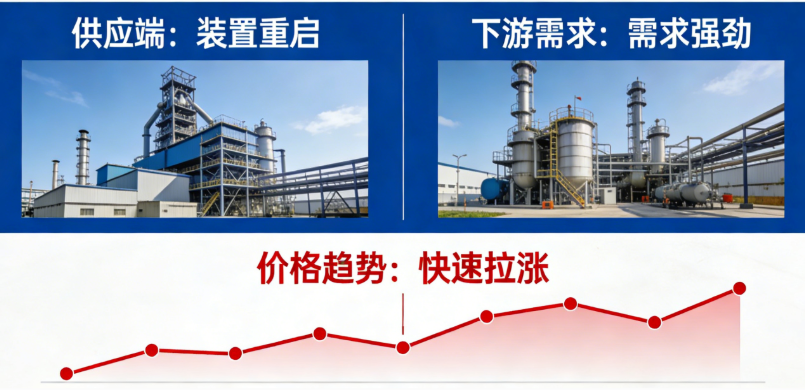
Recently, the domestic bisphenol A market has shown strong performance, with major producers significantly raising their quotes after the restart of facilities, reflecting a situation of supply shortage or robust downstream demand.
Fuyu Petrochemical’s Plant Restart Triggers Price Surge: On March 26, Shandong Fuyu Petrochemical Co., Ltd. restarted its 180,000-ton-per-year phenol-acetone plant. While producing premium-grade products, the company immediately raised the price of bisphenol A by RMB 500 per ton to RMB 11,500 per ton. Market analysts believe that, although supply increases will be limited during the initial restart phase, the price hike directly reflects robust end-user demand and low inventory levels.
Qingdao Bay Chemical’s quotation rose: In the same month, another major producer, Qingdao Bay Chemical, raised its quotation twice. On March 12, it increased the quotation for its 240,000-ton-per-year facility by RMB 3,300 per ton to RMB 12,800 per ton. By March 30, the facility remained in molten state, with the quotation maintained at the high level of RMB 12,000 per ton.
Construction of production capacity: Major projects are being advanced continuously.
Amid high prices, domestic bisphenol A capacity expansion projects are proceeding as planned.
On March 31, the Huizhou Polycarbonate Project of CNOOC & Shell (including a 240,000-ton-per-year Bisphenol A plant and a 220,000-ton-per-year Diphenyl Carbonate plant) announced the shortlisted bidders for its engineering contract. Companies including Anhui Fucan Construction Engineering Co., Ltd. have been shortlisted, marking steady progress in the construction of this major project.
📜 Policies and Environmental Protection: Comprehensive Regulatory Tightening
Unlike the market's enthusiasm, policy-level control over the environmental and health risks of BPA is rapidly tightening, which will be a key variable affecting the long-term development of the industry.
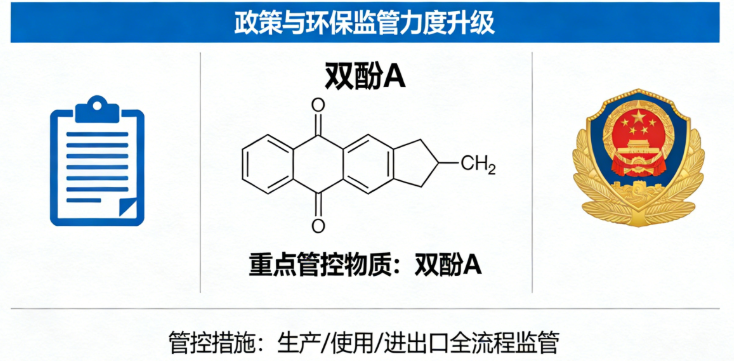
China's national "Priority Controlled Chemicals List" officially includes Bisphenol A: In January 2026, the Ministry of Ecology and Environment and the National Disease Control and Prevention Administration jointly issued the "Priority Controlled Chemicals List (Third Batch)," formally adding Bisphenol A to the list. The authorities stated that Bisphenol A, as an endocrine-disrupting chemical, poses potential "environmental and health risks," and required relevant enterprises to upgrade their production processes and develop alternative substances.
Jiangsu Province has issued the strictest local supplementary list: On March 3, 2026, the Jiangsu Provincial Department of Ecology and Environment released the "Jiangsu Province's Supplementary List for Key Controlled New Pollutants (First Batch)", adding bisphenol A as a substance of particular concern beyond the 14 categories of controlled substances at the national level, forming a "14+1" control situation. The new regulations set strict limits on drinking water and wastewater discharges for enterprises involving bisphenol A, and require the strengthening of bisphenol A emission monitoring and accounting in environmental impact assessments and discharge permits.
🌍 Global Perspective: Divergent Regulatory Attitudes
The United States maintains its current usage policy: In contrast to increasingly stringent regulatory trends worldwide, the U.S. Food and Drug Administration (FDA) announced on April 1, 2026, that it will not ban the use of bisphenol A (BPA) in food and beverage packaging. This means BPA will continue to be present in U.S. dietary packaging, highlighting significant differences in regulatory approaches across markets.
Overall, the bisphenol A sector is currently caught in a tug-of-war between short-term market tailwinds (price increases and capacity expansion) and long-term policy headwinds (stricter environmental regulations). Going forward, as environmental regulations are implemented and enforced, production costs and operational barriers for relevant enterprises are expected to rise further.
【Copyright and Disclaimer】The above information is collected and organized by PlastMatch. The copyright belongs to the original author. This article is reprinted for the purpose of providing more information, and it does not imply that PlastMatch endorses the views expressed in the article or guarantees its accuracy. If there are any errors in the source attribution or if your legitimate rights have been infringed, please contact us, and we will promptly correct or remove the content. If other media, websites, or individuals use the aforementioned content, they must clearly indicate the original source and origin of the work and assume legal responsibility on their own.
Most Popular
-
Massive Loss of $960 Million! Wansheng Co., Ltd. Sees Rising Revenue But Declining Profits—Why Did the Phosphorus-Based Flame Retardant Leader Falter?
-
Breakthrough! 13.6-million-ton new giant emerges as world’s fourth-largest polyolefin producer, reshaping industry landscape
-

BASF's $8.7 Billion Zhanjiang Site Fully Operational, Covestro, SABIC, Arkema and Other Plastics Giants Double Down on China
-

Deadly Impact: Hormuz Strait Blockade Sparks Shortage of Plastic Raw Materials, Threatening Shutdowns at Japanese and Korean Chemical Plants
-

Domestic PBE Breakthrough, Polyolefin Modification Industry to Break the Impasse


