Eighteen Point Five Billion Dollars! Emerging Industry Rises, PEEK Enters Golden Era
On March 27, Jiangsu Taicang Shuangchen Science and Technology Valley welcomed its first batch of project startups at the Xin Su Workshop. Among them, the "Houhe Medical" project invested by Jilin Zhongyan High-polymer Materials Co., Ltd. has attracted attention. The project plans to build a modern production line for medical-grade PEEK materials in the form of rods and plates, introducing international advanced automated equipment and testing instruments, and building a smart factory to support the development of the park's life health industry cluster. The launch of this project marks a new breakthrough in the industrialization of high-end domestic PEEK materials.
Market scale continues to expand steadily.
PEEK material offers exceptional properties such as high strength, heat resistance, chemical corrosion resistance, and low density. Its specific strength is approximately eight times that of aluminum alloy, while its density is less than half that of aluminum alloy. These characteristics enable significant weight reduction while meeting strength requirements, making it an ideal solution for "replacing metal with plastic" and lightweighting.
Under the context of "replacing steel with plastic" and lightweight trends, PEEK is recognized as one of the thermoplastic plastics with the best overall performance, and is entering a period of rapid development. In recent years, the market scale has been steadily expanding. In terms of market data, different institutions have varying statistical approaches: in 2024, the global demand for PEEK was 10,203 tons, representing a 13.8% year-on-year increase, with a market size of approximately $218 million. It is expected to reach $344 million by 2031, with a compound annual growth rate (CAGR) of 6.8% between 2025 and 2031. Another data source shows that the global polyetheretherketone (PEEK) market size was approximately $900 million in 2024, with a 5% year-on-year growth. It is expected to increase to $1.23 billion in 2025 and reach $1.85 billion by 2030, with an average annual growth rate of 8.4%.
According to regional distribution, the European market accounted for 38% in 2024, the Asia-Pacific market for 37%, and the North American market for 25%. Europe, supported by its advanced automotive industry and strict medical regulatory standards, holds a leading position. Germany focuses on the application of precision automotive components, while the UK has become a core of technology and production due to the presence of Victrex. The Asia-Pacific region, driven by the rapid growth of industries such as electronic information, automotive, and aerospace, has become a global growth engine. China's performance has been particularly outstanding, becoming a core growth pole in the global PEEK industry. In 2024, China's PEEK production reached 3,812 tons, an increase of 22.2% year-on-year, with a capacity of 25,000 tons, representing a 212% growth compared to 2020. The domestic production rate increased from 15% to 47%, gradually breaking the monopoly of international giants. From 2018 to 2024, China's PEEK demand continued to grow, rising from 1,100 tons in 2018 to 3,904 tons in 2024, with an average annual growth rate of 23.5%. In 2024, China's PEEK market size was approximately 1.92 billion yuan, accounting for 41.8% of the global market. It is expected that the Chinese market size will exceed 2.2 billion yuan, reaching 5 billion yuan by 2030, with an average annual growth rate of 17.8%.
"One Superpower, Multiple Strong Powers" competitive landscape
The production technology for PEEK is highly challenging, and the construction and customer validation cycles are long. The industry presents a "one superpower, multiple strong players" competitive landscape, with international giants dominating the market through technological monopolies and brand advantages. Currently, the major global PEEK producers include a few multinational companies such as Victrex from the UK, Evonik from Germany, and Solvay from Belgium. These companies, with their long-term technological accumulation, comprehensive global supply chains, and certifications for high-end markets, collectively hold over 60% of the global market share. Especially in high-end product areas such as medical and aerospace grades, these giants have a clear monopolistic advantage.
In addition to the aforementioned international giants, other manufacturers—such as Japan’s Daikin Industries and Taiwan’s Formosa Plastics—have also entered the PEEK market, though their global market shares remain relatively small. In recent years, with growing domestic demand, Chinese domestic enterprises have rapidly advanced in the PEEK field, accelerating the localization of PEEK production. Currently, major PEEK producers in China include Jilin Zhongyan High-Performance Polymer Co., Ltd., Weihua Composite Materials Co., Ltd., Guangdong Wonder New Materials Co., Ltd., and Anhui Kaisheng New Materials Co., Ltd. Among them, Jilin Zhongyan has achieved breakthroughs in PEEK polymerization technology and has become the first Chinese company to realize large-scale, thousand-ton annual production of PEEK, thereby breaking foreign monopolies on high-end PEEK materials. It is now ranked as the world’s fourth-largest PEEK producer.
The table below summarizes the production capacity and market position of some of the world's major PEEK producers:
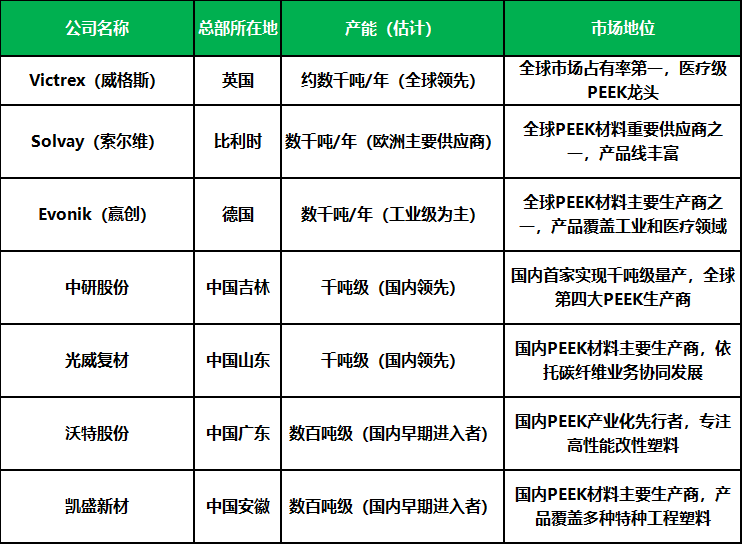
Note: The above capacity is an estimated value, specific details should refer to the announcements of each company.
Currently, the total share of domestic enterprises in the global PEEK market is about 18%, and their share in the domestic market has increased to about 30%. With technological breakthroughs and capacity expansion, it is expected that by 2030, the global market share of domestic enterprises will further increase to around 28%. From a competitive strategy perspective, international giants focus on R&D and deep cultivation of the high-end market, while domestic enterprises seize the mid-to-low-end market with cost advantages, and gradually transform towards high-end through process optimization and downstream collaborative development. Overall, the PEEK industry is moving from past overseas monopolies to a diversified competitive landscape, and the rise of local enterprises will bring new vitality to the market.
Demand resonance enters an explosive growth phase.
Overall, in recent years, the global downstream consumption structure of PEEK has shown the following trends: electronics and electrical applications remain dominant, while automotive and medical sectors are rapidly emerging, and aerospace is steadily growing. In the future, as demand for high-performance materials increases across various industries, the application proportions of PEEK across different sectors may undergo further adjustment and optimization.
In recent years, driven by the rise of emerging industries such as humanoid robots and new energy vehicles, coupled with domestic technological breakthroughs and capacity expansion, PEEK is experiencing a golden period of explosive growth fueled by surging demand across multiple sectors. The Chinese market is more heavily skewed toward high-growth emerging industries, differing from the global market, which remains dominated by traditional transportation and aerospace sectors, thus demonstrating stronger growth momentum.
In addition to traditional application areas, PEEK material has been continuously exploring new markets in recent years, demonstrating broad application prospects. The expansion of these new applications is attributed not only to the improvement of PEEK's performance, but also to technological advancements in related industries and changes in market demand.
Humanoid Robots: With the advancement of artificial intelligence and robotics technologies, humanoid robots are emerging as a new growth driver. Critical components of robots—such as precision gears and bearings—require a combination of high strength, excellent wear resistance, and lightweight properties, all of which align closely with the characteristics of PEEK material. In humanoid robots, PEEK can be used to manufacture joint bearings, gears, and transmission components, thereby reducing the robot’s overall weight while maintaining superior mechanical performance. Experts note that the development of humanoid robots is expected to open a new growth trajectory for PEEK. Currently, some domestic and international robotics companies have begun experimenting with PEEK for robot joints and transmission systems to enhance flexibility and durability.
Since 2025, the market attention on PEEK materials for humanoid robots has surged dramatically. Tesla plans to achieve a production capacity target of 500,000 Optimus humanoid robots by 2027, with each robot using about 3.9 kg of PEEK + carbon fiber composite materials. Tesla alone will drive a demand of 1,950 tons of PEEK, accounting for 13% of the current global capacity. Moreover, some industry opinions suggest that the PEEK material requirement for a single humanoid robot can reach 5-10 kg. If Tesla reaches its mass production target of 500,000 units, it will drive a demand of 3,250-6,500 tons; in the long term, if global humanoid robot sales reach 600,000 units by 2030, the PEEK demand will exceed 1,170 tons. Domestic enterprises have already taken the lead in breakthroughs, not only mass-producing PEEK precision gears but also completing the adaptation for robot joints of companies like Tesla and Unitree, fully demonstrating the rapid advancement of PEEK materials from demand expectations to actual application. The massive PEEK market centered around humanoid robots is accelerating its formation.
Energy storage equipment, such as electric vehicle batteries and energy storage power stations, demands materials with high heat resistance, excellent electrical insulation, and lightweight properties. PEEK materials can be used to manufacture structural components, insulating parts, and connectors within battery packs, achieving weight reduction while meeting performance requirements. With the rapid global expansion of the energy storage market, the application of PEEK in battery thermal management and high-voltage electrical connections is expected to gradually increase. In the future, as energy storage technologies continue to advance and costs decline, the market potential for PEEK in energy storage equipment will further expand.
In the field of advanced manufacturing and industry: In the areas of advanced manufacturing equipment, aerospace manufacturing, petrochemical industry, etc., PEEK is being used to manufacture some new types of components and tools. For example, in aerospace manufacturing, PEEK composites can be used to make aircraft skins, radar domes, and other structural parts, to reduce weight and improve fatigue resistance. In the petrochemical industry, PEEK seals and valve components, due to their excellent corrosion resistance and high-temperature performance, are used in equipment under harsh conditions. In addition, in high-end machinery and precision instruments, high-precision PEEK machined parts (such as precision bearing cages, transmission gears) are also beginning to be applied. As "advanced manufacturing" and "Industry 4.0" advance, the application boundaries of PEEK in these fields are continuously expanding, bringing new solutions to the industry.
Additive Manufacturing and 3D Printing: The development of additive manufacturing technology has provided a new application stage for PEEK materials. In recent years, the research and development of 3D printing-specific PEEK materials have made breakthroughs, enabling the direct manufacturing of high-performance components with complex shapes. 3D printed PEEK materials offer high precision and the advantage of forming complex structures, and have been successfully applied in medical implants (such as customized orthopedic implants) and aerospace components. Through 3D printing, PEEK can be customized according to the shape of a patient's bones, achieving "tailored" treatment; it can also manufacture complex parts in the aerospace industry, shortening the development cycle. With the maturity of 3D printing technology and the reduction in costs, the application of PEEK in additive manufacturing will become more widespread, becoming an important means to drive industry innovation.
The medical market: PEEK has a stiffness closer to human bones compared to metal materials. As a non-metallic material, PEEK does not produce artifacts in CT and MRI scans, which does not affect medical imaging diagnosis. PEEK has excellent processability, and after personalized design and processing, it can achieve a high degree of fit with the patient's skull, achieving aesthetics while eliminating the patient's psychological burden. Currently, PEEK products have been successfully applied in cases including artificial spinal implants, artificial joints, and bone repair products. In addition, PEEK can withstand 3000 cycles of high-pressure sterilization at 134°C, which meets the high sterilization requirements and repeated use of surgical and dental equipment manufacturing. Combined with its anti-creep and hydrolysis resistance properties, it can be used to manufacture various medical devices that require high-temperature steam sterilization.
According to the prospectus of Zhongyan Co., Ltd., as of 2018, titanium-based products accounted for approximately 93% of the market share in China’s cranial repair field, while the penetration rate of PEEK materials remained relatively low. Despite PEEK products’ ex-factory and end-user prices being nearly ten times higher than those of titanium products, the PEEK cranial repair market size has grown rapidly in recent years, with a CAGR exceeding 80% from 2017 to 2019, and its penetration rate has risen swiftly. In 2020, Kangtuo Medical’s PEEK product sales share surpassed that of titanium-based products, reflecting PEEK’s rapid substitution of titanium in the medical field.
Despite the fact that the ex-factory price and end-user price of PEEK products are nearly 10 times higher than those of titanium, the market size still managed to grow at a CAGR of over 80% from 2017 to 2019. This fully demonstrates that in the medical and health field, performance advantages are far more important than cost, and doctors and patients are willing to pay a high premium for better clinical outcomes.
PEEK industry is standing at the of a new round of development. Driven by the high-end manufacturing and lightweight trends, the PEEK material market scale will continue to expand, and the application fields will keep expanding. Although there are still challenges such as cost and certification, with technological advancements and the rise of domestic enterprises, these bottlenecks are expected to be gradually overcome. Experts generally hold an optimistic view on the future of the PEEK industry, believing that it is expected to break through in more fields, making an important contribution to the upgrading of global manufacturing and the development of new materials industry.
【Copyright and Disclaimer】The above information is collected and organized by PlastMatch. The copyright belongs to the original author. This article is reprinted for the purpose of providing more information, and it does not imply that PlastMatch endorses the views expressed in the article or guarantees its accuracy. If there are any errors in the source attribution or if your legitimate rights have been infringed, please contact us, and we will promptly correct or remove the content. If other media, websites, or individuals use the aforementioned content, they must clearly indicate the original source and origin of the work and assume legal responsibility on their own.
Most Popular
-

BASF's $8.7 Billion Zhanjiang Site Fully Operational, Covestro, SABIC, Arkema and Other Plastics Giants Double Down on China
-

Deadly Impact: Hormuz Strait Blockade Sparks Shortage of Plastic Raw Materials, Threatening Shutdowns at Japanese and Korean Chemical Plants
-
Massive Loss of $960 Million! Wansheng Co., Ltd. Sees Rising Revenue But Declining Profits—Why Did the Phosphorus-Based Flame Retardant Leader Falter?
-
SABIC Declares Force Majeure on Styrene Monomer and Methanol Production; Middle East Chemical Operations Halted
-

Domestic PBE Breakthrough, Polyolefin Modification Industry to Break the Impasse