



Cracking the Medical Packaging Circularity Dilemma! ISO 11607-Compatible Recycled Material Solution
The use of recycled materials in packaging is nothing new; such applications have existed since the 1980s. After the introduction of the Resin Identification Code in 1988 and the widespread adoption of plastic recycling systems across the United States, fast-moving consumer goods companies began incorporating recycled content into their new packaging.
In the 1990s, the U.S. Food and Drug Administration (FDA) approved the use of recycled plastics for food packaging. However, for patient safety considerations, medical device packaging still requires the use of entirely new, virgin materials.
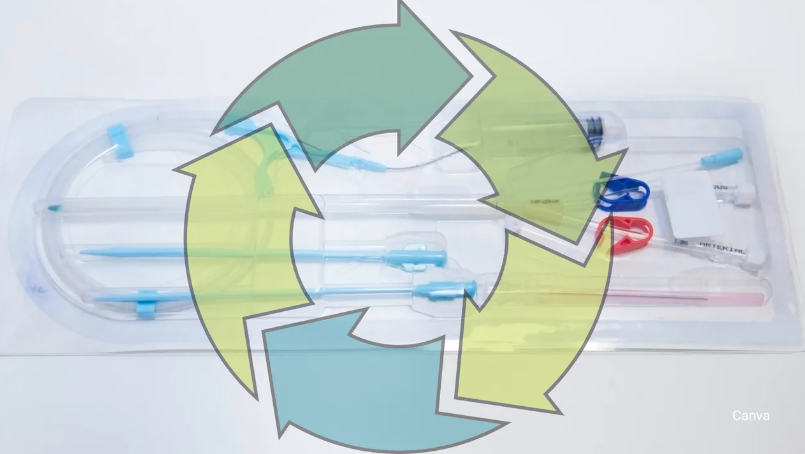
Clause 5.1.5 of the ISO 11607 international standard for terminally sterilized medical device packaging explicitly states:
Only recently has a traceability system for recycled materials, which are required for medical device packaging and comply with the ISO 11607 standard, been realized. Currently, two medical packaging recycled material solutions have been commercially applied:
Materials made from advanced recycled or alternative technology feedstocks that have been certified for mass balance.
Industrial Post-Industrial Recycled (PIR) materials with full traceability.
Both technologies can respond to the global healthcare system’s demand for sustainable packaging.
Standards and market expectations are misaligned.
Post-pandemic, waste generated from medical packaging has drawn significant attention, prompting numerous countries and regions to introduce relevant regulations and guidance documents. However, most of these standards are largely based on requirements for consumer packaging, leading the market to increasingly expect sterile barrier medical packaging to incorporate a certain percentage of post-consumer recycled (PCR) content. In some European tender projects, failure to meet this requirement results in substantial financial penalties.
However, according to ISO 11607 standards, the use of post-consumer recycled (PCR) materials is currently not applicable to medical packaging due to strict traceability requirements.
Despite this contradiction, the medical market still hopes to introduce regenerated components in the packaging.
How should the industry respond? And how can medical device manufacturers apply recycled materials to medical packaging, particularly sterile barrier systems?
Medical device manufacturers face two regenerative packaging solutions
The following are two commercially available regenerative material solutions currently accessible to medical device manufacturers:
Sources and Traceability Implementation of Post-Industrial Recycled (PIR) Materials
The current medical-grade extrusion and thermoforming processes generate scrap materials, which were previously mostly recycled for non-medical applications or sold to third parties. Now, it is only necessary to redirect the existing scrap back into the medical-grade material production process. The cutting scrap, frame material, and changeover scrap generated during the thermoforming process can all be collected and mechanically recycled.
To supply packaging products compliant with ISO 11607, medical packaging thermoforming and extrusion enterprises must establish a robust quality management system to ensure full traceability of all materials. Leveraging the existing system, only traceability management for reprocessed scrap material returning to the extrusion stage needs to be added. Extrusion enterprises treat such reprocessed scrap as incoming material and maintain continuous traceability throughout the entire extrusion and thermoforming processes; as long as traceability remains uninterrupted, this recycling loop can be repeated.
How to ensure pollution risk and material performance?
When it comes to mechanically recycled materials for medical packaging, medical device manufacturers are primarily concerned with biocompatibility and potential contamination risks. These issues can be managed through the following approaches:
Incorporate industrial waste material suppliers into the extrusion company's quality management system, treating them as raw material suppliers.
Conduct pollution and chemical property testing on post-industrial recycled materials to ensure equivalence with virgin materials.
Based on the above data and material specification document, the medical device manufacturer may evaluate the material structure and verify its conformity with design and test specifications in accordance with ISO 11607.
Currently, medical-grade recycled PETG trays commonly use a three-layer co-extruded structure: virgin PETG / post-industrial recycled (PIR) PETG / virgin PETG. Both the product contact layer and the heat-seal layer still utilize virgin PETG, and maintaining this structure can simplify the regulatory approval process for medical device manufacturers.
Does mechanical recycling lead to material degradation and affect usage performance?
In short, all input and output materials in the extrusion and thermoforming processes must be equivalent in performance to virgin PETG. Prior to market launch, extrusion companies must conduct comprehensive testing to verify that their processes and products maintain technical specifications consistent with those of virgin PETG.
Mechanical recycling indeed causes polymer degradation, and the material may ultimately fail to meet virgin material standards. However, adopting a “virgin + recycled” sandwich structure, combined with full-process traceability and virgin-grade performance testing, ensures material compliance and conformity.
This makes medical-grade industrial post-consumer recycled materials an excellent choice for medical device manufacturers, enabling their inclusion in compliant tray material lists. Mechanically recycled materials—previously destined for landfills or consumer goods—can now be used in medical packaging, thereby closing the loop by transforming medical packaging waste into new medical packaging. This circular approach represents a core requirement of the healthcare system for medical device manufacturers.
Recycled Material Procurement Channels
Once a robust control system is established, recycled packaging materials will meet the traceability requirements of ISO 11607 and exhibit performance equivalent to virgin PETG.
Regarding mass balance-certified advanced recycled materials, DuPont’s Tyvek Renewable Attribution (RA) material and Eastman’s Eastar Renew 6763 resin have already been mentioned above. In addition, ExxonMobil has launched its Exxtend advanced recycling technology for the medical market, while SABIC’s TruCircle portfolio offers certified circular polymers made from advanced (chemical) recycling of mixed plastic waste, applicable across multiple industries.
【Copyright and Disclaimer】This article is the property of PlastMatch. For business cooperation, media interviews, article reprints, or suggestions, please call the PlastMatch customer service hotline at +86-18030158354 or via email at service@zhuansushijie.com. The information and data provided by PlastMatch are for reference only and do not constitute direct advice for client decision-making. Any decisions made by clients based on such information and data, and all resulting direct or indirect losses and legal consequences, shall be borne by the clients themselves and are unrelated to PlastMatch. Unauthorized reprinting is strictly prohibited.
Most Popular
-
Massive Loss of $960 Million! Wansheng Co., Ltd. Sees Rising Revenue But Declining Profits—Why Did the Phosphorus-Based Flame Retardant Leader Falter?
-
Breakthrough! 13.6-million-ton new giant emerges as world’s fourth-largest polyolefin producer, reshaping industry landscape
-

BASF's $8.7 Billion Zhanjiang Site Fully Operational, Covestro, SABIC, Arkema and Other Plastics Giants Double Down on China
-

Deadly Impact: Hormuz Strait Blockade Sparks Shortage of Plastic Raw Materials, Threatening Shutdowns at Japanese and Korean Chemical Plants
-
Domestic PBE Breakthrough, Polyolefin Modification Industry to Break the Impasse


