



Coupling agent modified calcium carbonate process, equipment, and applicable scope
The coupling agents mainly used for the surface modification of calcium carbonate are titanate coupling agents and aluminate coupling agents, or compound coupling agents. Calcium carbonate treated with coupling agents (including precipitated calcium carbonate and ground calcium carbonate), in addition to being used as functional fillers for rigid polyvinyl chloride, is also widely used as fillers and pigments in adhesives, inks, coatings, and other applications.
1. Titanium ester coupling agent modified calcium carbonate
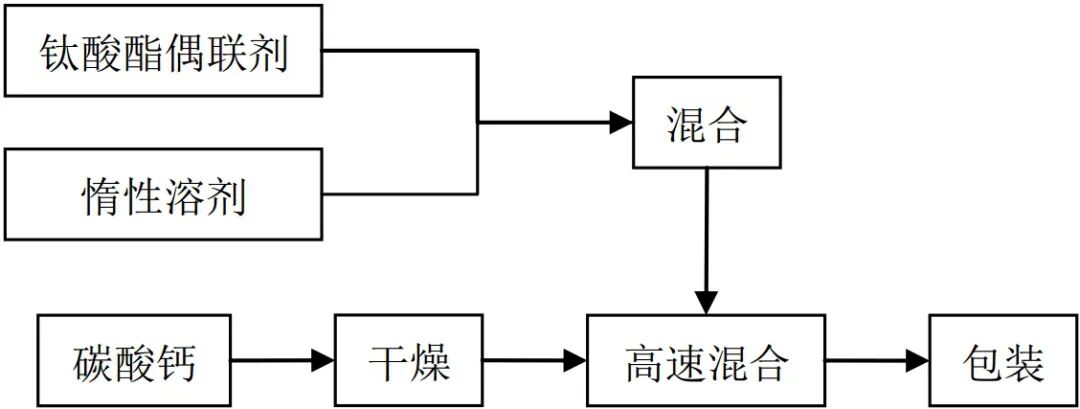
Process flow for dry surface coating modification using titanate coupling agents.
To improve the uniformity of the interaction between the titanate coupling agent and calcium carbonate, inert solvents such as liquid paraffin (white oil), petroleum ether, transformer oil, and anhydrous ethanol are generally used for dissolution and dilution.
After being mixed with an inert solvent, the titanate coupling agent is introduced into a high-speed mixer by spraying or dropwise addition, so that it can be more effectively dispersed and mixed with the calcium carbonate particles for surface chemical coating. When a continuous surface modification device is used, the titanate coupling agent may also be applied without prior dilution with a solvent.
The dosage of titanate coupling agent depends on the particle size and specific surface area of calcium carbonate, generally ranging from 0.5% to 3.0%. The drying temperature of calcium carbonate should be kept below the flash point of the coupling agent as much as possible, generally at 100–120°C.
Calcium carbonate treated with a titanate coupling agent has good compatibility with polymer molecules. Meanwhile, because the titanate coupling agent can form molecular bridges between calcium carbonate molecules and polymer molecules, it enhances the interaction between organic polymers or resins and calcium carbonate, thereby significantly improving the mechanical properties of thermoplastic composites and other materials, such as impact strength, tensile strength, flexural strength, and elongation.
2. Calcium carbonate modified with aluminate coupling agent
Aluminate coupling agents have been widely used in the surface treatment of calcium carbonate and in the processing of filled plastic products, such as PVC, PP, PE, and filler masterbatches.
Research shows that lightweight calcium carbonate treated with aluminum stearate significantly reduces the viscosity of the calcium carbonate/liquid paraffin mixture, indicating that the modified calcium carbonate has good dispersibility in organic media.
In addition, surface-modified activated calcium carbonate can significantly improve the mechanical properties of CaCO₃/PP (polypropylene) blends, such as impact strength and toughness.
3. Composite Coupling Modified Calcium Carbonate
The composite coupling system is a process based on calcium carbonate coupling agents, integrating other surface treatment agents, crosslinking agents, and processing modifiers to comprehensively treat the surface of calcium carbonate.
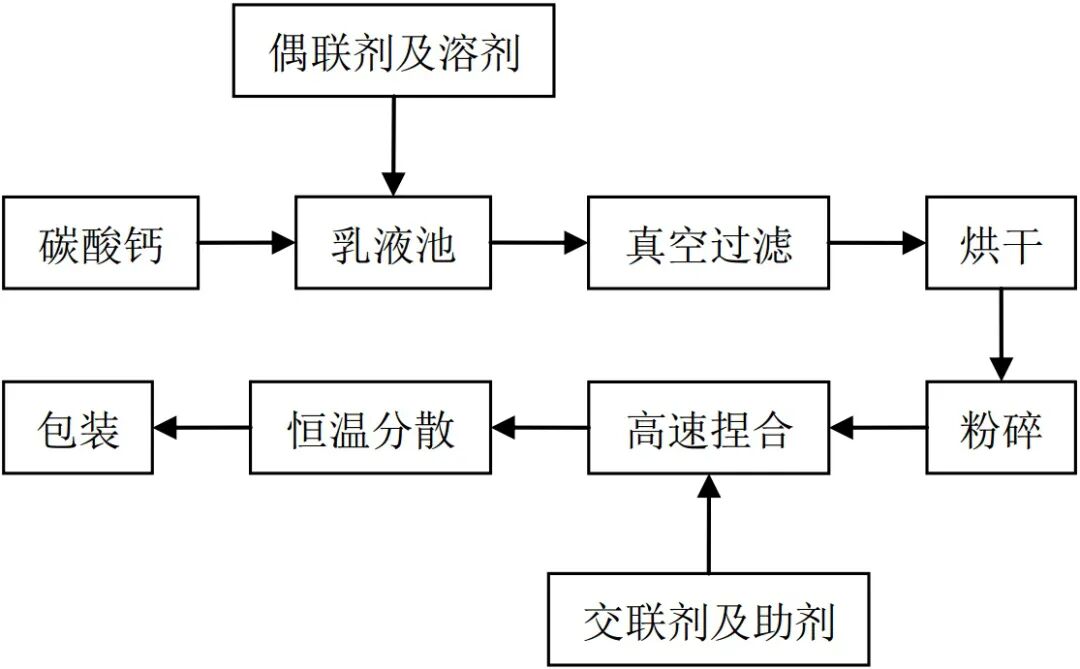
Process Flow of the Calcium Carbonate Composite Coupling Modification System
The coupling agents and various additives in composite coupling systems are described as follows:
Titanate coupling agents are mostly in liquid form and disperse easily, but they are usually darker in color and are therefore unsuitable for products requiring high whiteness.
Stearic acid. Treating calcium carbonate with stearic acid alone is not very effective. Treating calcium carbonate with a coupling agent alone is relatively costly. The combined use of stearic acid and a titanate coupling agent can achieve a good synergistic effect. The addition of stearic acid basically does not affect the coupling action of the coupling agent. At the same time, it can reduce the amount of coupling agent used and lower production costs.
The crosslinking agent bismaleimide. In the composite coupling agent system, the use of a crosslinking agent can enable inorganic fillers to be tightly bonded to the matrix resin through crosslinking technology, further improving the mechanical properties of the composite material. This is difficult to achieve with the surface treatment of “Bai Yanhua” or simple titanate coupling agents.
Processing modifier-80 resin, etc. Various processing modifiers are mainly polymer compounds. Processing modifiers can significantly improve the melt flowability and heat deformation properties of resins, as well as the surface gloss of products.
To ensure that the surface of all calcium carbonate particles is coated with a layer of coupling agent molecules, the spraying or dripping method can be replaced with emulsion impregnation, followed by filtration, drying, and pulverization, and then high-speed kneading (mixing) with the crosslinking agent and other additives to achieve uniform dispersion.
In summary, the main components of the calcium carbonate composite coupling system are calcium carbonate and titanate coupling agents. The titanate coupling agent plays the primary role; on this basis, the addition of crosslinking agents, surfactants, processing modifiers, and other additives can further enhance the surface activity of calcium carbonate fillers, increase the filler loading, and improve the performance of the composite material.
【Copyright and Disclaimer】The above information is collected and organized by PlastMatch. The copyright belongs to the original author. This article is reprinted for the purpose of providing more information, and it does not imply that PlastMatch endorses the views expressed in the article or guarantees its accuracy. If there are any errors in the source attribution or if your legitimate rights have been infringed, please contact us, and we will promptly correct or remove the content. If other media, websites, or individuals use the aforementioned content, they must clearly indicate the original source and origin of the work and assume legal responsibility on their own.
Most Popular
-

A Look at the Material Suppliers Behind SpaceX
-

Government's Triple Action, Enterprises' Three Arrows in Five Days, Semiconductor Reshuffle! What Signal Does Japan's Chemical Industry Release?
-

Next-generation motors of new energy vehicles: Single-Round Thousand Horsepower, Replacing Brakes, How Powerful Are They?
-
Ethylene: Production Capacity Accelerates Expansion, Global Industry Landscape Is Being Reshaped
-
Fire breaks out at jiangsu meiside!


