Biodegradable Plastic Sector Sees Slight Fluctuations, Driven Forward by Policy And Technology Dual Engines
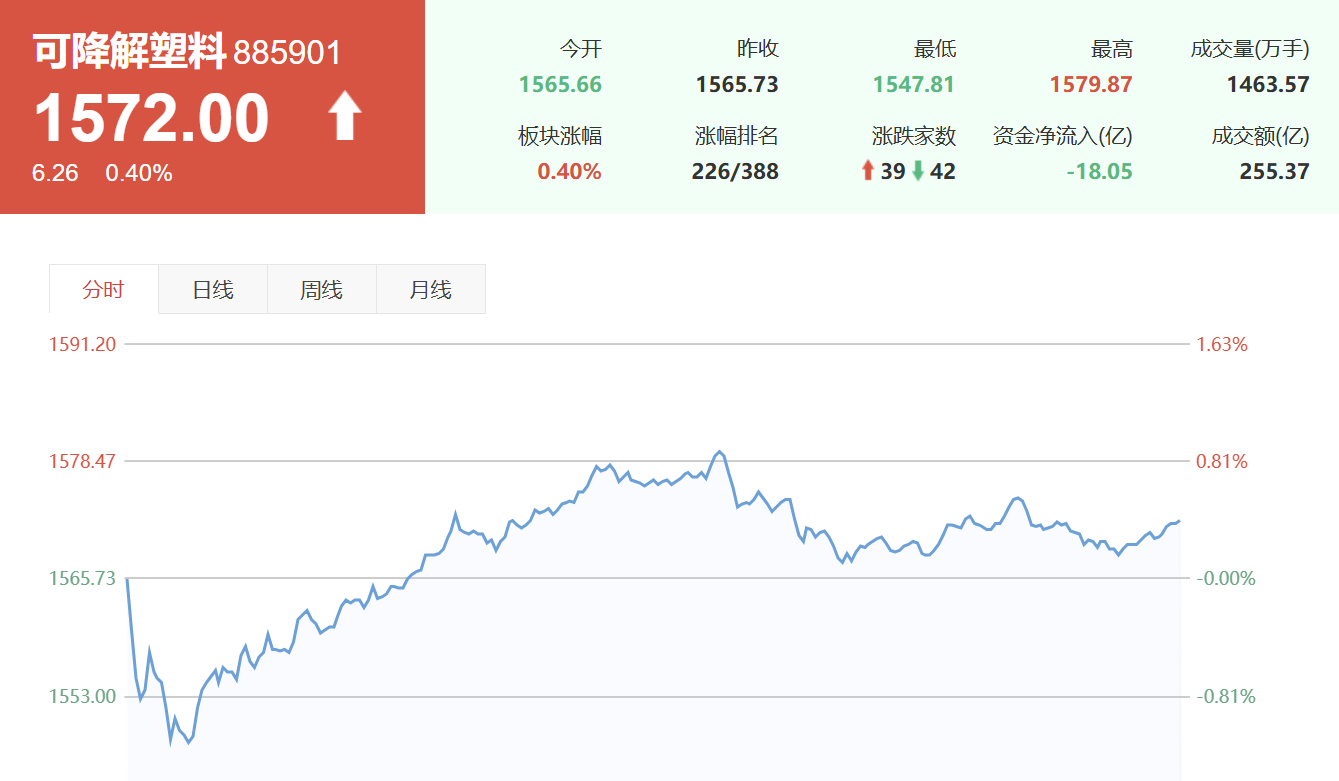
On June 16, the biodegradable plastics sector as a whole showed a volatile consolidation trend. The Wind Biodegradable Plastics Concept Index closed at 2,314.64 points, down 0.37% from the previous period; the Tonghuashun Biodegradable Plastics (885901) Index closed at 1,573.44 points, up slightly by 0.52%. Within the sector, 41 stocks rose and 39 fell, with total turnover reaching RMB 22.268 billion.
Individual stock performance has clearly diverged.Jushi Chemical rose sharply by 14.87%, leading the sector; Wangzi New Material hit the daily limit up, rising 10.01%; Shuangxing New Material gained 9.97%; and Huitong Shares rose 6.92%. Kingfa Sci. & Tech. rose 6.12% yesterday, with trading volume reaching RMB 1.368 billion. Huayang New Material rose 1.64%, with trading volume of RMB 64.0523 million. The company owns a 60,000-ton/year PBAT biodegradable new materials project and a 20,000-ton/year biodegradable plastic products project. Changhong High-Tech rose 1.03%; its first phase of the 600,000-ton/year fully biodegradable thermoplastic industrial park project, with 120,000 tons/year, is ready for production. On the other hand, Intco Recycling fell 1.30%, and Cathay Biotech fell 1.96%.
Positive signals are coming from the policy front.Recently, the China Express Association launched the first "Bamboo Instead of Plastic" special initiative in the express delivery industry, setting clear five-year goals for 2026-2030. The annual usage of bamboo packaging in express delivery is planned to reach no less than 200 million, 300 million, 450 million, 680 million, and 1 billion pieces respectively, with an average annual growth rate of 50%. Data shows that China produces about 45 million tons of plastic for packaging every year, and traditional plastic products take hundreds of years to decompose naturally. This initiative is expected to open new market opportunities for biodegradable materials in the express packaging sector.
At the same time, the development of biodegradable alternatives in the agricultural film sector is continuing to advance. According to the China Environment News, by the end of 2025, the actual application area of biodegradable film nationwide is expected to be less than 3 million mu, which is significantly lower than the planned target of 30 million mu. The cost of fully biodegradable film is approximately 130 to 180 yuan per mu, which is notably higher than the 60 to 70 yuan for traditional film. Industry experts are calling for strengthened top-level design and increased tax subsidies to promote the transition of bio-based agricultural films from "experimental fields" to "large-scale fields."
In terms of technological breakthroughs, the industrialization of carbon dioxide-based biodegradable materials has achieved a milestone progress.On May 29, Levima Advanced Materials successfully brought into operation in Tengzhou the world’s first 50,000-ton-per-year industrial-scale carbon dioxide-based polypropylene carbonate (PPC) production facility, filling the global gap in 50,000-ton-scale PPC industrial installations. The product offers a good balance of rigidity and toughness, excellent barrier properties, high transparency, and outstanding water-retention and moisture-preservation performance, and is fully biodegradable. In addition, Sinopec has recently achieved industrial-scale mass production of PBST fully biodegradable foaming materials, enabling applications in biodegradable mulch films, packaging films, nonwoven fabrics, and other fields.
From an industry trend perspective, China’s consumption of biodegradable plastics is projected to reach 1.86 million tons in 2026 and is expected to exceed 4.2 million tons by 2030, with a compound annual growth rate of 23.4%. With the continued advancement of policies such as “replacing plastic with bamboo,” as well as ongoing breakthroughs in new biodegradable materials technologies such as PPC, the biodegradable plastics industry is expected to maintain steady growth under the dual drivers of policy and technology.
Editor: Winnie
【Copyright and Disclaimer】This article is the property of PlastMatch. For business cooperation, media interviews, article reprints, or suggestions, please call the PlastMatch customer service hotline at +86-18030158354 or via email at service@zhuansushijie.com. The information and data provided by PlastMatch are for reference only and do not constitute direct advice for client decision-making. Any decisions made by clients based on such information and data, and all resulting direct or indirect losses and legal consequences, shall be borne by the clients themselves and are unrelated to PlastMatch. Unauthorized reprinting is strictly prohibited.
Most Popular
-

A Look at the Material Suppliers Behind SpaceX
-

Government's Triple Action, Enterprises' Three Arrows in Five Days, Semiconductor Reshuffle! What Signal Does Japan's Chemical Industry Release?
-

Next-generation motors of new energy vehicles: Single-Round Thousand Horsepower, Replacing Brakes, How Powerful Are They?
-
Ethylene: Production Capacity Accelerates Expansion, Global Industry Landscape Is Being Reshaped
-
Fire breaks out at jiangsu meiside!