



Auto Market Sees Significant Recovery in March: BYD No Longer Dominant, Changan Chery Geely Strive to Catch Up
After hitting its “darkest moment” during the February Spring Festival holiday, China’s automobile market rapidly rebounded in March.
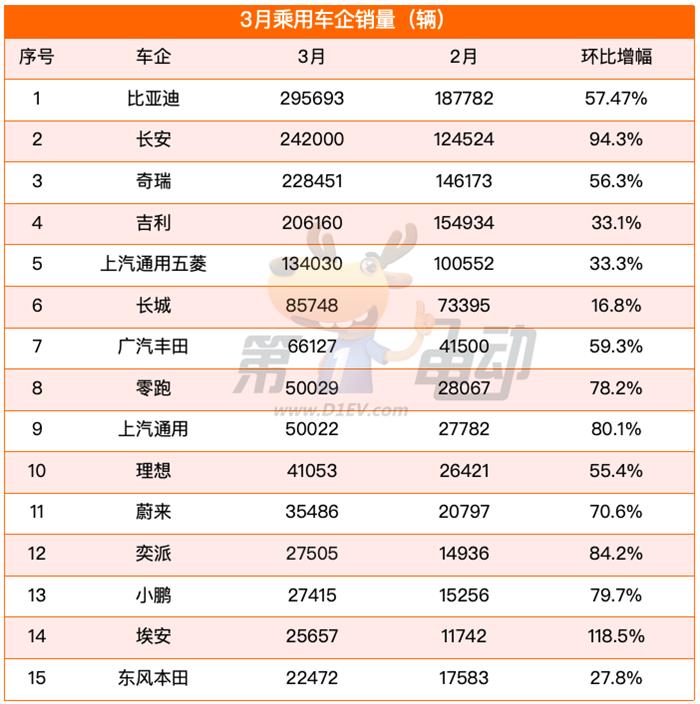
Fifteen mainstream car manufacturers all achieved positive month-on-month growth - BYD, Changan, Chery, SAIC-GM, GAC Toyota, Leapmotor, Li Auto, NIO, Yipai, and Xpeng all saw a significant increase of over 50% month-on-month.
BYD, Changan, Chery, and Geely all reported sales exceeding 200,000 units, with BYD no longer dominating alone as Changan, Chery, and Geely are visibly narrowing the gap with it.
"One dominant player" is turning into "a four-way rivalry."
In March, BYD led the market with sales of 295,693 units, representing a 57.5% month-on-month increase but a year-on-year decline of over 20%.
A closer look at the data reveals that BYD's previously dominant position is beginning to shift.
Next is Changan Automobile, with sales exceeding 24,000 units in March—a remarkable 94% month-on-month increase, the highest growth rate among leading automakers. Chery Automobile followed with over 50% month-on-month growth, ranking third, while Geely Automobile posted a 33% month-on-month increase to secure fourth place.
The combined sales of these four automakers exceeded 970,000 units. A year ago, BYD’s sales alone were nearly equal to the combined sales of the other three automakers. Now, this gap is rapidly closing.
The "one dominant player" landscape is shifting into a "four-way rivalry."
In the March data, the most surprising development was Changan’s “violent rebound”: a 94.3% month-on-month surge, new energy vehicle sales of 89,600 units—doubling month-on-month—and overseas exports exceeding 100,000 units for the first time—these three figures reflect Changan’s explosive growth trajectory in March.
Yuan 36,875 units, Deep Blue 31,742 units. These two "mid-tier brands" together accounted for nearly 70,000 units, effectively covering the mainstream market in the 100,000 to 200,000 yuan price range. This is not "single-point breakthrough," but "systematic growth."
China's Chery sales growth is not only domestic, but also overseas. In March, Chery's exports reached 148,777 units, accounting for 61.8% of total sales, and set a new record for Chinese brands in monthly exports. However, Chery's ambitions go beyond this. In March, Chery's new energy vehicle sales reached 62,564 units, an increase of 75.1% compared to the previous month. The new QQ3 model received orders exceeding 56,000 units, and exports and new energy vehicles are becoming the "two engines" driving Chery's growth.
Compared with Changan’s surge and Chery’s export miracle, Geely’s figures appear “underwhelming”—206,000 units, a month-on-month increase of 33.1%, the lowest growth rate among the top four automakers.
Yet, beneath this “ordinariness” lies another competitive edge. In March, Geely’s new energy vehicle penetration rate reached 57%; the Galaxy series achieved monthly sales of 82,700 units; Zeekr delivered 29,318 vehicles, up 90% year-on-year; and exports totaled 81,639 units, up 120% year-on-year. In Q1, Geely’s cumulative sales reached 709,000 units, ranking first among domestic brands for the quarter.
Joint venture brands: Guangfeng makes a bold breakthrough, SAIC General Motors stages a desperate comeback.
The joint-venture camp has experienced greater ups and downs than the domestic brands.
GAC Toyota sold 66,127 vehicles in March, a month-on-month increase of 59.3%. Against the backdrop of a general slowdown in Japanese joint ventures, GAC Toyota stands out as the sole highlight — in the first quarter, it sold 95,800 intelligent electric hybrid vehicles, a 12% increase year-on-year, and 16,900 BZ3 pure electric vehicles. The proportion of hybrid vehicles reached a record high of 56%, proving how important it is to choose the right technological route.
SAIC-GM sold 50,022 vehicles in March, a month-on-month surge of 80.1%. Its Ultium-platform NEVs saw a staggering 221% increase in Q1; however, the monthly sales volume of 50,000 units remains far below its peak of over 150,000 units.
Dongfeng Honda sold 22,472 units in March, a month-on-month increase of 27.8%. Its sales volume remains modest, and its growth rate is unremarkable, making it appear “lukewarm” among joint-venture automakers.
Meanwhile, former joint-venture giants such as GAC Honda, SAIC Volkswagen, and FAW-Volkswagen have yet to release their March figures—their collective silence itself is a signal.
New energy brands: Traditional top five Chinese automakers dominate, Wuling, Xpeng, Xiaomi, and Huawei's brand face pressure.
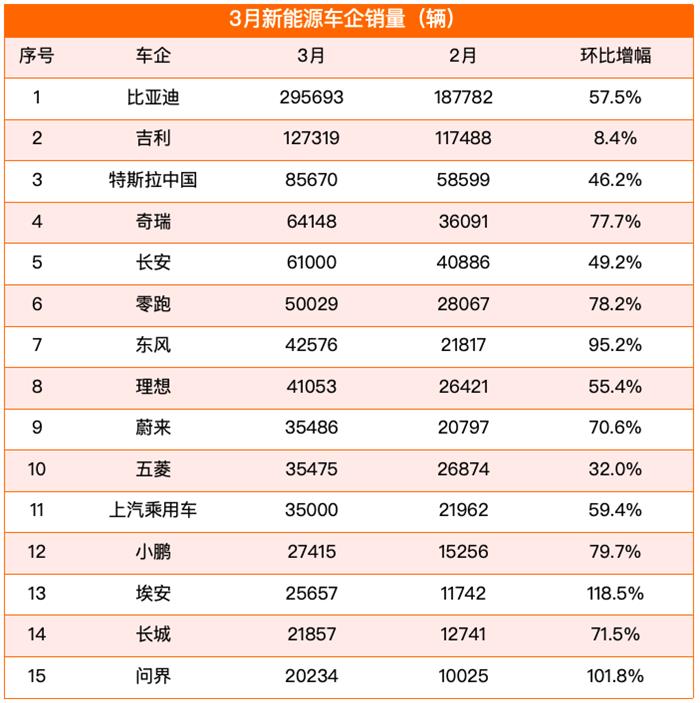
Among the top five new energy vehicle sellers in March, four spots were occupied by traditional Chinese brands—BYD, Geely, Chery, and Changan—demonstrating their strong systemic competitiveness. Tesla China sold 85,670 units, a 46.2% month-over-month increase, reclaiming a place in the top three.
Amid a general surge in sales, Wuling and XPeng are among the few brands showing weak performance. In March, Wuling’s new energy vehicle sales reached 35,475 units, representing a mere 32.0% sequential growth—the slowest among mainstream new energy vehicle manufacturers. The adjustment of the vehicle purchase tax policy has significantly impacted the Wuling Hongguang MINI EV—the once “national bestseller”—whose monthly sales plummeted from 36,000 units to just 7,133 units in February; although sales rebounded slightly in March, they remain far from recovery.
XPeng delivered 27,415 vehicles in March, up 79.7% month-over-month but down 17.4% year-over-year, making it the only leading new energy vehicle maker among its peers to experience a year-over-year decline.
AITO’s March sales volume reached 20,234 units, representing a 101.8% month-on-month increase—more than doubling—yet this growth was primarily driven by a seasonal lull during the model transition period: the upcoming AITO M6 launch has led to inventory clearance of the existing models, thereby impacting short-term delivery volumes.
Xiaomi's electric vehicles delivered over 20,000 units in March, basically consistent with February's figure, and did not make the list. However, the new SU7 model began deliveries on March 23, and within 9 days, cumulative deliveries exceeded 7,000 units, averaging nearly 800 units per day. The growth potential has not been fully reflected in March's data. With capacity ramp-up, sales in April are expected to further increase.
In conclusion Translate the above content into English, output the translation directly, without any explanation.
The recovery of the car market in March is essentially a "post-holiday recovery trend." The real signal is the change in the landscape.
A year ago, BYD’s monthly sales stood at 300,000–400,000+ units, and its “uncontested leadership” was the norm. Today, the “200,000+ Club” comprised of Changan, Chery, and Geely has taken shape, and the gaps among the top four automakers are narrowing at a visibly rapid pace.
This race is far from over. With the Beijing Auto Show approaching in late April, dozens of major new models, including the Leapmotor D19, Aito M6, and NIO ES9, will compete on the same stage, signaling the official start of a new round of ranking battles.
【Copyright and Disclaimer】The above information is collected and organized by PlastMatch. The copyright belongs to the original author. This article is reprinted for the purpose of providing more information, and it does not imply that PlastMatch endorses the views expressed in the article or guarantees its accuracy. If there are any errors in the source attribution or if your legitimate rights have been infringed, please contact us, and we will promptly correct or remove the content. If other media, websites, or individuals use the aforementioned content, they must clearly indicate the original source and origin of the work and assume legal responsibility on their own.
Most Popular
-
Massive Loss of $960 Million! Wansheng Co., Ltd. Sees Rising Revenue But Declining Profits—Why Did the Phosphorus-Based Flame Retardant Leader Falter?
-
Breakthrough! 13.6-million-ton new giant emerges as world’s fourth-largest polyolefin producer, reshaping industry landscape
-
BASF's $8.7 Billion Zhanjiang Site Fully Operational, Covestro, SABIC, Arkema and Other Plastics Giants Double Down on China
-
Deadly Impact: Hormuz Strait Blockade Sparks Shortage of Plastic Raw Materials, Threatening Shutdowns at Japanese and Korean Chemical Plants
-
Domestic PBE Breakthrough, Polyolefin Modification Industry to Break the Impasse


