



AI Robotics Technology Drives Smarter Plastic Manufacturing
AI-driven robotics and intelligent machine control are helping plastic manufacturers accelerate cycle times, reduce waste, and improve quality through real-time data and automation.
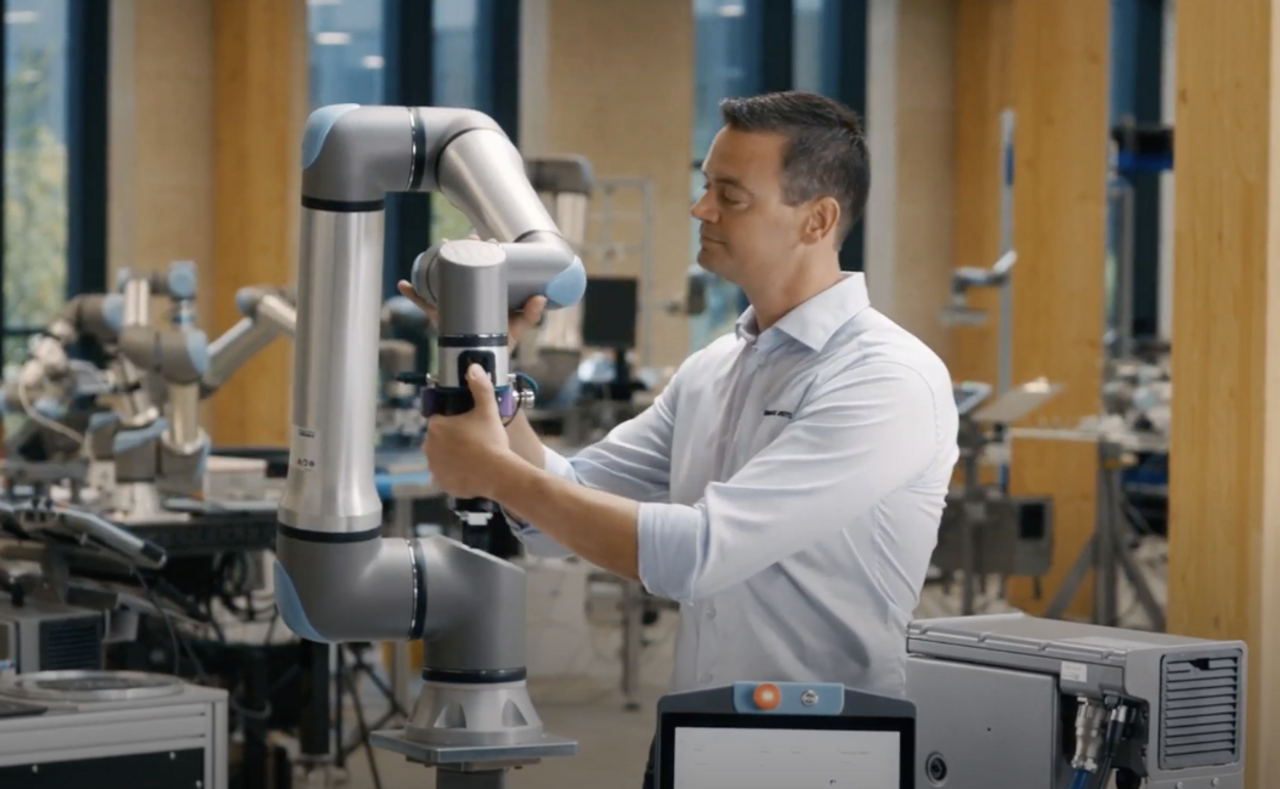
Artificial intelligence is transforming plastic manufacturing, as robot suppliers and equipment manufacturers deploy machine learning and advanced data analytics to build more agile, efficient, and sustainable production lines.
From smarter material handling to dynamic production scheduling that optimizes supply chain readiness, artificial intelligence is elevating plastic manufacturing efficiency to a new level.
Plastics equipment suppliers such as KraussMaffei, along with robotics experts like Fanuc and Universal Robots, are deploying artificial intelligence to help manufacturers better understand and optimize their operations. For example, AI-driven robots from Universal Robots (UR) are enabling various production savings, including:
-
Using UR's OptiMove motion control software, the cycle time was reduced by 40%, as the software optimizes trajectory paths more effectively than traditionally programmed robot routines.
-
When integrated with Inbolt’s robotic intelligence platform, 3D part localization is achieved in under 0.5 seconds, whereas waiting for physical alignment of parts using mechanical vibratory feeders, pneumatic grippers, or indexing tables incurs a delay of 5 to 10 seconds.
Artificial intelligence enhances the performance of robots.
Industrial robot suppliers are integrating AI-driven features into their platforms and controllers to optimize processes before production begins. AI-enabled robotics allow plastic manufacturers to gain deeper insights into how production systems perform and how process decisions impact operations.
“At FANUC, our physical AI strategy combines robotics, simulation, digital twins, and AI-driven technologies to help manufacturers evaluate production scenarios, identify inefficiencies, and validate workflows before implementing them on the factory floor,” said Amar Dhaliwal, General Manager of FANUC America’s Automation Systems Group. “By creating and testing production processes in a virtual environment, manufacturers can make more informed decisions, thereby improving overall operational efficiency and reducing costly trial-and-error during deployment.”
Dhaliwal explained that Fanuc’s physical AI strategy enables robots to “perceive their environment, make decisions, and take actions in ways that traditional fixed automation cannot achieve.” “Fanuc combines real-time robot control, AI-driven perception, simulation, and digital twins to help robots operate more effectively in dynamic manufacturing environments. AI-enabled systems can use visual and sensor data to understand what is happening around them and adapt to changing conditions.”
He went on to say that artificial intelligence not only enables robots to perform better, but also makes automation more “accessible” to human operators.
Technologies such as simulation, digital twins, AI-assisted programming, and natural language commands can reduce complexity and enable more employees to interact with automation systems. These tools do not replace personnel; instead, they enhance productivity by allowing workers to focus on higher-value activities, such as process improvement, troubleshooting, and system optimization.
Meanwhile, Universal Robots has just launched its new 7th-generation platform, which provides a physical AI infrastructure for robotic applications in plastic manufacturing.
UR’s new CB7 core controller delivers 40% more computing power in just 30% of the footprint, running the open PolyScope X operating software. UR Application Engineer Christopher Buse explains that this allows third-party AI vision and sensor algorithms to run locally at the edge, directly on the robot controller, without the need for a host PC or cloud connection.
Buse points out that plastic manufacturing processes such as injection molding, thermoforming, and blow molding often involve material variations caused by thermal shrinkage, part warpage, misalignment, or uneven gate trimming. “Traditional automation relies on rigid mechanical fixtures to hold parts in fixed positions; when parts vary, errors in loading and mold collisions can result in scrap and downtime.”
The new tool flange on the 7th-generation robot routes power, high-speed Ethernet, and safety signals directly through the robot’s internal joints. This eliminates external wiring harnesses, which in traditional narrow molding environments are susceptible to bending radius limitations, cable fatigue, or snagging.
UR partners, including Inbolt and Cognex, have developed solutions that run on the Gen 7 platform. These solutions include:
-
3D Vision Guidance and Part Localization: Inbolt offers the Inbolt Standard 3D Vision Guidance System. Using a wrist-mounted 3D camera, Inbolt compares real-time parts with 3D CAD models to locate components in six degrees of freedom (6DoF) within just 0.5 seconds. By enabling cobots to automatically adapt to warped or misaligned molded parts, Inbolt eliminates the need for rigid mechanical fixtures.
-
Quality Inspection and Defect Detection: Cognex provides 2D and 3D vision systems powered by edge learning tools. Through native PolyScope X integration, Cognex inspects molded components immediately after extraction, performs optical character recognition (OCR), verifies component placement, and instantly identifies surface defects. Detecting non-conforming parts at the mold prevents defective inventory from moving downstream, thereby reducing material waste.
In each case, the 3D camera (Inbolt) or vision camera (Cognex) is mounted directly on the robot wrist and connected directly to the internal flange Ethernet port.
“The 3D camera captures a snapshot of the scene,” explains Buse. Inbolt’s AI software runs on the edge within the CB7 controller, comparing the image with the part’s 3D CAD digital twin and calculating the exact spatial offsets in X, Y, and Z coordinates as well as roll, pitch, and yaw angles.
He added that, to achieve in-air trajectory adjustment, Inbolt “passes the calculated 6DoF offset vector directly into the UR program tree as a native script command.”
Buse states that, overall, the built-in force-torque sensing within the UR Gen 7 tool flange provides collaborative robots with a “digital sense of touch.” During tasks such as precision part insertion, machine maintenance, or nozzle trimming, the robot perceives insertion forces in real time and automatically adjusts force levels to prevent fragile plastic parts from breaking or tools from being damaged.
Machine-level artificial intelligence
Beyond the robotics phase, leveraging artificial intelligence across the entire automated plastic production ecosystem can utilize process and material data to stabilize production, improve material utilization, and reduce waste.
Markus Bauer, Managing Director of KraussMaffei Technologies, stated that KraussMaffei embeds intelligence directly into the production environment, making advanced technologies practical for everyday manufacturing.
Bauer explained that KraussMaffei is currently focusing on artificial intelligence and intelligent algorithms, primarily to optimize manufacturing processes and support production teams. With socialProduction, we have a tool that transforms large volumes of unmanageable data (data lakes) into clear actions and instructions.
He added that KraussMaffei is developing an AI assistant called “K-AI” for industrial production environments, enabling manufacturing teams to access relevant information more quickly and supporting data-driven decision-making. “Our focus is on applying artificial intelligence and intelligent algorithms, leveraging KraussMaffei’s deep process expertise directly at the machine and production process levels.”
To improve the recycling process, reduce scrap rates, and advance circular economy initiatives, KraussMaffei is elevating quality control to a new level through its autonomous quality control system. The system measures the actual part weight after each cycle and feeds the results directly back into the machine control system.
Bauer states that variations caused by changes in material density, such as those in recycled materials, additives, or fillers, can be automatically detected and compensated for. “This helps reduce waste, stabilize the process, and keep material consumption within strict tolerances.”
He added that recyclability extends beyond the scope of injection molding.
KraussMaffei Extrusion offers technologies for mechanical recycling, advanced chemical recycling, and PUR recycling, including the ZE BluePower twin-screw extruder for processing and upgrading recycled material streams. In this context, intelligent control does not replace recycling technology; rather, it helps manufacturers manage the variability of recycled materials and use them more reliably in industrial production.
To help customers overcome the challenges of integrating artificial intelligence technologies in plastic manufacturing environments, KraussMaffei’s integration technology has launched automatic correction, going beyond merely generating additional data for operators to interpret. Solutions such as APCplus and autonomous quality control are integrated into the machines and their control architectures.
Bauer stated that APCplus compensates for variations during the molding process, while autonomous quality control establishes a closed-loop control between actual part quality and machine processes.
Meanwhile, Bauer points out that socialProduction addresses another challenge in digital manufacturing: transforming the growing volume of production data into information useful for shop floor personnel.
Bauer concludes, “In manufacturing, AI delivers value when it is connected to reliable process data and a detailed understanding of underlying production processes.”
【Copyright and Disclaimer】The above information is collected and organized by PlastMatch. The copyright belongs to the original author. This article is reprinted for the purpose of providing more information, and it does not imply that PlastMatch endorses the views expressed in the article or guarantees its accuracy. If there are any errors in the source attribution or if your legitimate rights have been infringed, please contact us, and we will promptly correct or remove the content. If other media, websites, or individuals use the aforementioned content, they must clearly indicate the original source and origin of the work and assume legal responsibility on their own.
Most Popular
-

Finally, someone has clearly explained the "plasticizer" of polymers!
-

Differences Between Pc, As, Pp, And Tritan Four Common Water Bottle Materials
-
Injection Molding Machine Screw Noise and Slippage: What to Do?
-
Blown Film Always Has Problems? Root Causes and Solutions for 9 Major Pain Points Are All Here
-

Packaging Basics | An Overview of "Perfume Pump" Manufacturing Process, Technical Principles, and Procurement Key Points