



Whisker Application in Nylon Modification Research
Whiskers, as a high-performance reinforcing material, play a crucial role in enhancing the properties of nylon (especially engineering plastics such as PA6 and PA66).
What is whisker?
It is a type of single crystal fiber material with a complete crystal structure and very small size. It almost lacks common crystal defects (such as dislocations, voids, etc.), hence its strength approaches the theoretical value of interatomic bonding forces.
Main features:
✔ High strength and modulus:Its tensile strength and elastic modulus are far higher than those of ordinary fibers and glass fibers.
✔ High aspect ratio:Conducive to stress transfer, enhancing the effect well.
Heat resistance:Good thermal stability and low coefficient of thermal expansion.
✔Wear resistance:High hardness can significantly enhance the wear resistance of composite materials.
✔ Good dimensional stability:Deformation is small under high temperature and load.
Isotropic enhancement:Unlike long fibers (such as glass fibers), whiskers are short fibers that do not exhibit significant orientation during the injection molding process. As a result, the shrinkage rate and mechanical properties of the product are more uniform in all directions, and it is less prone to warping.
Common types of whiskers used for nylon modification:
Calcium sulfate whiskers
Calcium carbonate whiskers
Zinc oxide whiskers
Potassium titanate whiskers
Boron oxide aluminum whiskers
The main role of whiskers in nylon modification.
Adding whiskers to the nylon matrix can enhance the performance of nylon in all aspects, upgrading it from a "good" engineering plastic to an "excellent" high-performance material.
1. Significantly enhance toughness
Enhancement: Translate the above content into English and output the translation directly, without any explanation.Whiskers, as rigid particles, can effectively bear loads and significantly improve the tensile strength, bending strength, and bending modulus of nylon. Their effect is superior to that of ordinary spherical fillers like calcium carbonate and is comparable to or even better than that of short-cut glass fibers in certain aspects.
Toughening:A unique advantage of whiskers compared to glass fibers is that while glass fiber reinforcement usually reduces the impact strength of materials, suitable whiskers (such as calcium sulfate whiskers) can improve strength while maintaining or even enhancing the impact toughness of nylon. The mechanism is that whiskers can induce crazing, pin cracks, and promote crack deflection and branching, thereby absorbing a large amount of impact energy.
2. Improve heat resistance and heat deformation temperature.
The addition of whiskers can significantly increase the heat distortion temperature of nylon, allowing it to maintain its shape and mechanical properties even in higher temperature environments. This is crucial for high-temperature applications such as engine peripheral components and electronic appliances.
3. Improve dimensional stability and reduce warping.
Reduce molding shrinkage rate:The whiskers restrict the movement of nylon molecular chains, thereby reducing its shrinkage during the cooling process.
Reduce warping.Since whiskers provide isotropic reinforcement, unlike glass fibers which have strong orientation in the flow direction, the shrinkage of the product is more uniform in all directions. This greatly improves the issue of warpage deformation caused by uneven orientation and shrinkage. This is particularly beneficial for manufacturing large, flat, and precise components (such as gears and connectors).
4. Enhance wear resistance and surface performance.
Durability:High-hardness whiskers (such as potassium titanate whiskers) can significantly improve the friction and wear resistance of nylon.
Surface finish:Compared to glass fibers, whiskers are smaller in size and cause less damage to the surface of the product. Therefore, nylon products reinforced with whiskers have smoother and more even surfaces, resulting in better appearance quality.
5. Improve processing fluidity
Some whiskers (such as surface-treated calcium sulfate whiskers) exhibit a certain "ball bearing effect," which can improve the flowability of nylon melts during melt processing, reduce viscosity, and facilitate mold filling, making them particularly suitable for injection molding of thin-walled products or complex structures.
Specific application areas
Based on the excellent combination of performance mentioned above, whisker-reinforced nylon has been widely used in the following fields:
1. Automotive Industry:
Engine peripheral components:Intake manifold, engine cover, thermostat housing, etc. (requiring high heat resistance, high strength, and low warpage).
Transmission system components:Gears, bearing cages, etc. (requiring high wear resistance and high strength).
Other functional components:Door handles, lock cylinders, connectors, etc.
2. Electronics and electrical appliances:
Precision connectors:High dimensional stability and low warpage are required to ensure contact reliability.
Coil framework, miniature circuit breaker housing:Requires good heat resistance and electrical insulation.
Precision components of office equipment:Gears, brackets, etc. inside printers and copiers.
3. Machinery Industry:
Wear-resistant components:Such as bearings, sliders, transmission worm gears, etc.
Precision mechanical parts:Replace some metal parts to achieve lightweight design.
4. Other Fields:
Sports equipment, special tools, etc.
Challenges and Key Technologies
Despite the excellent performance of whiskers, their application also faces some challenges. The core technology lies in addressing these issues.
1. Interface Compatibility:Whiskers are inorganic materials, while nylon is a polar organic polymer. The insufficient interfacial bonding strength between the two can lead to a decline in performance.Surface treatment of crystal whiskersThe key to success or failure. Silane coupling agents, titanate coupling agents, etc., are usually used for surface modification of whiskers to enhance their interfacial adhesion with the nylon matrix.
2. Variability:Whiskers tend to agglomerate, and uneven dispersion in a nylon matrix can create stress concentration points, becoming weak links in the material. It is necessary to ensure their uniform dispersion in the matrix through optimized mixing processes and surface treatments.
3. Cost:The high cost of high-performance whiskers (such as aluminum borate and potassium titanate) somewhat limits their large-scale application. Currently, the cost-effectiveness is extremely high.Calcium sulfate whiskerIt is one of the most widely used varieties in the market.
Summary Table:
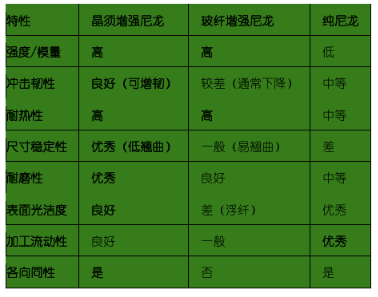
In summary, whiskers, as a high-performance reinforcement material, provide a way to modify nylon by overcoming issues such as warping, brittleness, and surface roughness associated with traditional fiberglass reinforcement.High strength, high heat resistance, high wear resistance, low warpage, good toughnessThe comprehensive solution is particularly suitable for applications with stringent requirements for dimensional accuracy, surface quality, and overall mechanical properties. It is an important force driving the advancement of nylon engineering plastics towards high-end and precision development.
【Copyright and Disclaimer】The above information is collected and organized by PlastMatch. The copyright belongs to the original author. This article is reprinted for the purpose of providing more information, and it does not imply that PlastMatch endorses the views expressed in the article or guarantees its accuracy. If there are any errors in the source attribution or if your legitimate rights have been infringed, please contact us, and we will promptly correct or remove the content. If other media, websites, or individuals use the aforementioned content, they must clearly indicate the original source and origin of the work and assume legal responsibility on their own.
Most Popular
-

Mexico Imposes Tariff Up to 36% on Cross-Border E-Commerce Products, Effective January 1, 2026; Plastic Shows Partial Fluctuation Today
-

Trump Delays Tariff Increase on Furniture, Cabinets, and Vanities
-
4.5 Million Tons! Wanhua Chemical Dominates Globally in MDI, Heavy Investment in Battery Materials Spurs New Storm
-
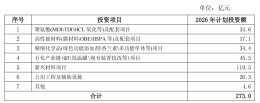
Wanhua Chemical Invests $27.3 Billion, 2026 Investment Map Revealed, $1.1 Billion Bet on Battery Materials
-
Back-to-back major joker moves! covestro’s 1.32 million ton mdi dual-line expansion and hdi acquisition reshape global polyurethane landscape


