2026 Spring Festival Gala: China's Humanoid Robots' Coming-of-Age Ceremony
"Is this year's Spring Festival Gala a robot gala?" When Cai Ming beamed at her robot "grandson" in the skit, who could act spoiled and do backflips, when dozens of robots on stage struck horse stances and performed drunken boxing alongside kung fu kids, when robots danced to the rhythm in the song "Intelligent Manufacturing Future" – countless viewers in front of the screen exclaimed this.
From Cai Ming and Guo Da's romantic depiction of future technology in "Robot Fun Talk" in 1996, to her reprising her role as the "first-generation robot" 30 years later in 2026, performing alongside a real embodied AI, these three decades represent not only the span of Cai Ming's artistic career, but also the true portrayal of China's robotics industry's evolution from "theoretical discussion" to "flourishing diversity."
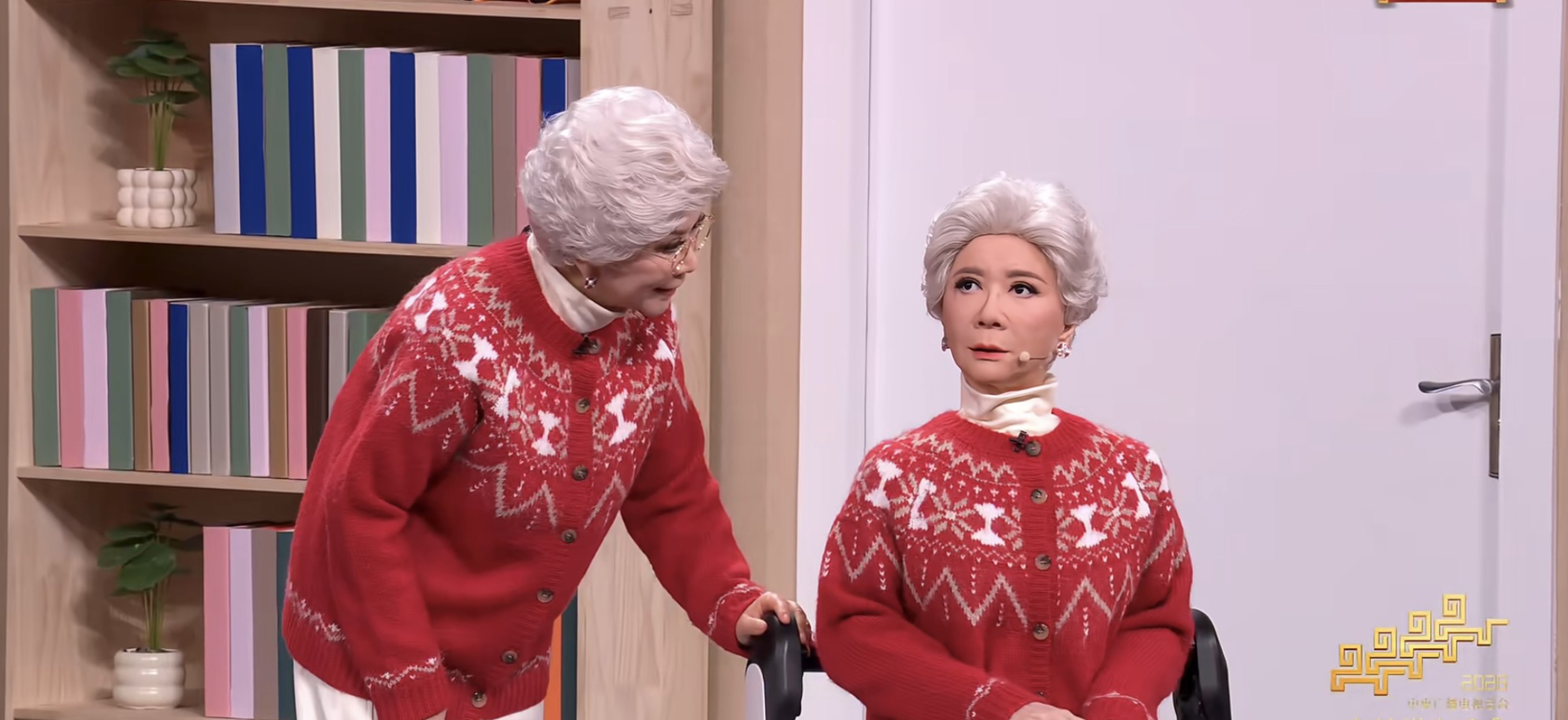
Image source: Screenshot from the Spring Festival Gala
A netizen's comment struck a nerve with many: "It's hard to imagine they were still swaying handkerchiefs a year ago, and this year they're directly practicing martial arts, performing skits, singing and dancing. They've evolved like they're on fast-forward."
What's even more noteworthy is that the robots appearing on the Spring Festival Gala stage this year are not a "solo act," but rather a competition among four companies and a joint appearance of multiple enterprises. Unitree Robotics, Magic Atom, Galaxy General, and Songyan Power, these four domestic robot companies, made their collective debut on the Spring Festival Gala stage. This is not only a feast of technology but also a collective declaration of the industry.
"Four Nations Showdown" on the Spring Festival Gala Stage
As the spotlight illuminated the Spring Festival Gala stage, four robotics companies entered the spotlight of billions of viewers in their own unique ways.
Unitree Robotics made its third appearance on the Spring Festival Gala, with its G1/H1 humanoid robots joining the kung fu kids from Henan Tagou Martial Arts School to perform "Wu BOT." Their movements were fluid and seamless, demonstrating horse stances, somersaults, sweeping leg kicks, and side aerials. They wielded long staffs, twirled nunchaku, performed aerial flips, and executed drunken boxing routines in one continuous flow. Compared to the "Benniu" robot ox in 2021 and last year's "Yang BOT," this year's performance exuded an even greater sense of composure and the confident demeanor of a "martial arts master."
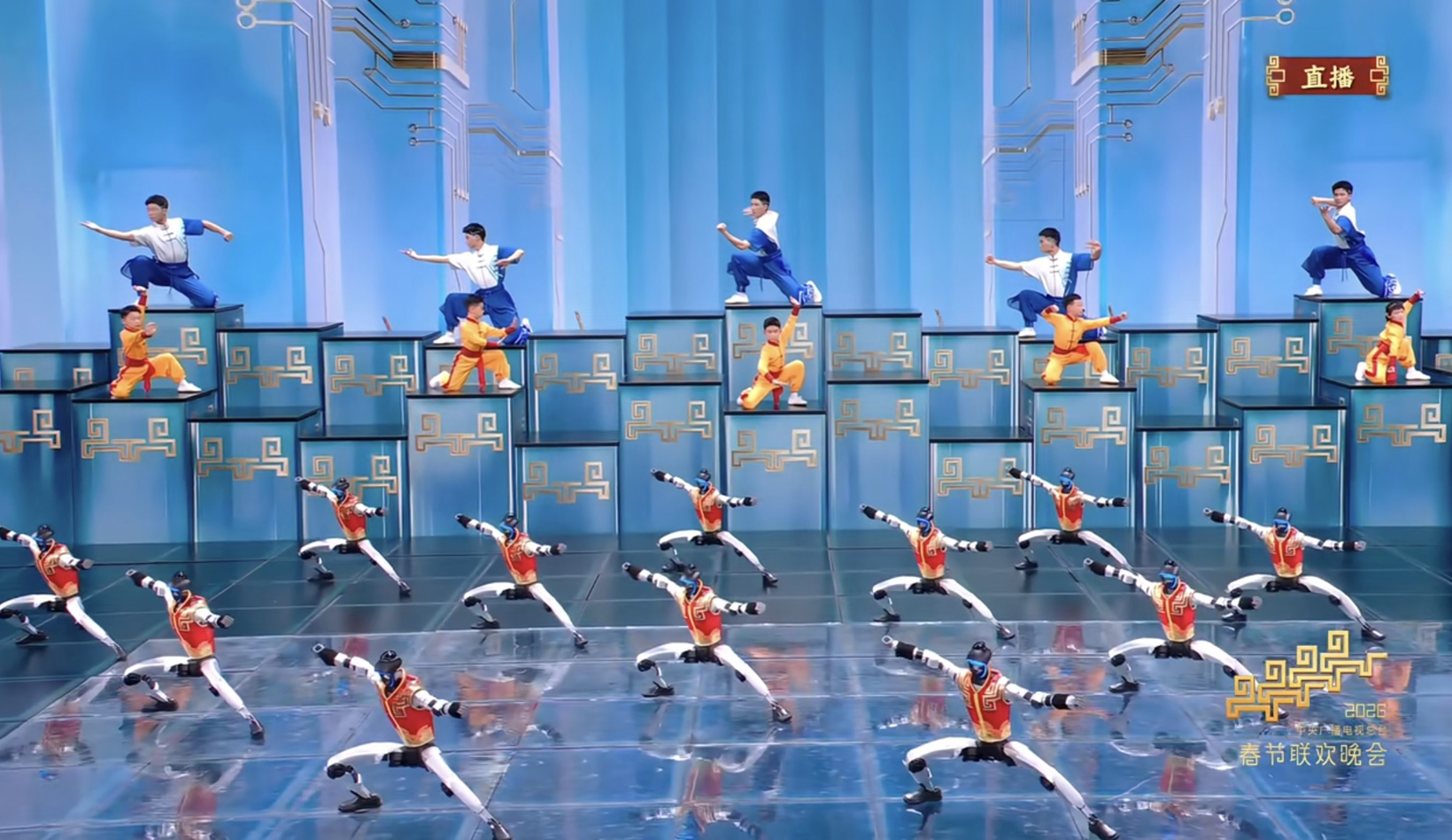
Image source: CCTV Spring Festival Gala screenshot
This year's Spring Festival Gala featured far more than just Unitree's robots – over 200 humanoid robots made an appearance, with domestic robot companies such as Songyan Dynamics, Magical Atoms, and Galaxy General competing on the same stage, resembling a "Chinese Embodied Intelligence Parade."
Among them, Cai Ming's skit "Grandma's Favorite," in collaboration with Songyan Dynamics Robotics, gained countless fans with its heartwarming plot and realistic robot performance. In the skit, the robots not only do housework, but also cajole, tell jokes, and even perform difficult stunts like backflips. The "robot grandma" who appeared at the end was incredibly lifelike.
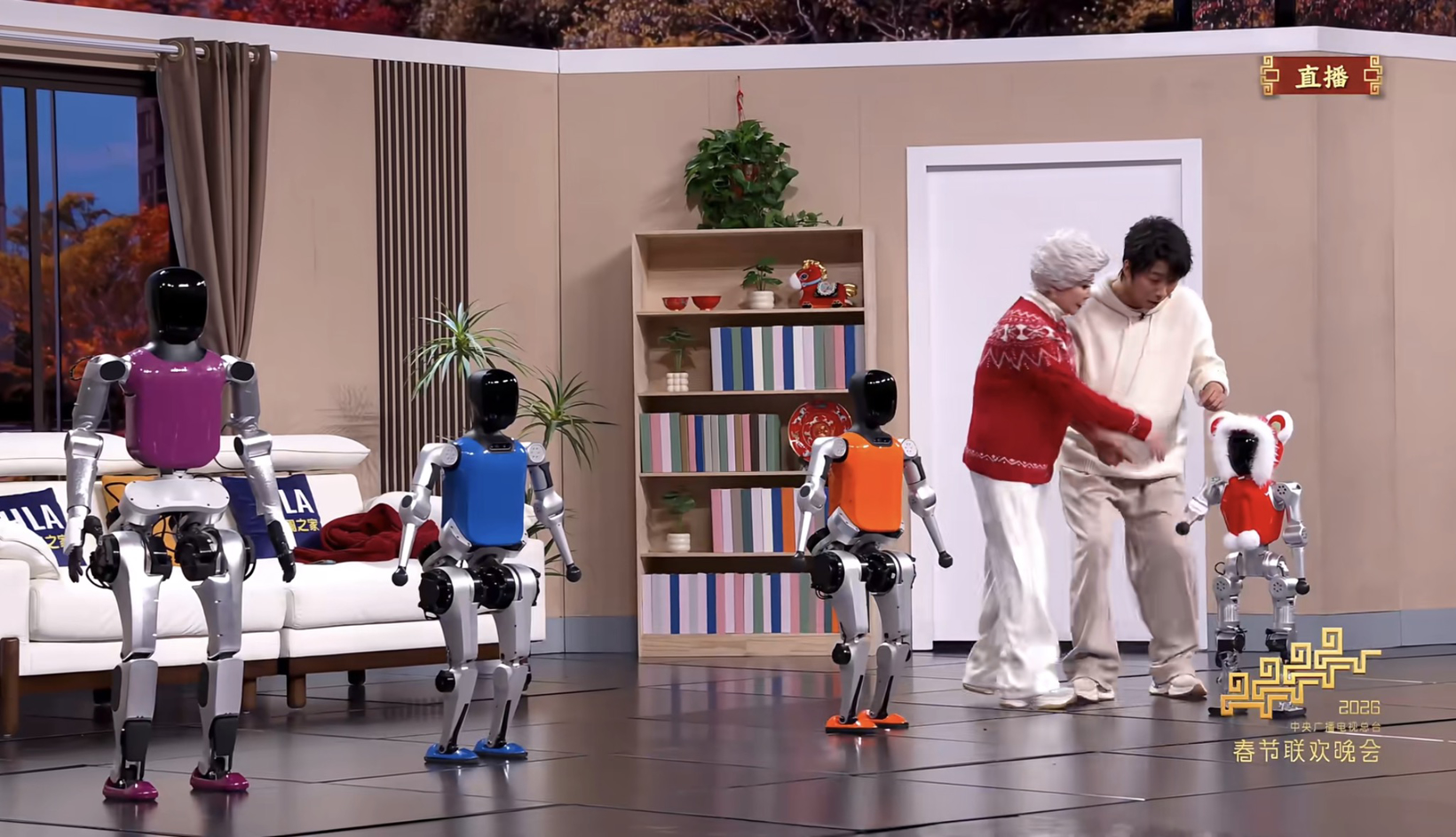
Image source: Screenshot from the Spring Festival Gala
This also marks Cai Ming's third Spring Festival Gala encounter with "robots": 30 years ago, her role as a "robot wife" on the Gala stage was merely a beautiful fantasy about future technology; but now, robots with human-level interaction capabilities have gradually entered people's daily lives. Songyan Dynamics' breakthroughs in anthropomorphic representation are a vivid microcosm of the rapid development of China's service robot industry.
Magic Atom participated in the performance of the song "Intelligent Manufacturing of the Future," showcasing the diverse layout of China's intelligent manufacturing to the audience. Its high-dynamic bipedal humanoid robot, Magicbot Z1, has previously completed stunts such as 360-degree Thomas flares and one-handed handstands, demonstrating powerful athletic capabilities.
Galaxy General, making its debut on the Spring Festival Gala, will highlight robots' autonomous decision-making capabilities in complex scenarios. Audiences will witness intelligent agents with environmental perception and real-time response abilities, rather than the repetitive actions of pre-programmed routines.
It is understood that in order to secure cooperation with the Spring Festival Gala, various companies are willing to invest heavily - with cooperation rights quoted between 60 million and 100 million yuan. For unprofitable startups, this is equivalent to the comprehensive cost of the R&D team for an entire year. Why such a "big gamble"?
The answer perhaps lies in the successful demonstration by Unitree Robotics during the 2025 Spring Festival Gala. Last year, "Yang BOT" became a phenomenal hit, directly driving a surge in corporate orders; consequently, the company completed its Series C financing in the first half of the year, with its valuation soaring to 12 billion yuan. "The Spring Festival Gala brings massive cross-over recognition at the level of hundreds of millions, which is clearly visible and creates a significant amplification effect for both branding and capital," said Zhang Yi, CEO of iiMedia Research. He believes that such exposure often generates positive stimulation for valuations, financing, and even IPO expectations.
However, some companies have chosen a different path. Unitree Robotics, a leader in shipment volume, opted to self-fund the world's first robot gala, "Robot Wonderful Night." Over 200 robots performed 12 acts, even inviting Huang Xiaoming to perform magic tricks alongside them.
On one hand, there's a "four-player game" with a hundred-million-yuan entry ticket, and on the other, a "one-man show" of self-organized galas at zero cost. These two drastically different paths reflect the commercialization anxiety of robotics companies in their "first year of commercialization."
Robots are stepping out of the spotlight.
The stunning performance at the Spring Festival Gala successfully brought humanoid robots into the spotlight. But what's more noteworthy is: what can these robots do when the lights go down and the music stops?
For the Spring Festival in 2026, the answers are becoming clear—they can not only "perform," but also genuinely "act."
Over the past year, the state has supported Beijing and Shanghai in establishing innovation centers for embodied intelligence and humanoid robots, and promoted the development of open-source humanoid robot common platforms such as "Tiangong".
In terms of market landscape, Chinese companies are establishing a leading position in the global market. According to a report by market research firm Omdia, Unitree Robotics is projected to hold a 39% global market share by 2025, followed by Unitree Technology with 32%. Unitree Technology responded by stating that its actual humanoid robot shipments have exceeded 5,500 units, with over 6,500 units produced on the production line, making it one of the top-selling humanoid robot manufacturers globally.
More noteworthy is that robots are moving from laboratories to real-world scenarios.
In the industrial frontline, UBTECH's industrial humanoid robot Walker S2 has commenced mass production and delivery, covering key sectors such as automotive manufacturing, intelligent manufacturing, and smart logistics. According to its production ramp-up plan, the annual production capacity for industrial humanoid robots is expected to reach 5,000 units by 2026, and further expand to 10,000 units by 2027. Recently, Walker S2 has collaborated with mobile robots to achieve unmanned automated loading for SPS (Sequential Production System) with unmanned logistics vehicles, creating an intelligent manufacturing system with multi-agent collaboration.
In the commercial service sector, Galaxy General's robots have been deployed in leading factories such as CATL. They have also set up 100 fully autonomous "Galaxy Space Capsule" convenience stores in over 20 cities nationwide and built the world's first instant retail warehouse operated by humanoid robots continuously working 8 hours a day for over a year. Zhi Ping Fang's "Zhi Mo Fang" robots have achieved stable operation, working 8 hours daily in multiple stores in Shenzhen, Beijing, and other cities. They consistently produce hundreds of cups of coffee and ice cream daily with zero errors in fully autonomous service, having served tens of thousands of people in total.
In the consumer market, Songyan Power has launched its humanoid robot "Xiaobumi" at a price point of tens of thousands of yuan, attempting to drive humanoid robots into the mass consumer market.
Morgan Stanley's latest report has revised its forecast for humanoid robot sales in China for 2026, now projecting 28,000 units, a 133% year-on-year increase, significantly higher than the previous forecast of 14,000 units. The institution believes that China's humanoid robot market is entering a phase of "exponential growth," with sales expected to reach 262,000 units by 2030 and potentially exceed 2.6 million units by 2035. Declining costs are a key driving factor – the cost of raw materials for robot production in China is projected to decrease by 16% in 2026, and the future price of robots is expected to fall from $50,000 in 2024 to $21,000 in 2050.
However, beneath the dazzling and bustling stage, what is the true temperature of the industry? Many listed companies regarded as "concept stocks" admit that related businesses are mostly still in the market development, sampling, or small-batch order stage, and their contribution to current performance is still minimal. Industry data also confirms this caution. The Robot Report shows that in 2025, the humanoid robot field completed 463 rounds of financing, and valuations soared by 300%, but actual shipments only increased by 17% year-on-year. Goldman Sachs surveyed 9 Chinese robot supply chain companies, and suppliers planned annual production capacities of 100,000 to 1 million units, but none confirmed receiving large-scale orders. In addition, purchases by educational and research institutions account for 75% of the total orders for humanoid robots.
"Compared to dancing, robots should better integrate into human society, with elderly care and childcare being the ideal first applications to effectively help humans relieve pressure," a robot industry insider stated bluntly. In his view, the craze will be hard to sustain if it remains limited to dance performances.
The 2026 Spring Festival Gala has concluded, but the spectacular performance of robots still resonates in people's minds. From Cai Ming's 30-year promise with the "first-generation robot" to the on-stage competition of four robot companies, and then to various robots quietly taking up their posts across the country – China's humanoid robot industry is experiencing an unprecedented boom.
This Spring Festival Gala robot battle had a positive impact on China's robotics industry. Whether it was the four companies competing to be featured on CCTV or Zhiyuan hosting its own gala, both brought robot technology to the attention of hundreds of millions of people, broke down public stereotypes about robots, and cultivated potential users for the industry.
However, it's even more important to soberly recognize that the core competitiveness of the robotics industry has never been a few minutes of dazzling showmanship on stage, but rather the accumulation of technology, the strength of products, and the implementation of scenarios. As one industry insider put it: "Robots being able to appear on the Spring Festival Gala means they have moved from the laboratory prototype stage to an engineering stage where they can operate stably and be replicated on a large scale. But what truly determines the future of robots is not whether they can complete a performance, but whether they can enter real-world scenarios and enter thousands of households."
The 2024 Spring Festival Gala marketing battle is essentially a rehearsal for "the right to survive." A hundred-million-yuan ticket to the Gala buys exposure, but whether that exposure can translate into orders remains to be seen. Hosting independent galas saves costs, but whether those savings can be channeled into breakthroughs in core technology is the real question. Between these two paths, there is no right or wrong—only success or failure.
Stepping off the stage, they are now racing into our daily lives. Yet, the spotlight of the Spring Festival Gala will eventually fade; the true test of the market has only just begun.
【Copyright and Disclaimer】The above information is collected and organized by PlastMatch. The copyright belongs to the original author. This article is reprinted for the purpose of providing more information, and it does not imply that PlastMatch endorses the views expressed in the article or guarantees its accuracy. If there are any errors in the source attribution or if your legitimate rights have been infringed, please contact us, and we will promptly correct or remove the content. If other media, websites, or individuals use the aforementioned content, they must clearly indicate the original source and origin of the work and assume legal responsibility on their own.
Most Popular
-

[overseas news] celanese and toray announce price hikes; basf: European Chemical Industry to Face a Decade of Consolidation
-

Covestro To Cut Antwerp PC Production Capacity, Close Bisphenol A Plant
-

[Overseas News] US Just Relaxed Rebates for Aluminum Can Stock, Saudi Arabia Turns Around and Imposes 38.7% Tax on Aluminum Can Lids
-
China’s First Domestic COP Project in Zhejiang Breaks a 30-Year Japanese Technology Stranglehold
-

Austrian Injection Molding And Automation Manufacturer Expects 10% Revenue Growth To €330 Million In 2026