Trump Vows Full Blockade of Hormuz, U.S. Military Says Only Iran Ports Will Be Blocked, Oil Prices Surge at Open
According to Bloomberg, U.S. President Trump stated that the peace talks held in Islamabad over the weekend failed to yield results.The United States will impose a blockade on the Strait of Hormuz. This move could exacerbate global oil and fuel shortages.
Trump stated in a social media post: "Starting today, the United States Navy - the most elite maritime force in the world will initiate the process,"Block any vessels attempting to enter or leave the Strait of Hormuz."This blockade will effectively cut off the main route for Iran to export oil."
Vice President Vance, along with envoys Steve Witkoff and Jared Kushner, left the region on Sunday after engaging in 21 hours of negotiations with senior Iranian officials, facilitated by Pakistan, in an effort to end the six-week-long war.The failure of the negotiations has cast doubt on the future of the ceasefire agreement reached just last week, and Trump's post indicates a greater risk to the agreement.
However,The U.S. Central Command has a different statement. Trump said the strait is fully blocked, while the U.S. military said only Iranian port vessels are blocked.
The statement from the U.S. Central Command says that U.S. Central Command forces will begin implementing a maritime traffic blockade on all vessels entering and exiting Iranian ports at 10:00 AM Eastern Time on April 13 (22:00 Beijing Time today). The blockade will be applied equally to all national vessels entering and exiting Iranian ports and coastal areas, including all Iranian ports in the Arabian Gulf and the Gulf of Oman. Central Command forces will not impede the freedom of navigation for vessels transiting the Strait of Hormuz to and from non-Iranian ports.Prior to the commencement of the blockade, additional information will be provided to commercial seafarers via official notification. All seafarers are advised to monitor NAVTEX broadcasts and contact U.S. naval forces on VHF Channel 16 while operating in the Gulf of Oman and the approaches to the Strait of Hormuz.
According to foreign media reports, the operation was more restrained than what Trump described on Sunday. However, the announced blockade appears to be broader, as it targets ships leaving all Iranian ports, apparently including those distributed along the Gulf of Oman beyond the Strait of Hormuz.
This move aims to increase pressure on Tehran without fully closing the Strait of Hormuz, yet it also raises the risk of Iranian retaliation and miscalculation. Analyst Eamonn Sheridan stated that this distinction is crucial: while the U.S. effectively severs Iran’s direct maritime trade, it seeks to avoid the broader disruption to global oil flows that would result from a complete closure of the Strait of Hormuz.This move marks a shift in US policy from diplomacy to coercive economic containment.
For the market, this situation reshapes the risk landscape, shifting the focus from a binary scenario of "open or closed" Strait of Hormuz to the methods of law enforcement, the possibility of maritime misjudgments, and the sustainability of assurances for the safe passage of non-Iranian shipping. This means that the geopolitical risk premium will be more enduring and complex, especially in the energy market.
The Strait of Hormuz is the world's most important energy chokepoint, accounting for a significant portion of global oil and liquefied natural gas transit.Natural gasAbout one-fifth of the trade volume. A full blockade of the strait would cut off the small remaining shipping still passing through the waterway, further pressuring the global oil market.
The blockade will also sever a critical financial lifeline for Iran. Iran’s export levels remain at pre-war levels, and it is simultaneously benefiting from a surge in its crude oil prices. Crude oil futures closed last week 30% higher than pre-war levels, and traders, scrambling globally for supplies, paid record-high spot crude prices exceeding $140 per barrel.
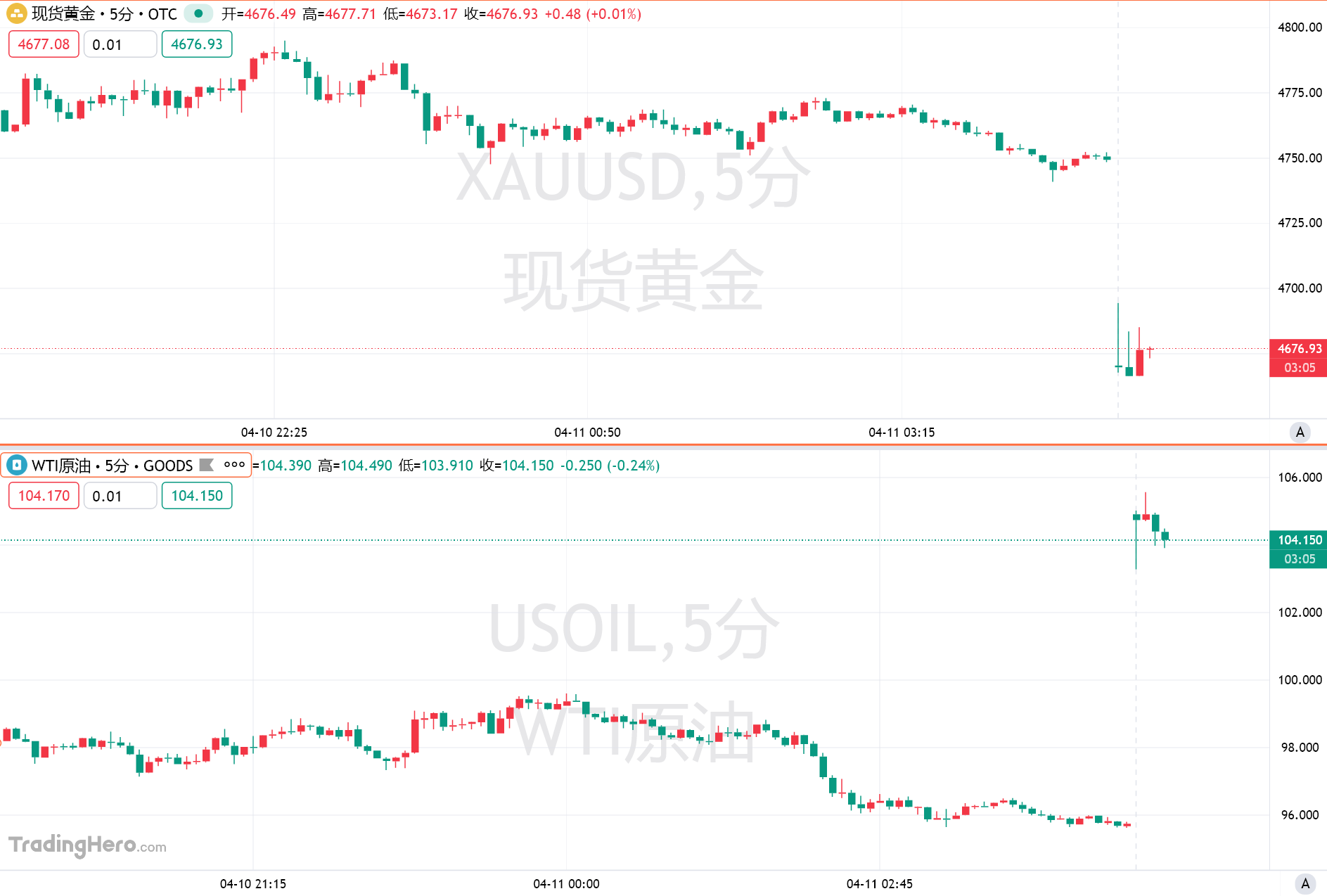
Monday (April 13)West Texas Intermediate crude oilSurged 9.4% at the open, with gains widening to over 10% shortly thereafter.Brent crude oilFutures hit a high of $102.60 per barrel. Spot gold and silver opened lower.Spot goldIt fell by $70, with the latest price at $4,673 per ounce.Spot SilverOpened down more than 3%. U.S. stock index futures opened more than 1% lower on Monday.
Trump subsequently stated that the blockade would ultimately restore strait traffic to the state of free passage that existed before the United States and Israel launched the war.
Trump said during a phone interview with Fox News Channel's "Sunday Morning Futures" program: "This is called 'all in, all out.'" He said: "There will always be a moment when we let all ships in and all ships out, but it won't be on a proportional basis. It won't be like one of your friends, for example, a country that is your ally, or a country that is your friend."It’s either all or nothing.”
Trump mentioned that the UK would dispatch minesweepers and hinted that allied nations would assist in this blockade operation.
According to sources familiar with the UK government's position, the UK will not participate in this blockade. These sources stated that the UK possesses autonomous mine-hunting drones in the region but would only deploy them to the Strait of Hormuz after reaching an agreement with other allied nations on a viable plan to reopen the strait. This would be an action independent of Trump’s plan to blockade the Strait of Hormuz.
Has Iran's "lifeline" been severed?
Iran's semi-official media cited reports that the U.S. made "excessive" demands, leading to the failure of the negotiations. However, the Iranian Foreign Ministry stated that differences could not be resolved in one round of talks, leaving room for more discussions.
Earlier this year, the Trump administration had previously taken similar measures against Venezuela - effectively blockading its sanctioned oil on the high seas before forcefully taking control of Nicolas Maduro in January. For this, the United States deployed about twelve warships. Although the operation was mainly focused in the Caribbean Sea, the seizure operations sometimes took place far from Venezuela, including in the Indian Ocean.
Trump did not specify where the US would impose a blockade on Iran on Sunday. However, some energy experts had been encouraging such a move for weeks before his statement.These experts believe that this approach would deprive Iran of revenue related to oil, and strengthen its leverage over Tehran while the U.S. seeks full opening of the Strait of Hormuz.
If Trump ordered the navy to blockade the strait itself, it would put US assets within range of Iranian missiles. But the US could more easily impose a blockade in the Arabian Sea and other waters, which are beyond the reach of most of Tehran’s arsenal.
Former U.S. diplomat and Middle East envoy Dennis Ross stated,Compared to taking military action to seize Iran's key oil export hub, Kharg Island, blockading the Strait of Hormuz is a lower-risk option.
On Sunday, Ross said on Fox News Channel: "Khark Island is a place they must be able to hold. We could take it, but then our troops would be extremely vulnerable. It’s wiser than capturing Khark Island."
Clayton Seigle, a senior fellow at the Center for Strategic and International Studies, stated that the seized oil cargo could be sold on global markets by commodity trading firms, thereby ensuring Tehran does not benefit from it.
Last month, the United States issued a sanctions waiver permitting the sale of certain Iranian crude oil—a move seen as helping to ease concerns over oil supply, particularly in Asia.Even before this exemption expires on April 19, the blockade could already reduce supply.
Brett Erickson, managing director at advisory firm Obsidian Risk Advisors, stated, "The world is currently facing a genuine energy emergency, and Washington's economic response is completely disconnected." Government officials "have boxed themselves into a corner."The only remaining options are either to harm our allies in Asia or to let Iran plunder the global energy market.。”
Since the outbreak of the war, Iran has been the only country in the Gulf region capable of exporting oil at levels close to pre-war volumes. In contrast, as the Strait of Hormuz has effectively been closed and Tehran has begun targeting critical energy infrastructure in the region, its neighbors' oil production has collapsed, triggering a global scramble for crude oil.
According to preliminary tanker tracking data compiled by Bloomberg, Iran exported about 1.7 million barrels of crude and condensate per day in March. This surpasses its neighbor Iraq, which had much higher export volumes than Iran before the war.
Trump also stated that Iran might lay mines in this critical waterway and that its demand to charge tolls for ensuring safe passage constitutes "global extortion," which world leaders, especially those of the United States, would never accept.
Trump also expanded the threat to international waters, stating that the U.S. Navy will intercept any ships that have paid tolls to Iran.He said, "Anyone who pays for illegal passage will not be granted safe passage on the high seas."
Despite the US President's demand for free and open passage through the Strait of Hormuz, some shipping companies have already negotiated with Iran for safe transit through the corridor. Trump had previously praised the Iranian regime for allowing 10 ships to pass, calling it a "gift."
【Copyright and Disclaimer】The above information is collected and organized by PlastMatch. The copyright belongs to the original author. This article is reprinted for the purpose of providing more information, and it does not imply that PlastMatch endorses the views expressed in the article or guarantees its accuracy. If there are any errors in the source attribution or if your legitimate rights have been infringed, please contact us, and we will promptly correct or remove the content. If other media, websites, or individuals use the aforementioned content, they must clearly indicate the original source and origin of the work and assume legal responsibility on their own.
Most Popular
-

Continental Plans to Begin Sale of ContiTech in Early 2026
-

$4 Billion! Medtronic Makes Another Acquisition
-

BASF Delivers First Batch of Innovative Cathode Materials for Semi-Solid-State Batteries to Weilan New Energy
-
Profit and Revenue Growth Struggle to Conceal Debt Repayment Pressure; Success of Kingfa Sci & Tech's High-End Strategy Yet to Be Seen
-
Why did a century-old european dental instrument giant relocate its manufacturing hub to china?