Trump Launches New Section 301 Investigation Targeting Chinese Textile Fabrics; New Tariffs Possible in May
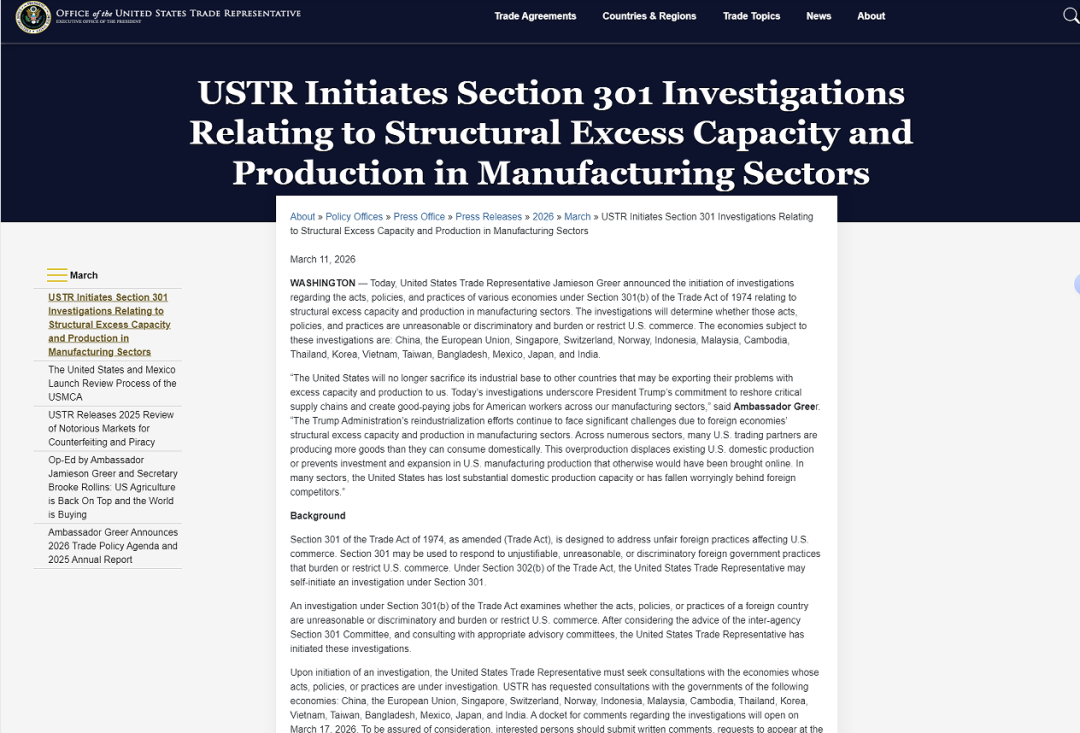
On March 11 local time, the Office of the United States Trade Representative (USTR) issued a formal notice to initiate a Section 301 investigation, targeting 16 economies regarding structural overcapacity and production issues in the manufacturing sector, aiming to re-impose tariff pressures.
The list of economies under investigation (a total of 16): China, the European Union, Singapore, Switzerland, Norway, Indonesia, Malaysia, Cambodia, Thailand, South Korea, Vietnam, Chinese Taipei, Bangladesh, Mexico, Japan, and India.
Structural surplus and trade surplus
In this announcement, USTR provided a systematic definition of structural overcapacity. USTR believes that major trading partners have developed excess production capacity that is disconnected from the objective laws of domestic and global actual demand. This excess capacity has led to overproduction in manufacturing, large and persistent trade surpluses, and underutilized or idle capacity.
To support its investigative rationale, USTR cited several macroeconomic and industrial data points. The U.S. government estimates that global manufacturing capacity utilization remains between 75.0% and 75.9%, significantly below the approximately 80% benchmark widely considered healthy for many industries. USTR views this as direct evidence that global manufacturing supply has exceeded underlying demand.
The announcement states that a massive manufacturing surplus inevitably requires offsetting manufacturing deficits elsewhere in the global economy. Trade surpluses typically stem from imbalances between domestic savings and investment, imbalances shaped by government policies that weaken domestic demand and foster overproduction.
Among the 16 economies investigated, the USTR conducted the most detailed penetration review of China's trade and capacity data. The notice stated that China's global goods trade surplus reached a new historical high in 2025, exceeding $1.2 trillion, accounting for nearly 70% of the global goods trade surplus. Compared to China's global goods trade surplus of $993 billion in 2024, it shows a significant growth trend.
Regarding capacity utilization, the announcement clearly states that the overall capacity utilization rate in China for 2025 is 74.4%, which is lower than 75% in 2024. USTR believes that the increasing number of unprofitable companies that are unable to meet interest payments through operations is a manifestation of excess capacity, and claims that there is evidence showing an increasing number of such companies in China and Japan.
USTR has detailed a list of several core industries where China dominates global exports, including: electronic devices, machinery, automobiles and parts, plastics, furniture, steel products, apparel, organic chemicals, toys and sporting goods, optical, photographic, technical and medical equipment, steel, footwear, ships, and aluminum.
A new round of tariff hikes may be imminent.
The so-called "Section 301 investigation" originates from Section 301 of the U.S. Trade Act of 1974. This clause authorizes the U.S. Trade Representative to initiate investigations into other countries' "unreasonable or unfair trade practices" and, upon completion of the investigation, to recommend that the U.S. President implement unilateral sanctions. This investigation is initiated, conducted, adjudicated, and enforced by the U.S. itself, bearing a strong unilateralist hue.
During Trump's first term and under Biden, Section 301 tariffs have already been imposed on a wide range of Chinese products, with tariff rates ranging from 7.5% to 100%, most products falling within the 7.5%–25% range, and a very small number of products subjected to a 100% tariff rate.
USTR representative Jamieson Greer stated that this "Section 301" unfair trade practices investigation could lead to new tariffs being imposed on China, the EU, India, Japan, South Korea, and Mexico by around May this year.
【Copyright and Disclaimer】The above information is collected and organized by PlastMatch. The copyright belongs to the original author. This article is reprinted for the purpose of providing more information, and it does not imply that PlastMatch endorses the views expressed in the article or guarantees its accuracy. If there are any errors in the source attribution or if your legitimate rights have been infringed, please contact us, and we will promptly correct or remove the content. If other media, websites, or individuals use the aforementioned content, they must clearly indicate the original source and origin of the work and assume legal responsibility on their own.
Most Popular
-

Continental Plans to Begin Sale of ContiTech in Early 2026
-

$4 Billion! Medtronic Makes Another Acquisition
-

BASF Delivers First Batch of Innovative Cathode Materials for Semi-Solid-State Batteries to Weilan New Energy
-
Profit and Revenue Growth Struggle to Conceal Debt Repayment Pressure; Success of Kingfa Sci & Tech's High-End Strategy Yet to Be Seen
-

Why did a century-old european dental instrument giant relocate its manufacturing hub to china?