Tesla’s Departure Wave Intensifies: Software Director and CFO Announce Resignations! Netizens: “Even a 17-Year Veteran Has Left—It Signals…”
Just as Elon Musk was elated by the recent rollout of the Cybercab, cracks emerged anew within his core management team. In March 2026, Thomas Dimitrik, Tesla’s Software Director, and Sandeep Palani, Vice President of Finance, both announced their resignations. Dimitrik, a technical veteran who built the vehicle-wide OTA remote update system and the foundational Robotaxi architecture, and Palani, a “living fossil”-level figure who had served Tesla for 17 years and participated in its Series E funding round and IPO, are now departing.
This is not an isolated personnel fluctuation. Since the end of 2025, a series of key positions, including the project manager of the Cybertruck, the project manager of the Model Y, and the project manager of the Cybercab, have all changed hands.
When a company undergoing a perilous transformation from an automotive manufacturer to an AI company loses such a dense concentration of senior executives within just a few months, what we are witnessing is no longer merely the cumulative effect of individual career choices, but a profound organizational earthquake concerning corporate culture, strategic priorities, and the talent ecosystem.
Regarding the surprise from the outside, Musk's response remained casual — "Few people leaving the company cause regret." This statement may reflect the philosophy of this billionaire in managing talent: a company should naturally evolve like a living organism, and the turnover of personnel is just metabolic renewal.
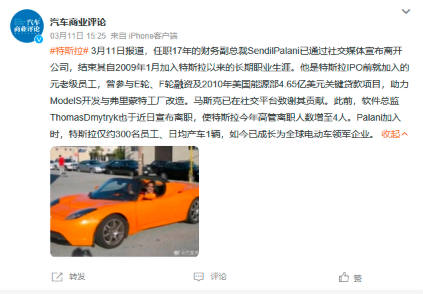
Yet, examining this ever-growing list of departures reveals a telling commonality: most of them were "core insiders among core insiders." Dmitrić, who just left, spent 11 years at Tesla and personally built the company’s remarkable OTA capability that allows vehicles to be fixed without recalls. Palani, meanwhile, lived through Tesla’s darkest days—joining when the company was producing just one car per day—and witnessed its entire journey from the brink of bankruptcy to a trillion-dollar valuation.
If ordinary employees’ turnover is akin to blood circulation, then the departure of veteran executives—who have endured the “production hell” and helped Tesla establish its manufacturing moat and technological moat—represents a significant loss of organizational memory.
Previously, outsiders often attributed the departure of Tesla executives to its "7x24 hours" extreme work system. This is indeed true, as Musk's obsession with efficiency has deeply rooted in the company. All-night meetings and being on call at any time have become a must for executives. However, by 2026, mere "fatigue" is no longer sufficient to explain the scale of this wave of departures. A deeper change lies in the fact that as Tesla's strategic focus shifts sharply from vehicle manufacturing to AI, Robotaxi, and humanoid robots, the value framework of the veterans is being redefined.
Tesla is undergoing a brutal self-revolution.
In early 2026, Musk announced the discontinuation of Tesla’s flagship models, the Model S and Model X, and redirected part of the production capacity at Tesla’s Fremont factory in California toward the humanoid robot Optimus. Meanwhile, financial reports underscored the urgency of this transition: in 2025, Tesla suffered its first-ever annual revenue decline (–3%), a 46% plunge in net profit, and an 8.6% drop in global vehicle deliveries, losing the title of world’s top-selling all-electric automaker to BYD.
In this context, Musk has put all his bets on the future-oriented Cybercab, FSD, and Optimus. This is both a vision and a purge at the organizational level.
As company resources shift toward new ventures, heroes who once conquered the "production hell" for the Model 3 and engineering vice presidents who made pivotal contributions to the S/X inevitably drift from the core circle to the periphery. Just like Nechita, the departing Cybercab project manager, who rose from intern to leadership but chose to leave just before the new vehicle’s mass production.
When “building cars” is no longer the company’s sole narrative, many traditional automotive professionals find themselves obsolete—not due to lack of competence, but because of strategic misalignment. Tesla’s wave of departures is, at its core, the organization “replacing blood” to align with its new strategic direction. Yet if this replacement is too drastic, it risks causing knowledge gaps and operational chaos—especially when Robotaxi and AI businesses remain immature and still rely on traditional manufacturing for financial and operational support. Prematurely alienating manufacturing talent is akin to replacing engines mid-flight.
According to Unemployment Daily's observation, the reason the departures of these two executives have drawn attention is that their roles correspond precisely to Tesla's two most vulnerable ribs at the moment.
The risk in the financial dimension. Palani's departure occurred at a critical moment when Tesla was under pressure in its performance. The 2025 financial report showed that the company not only experienced a decline in sales but also faced challenges in gross margin. To maintain sales, Tesla frequently cut prices in the Chinese, American, and European markets. In early 2026, it even launched aggressive promotions such as 0% interest over five years. Losing a veteran financial executive who had experience in multiple funding rounds and was well-versed in capital operations is a major loss for Tesla, which requires precise cash flow management.
Concerns in the software dimension. Dmitriev's team is responsible for Tesla's most prideful OTA technology and the underlying system of Robotaxi. Software-defined cars have become an industry consensus, and OTA is the physical basis of this concept. More importantly, this year is a critical year for the commercialization of Tesla's Robotaxi, and the stability of the underlying system directly determines whether autonomous taxi services can be widely deployed. At this crucial stage, the departure of the core software leader inevitably casts a shadow on the expansion of Cybercab.
Notably, in the face of the wave of executive departures, capital markets appear calmer than expected. Tesla's stock price has not experienced significant volatility, and institutions such as Bank of America have even reiterated their "Buy" rating, citing confidence in Tesla's leadership in consumer-grade autonomous driving. The rationale behind this bullish sentiment is that investors are betting on Elon Musk himself, not any individual executive. As long as Musk remains, Tesla's "soul" remains intact.
However, this logic is being put to the test. As industry commentators have noted: "In the face of a decisive battle, frequent changes in personnel are a major taboo in military strategy." The competition among AI companies, on the surface, is about computational power and models, but at the bottom, it is about the density of talent and the stability of the team. The mass departure of xAI co-founders has already sounded the alarm.
Ultimately, the wave of resignations in 2026 may become merely a footnote in Tesla’s history; yet it serves as a reminder that even the “Iron Man’s” commercial empire is not exempt from the physical law of organizational entropy. When rocket culture collides with the hard wall of transformation, retaining talent may prove more difficult than building the next vehicle.
【Copyright and Disclaimer】The above information is collected and organized by PlastMatch. The copyright belongs to the original author. This article is reprinted for the purpose of providing more information, and it does not imply that PlastMatch endorses the views expressed in the article or guarantees its accuracy. If there are any errors in the source attribution or if your legitimate rights have been infringed, please contact us, and we will promptly correct or remove the content. If other media, websites, or individuals use the aforementioned content, they must clearly indicate the original source and origin of the work and assume legal responsibility on their own.
Most Popular
-

Continental Plans to Begin Sale of ContiTech in Early 2026
-

$4 Billion! Medtronic Makes Another Acquisition
-

BASF Delivers First Batch of Innovative Cathode Materials for Semi-Solid-State Batteries to Weilan New Energy
-
Profit and Revenue Growth Struggle to Conceal Debt Repayment Pressure; Success of Kingfa Sci & Tech's High-End Strategy Yet to Be Seen
-
Why did a century-old european dental instrument giant relocate its manufacturing hub to china?