Solving Two Major Issues of Nylon with Fiber: Exposed Glass Fiber and Water Absorption Expansion
High-strength and heat-resistant nylon (PA+GF) has become the "main force" in fields such as automotive, electronics, and machinery. However, in actual production, two issues have been troubling engineers: surface fiber exposure and water absorption deformation.
Fiber bloom makes smooth products rough, while moisture absorption causes precise dimensions to go out of tolerance. Today, we’ll thoroughly explain the root causes and solutions for both issues in one go.
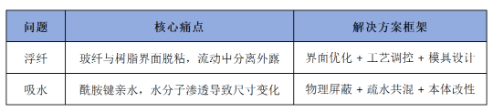
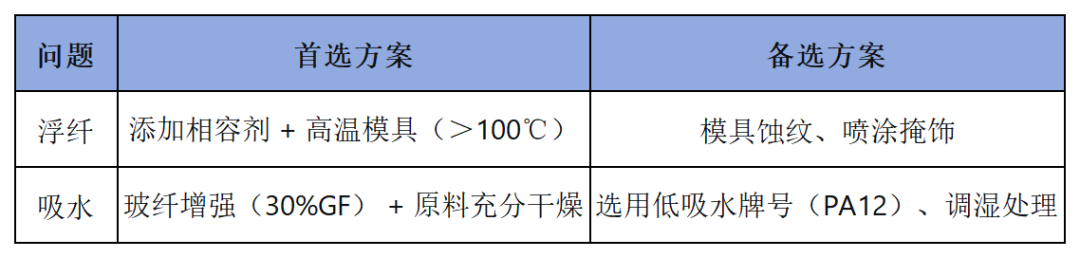
01Two major issues and solution framework
02Fiberglass: Why can't "fibers" be hidden?
Floating fibers (also known as exposed fibers) refer to glass fibers protruding from the surface of a molded part, forming rough, white streaks. This is not merely an aesthetic issue but may also affect subsequent processes such as painting.
How does floating fiber come about?
Floating fibers are mainly caused by three reasons.:
First, poor compatibilityGlass fiber is "inorganic," while nylon is "organic," and the two are not very compatible. If the interfacial bonding strength is not strong enough, they tend to separate during the flow process.
Second, Difference in ProportionResins and glass fibers differ in fluidity and density. During melt flow, they tend to separate—the lighter, more fluid components move faster, while the heavier, less fluid components lag behind and tend to float to the surface.
Third, the fountain effectWhen the molten material is injected into the mold, the front end of the melt rolls outward like a fountain, bringing the glass fibers to the surface. However, the mold wall temperature is relatively low, and the glass fibers are "frozen" before they can be encapsulated by the resin.
How to solve floating fibers?
Start from the interface, and make them "close" to each other
Coupling agent treatmentUsing silane coupling agents (such as KH-550, KH-560) to treat glass fiber, building a "bridge" between the fiber and the resin.
Add compatibilizer: Introduce maleic anhydride grafted materials (such as POE-g-MAH, PP-g-MAH) to enhance interfacial adhesion
Start from the manufacturing process to make them impossible to hide.
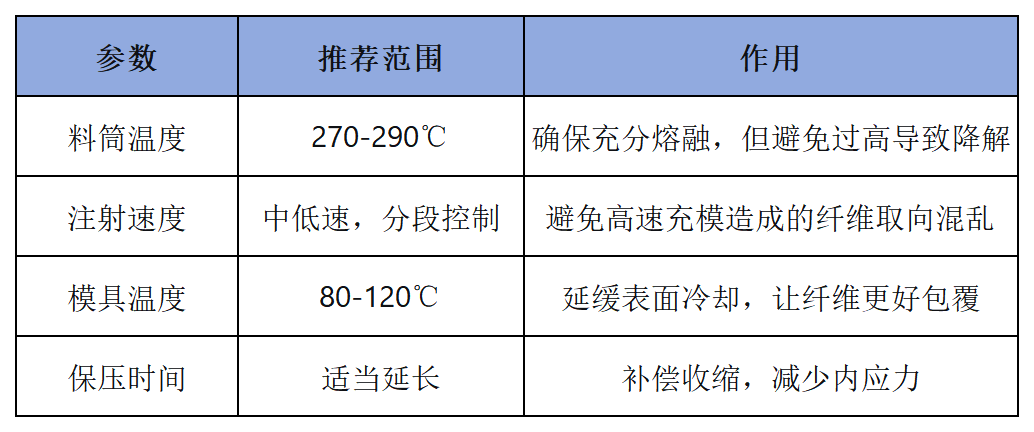
Start from the formulation to make the system smoother.
LubricantInternal lubricants (such as zinc stearate) reduce internal friction in the melt; external lubricants (such as silicone masterbatch) reduce the adhesion of the melt to the mold.
Fiber ControlContent should be kept below 30%, length ≤ 3mm, to avoid agglomeration.
Start from the molds and leave them "nowhere to hide."
Gate design: Use multiple gates or fan gates to make the flow uniform
Vent grooveAdd vent grooves with a depth of 0.02–0.04 mm to prevent air entrapment.
Cavity PolishingPolish to a mirror finish (Ra ≤ 0.2 μm) to reduce flow resistance.
03Water Absorption: Why Does Nylon “Never Get Enough”?
Nylon molecular chains contain highly polar amide groups, which attract water molecules like old friends, eager to "shake hands and embrace." This makes nylon inherently hydrophilic. The saturation water absorption of PA6 can exceed 2.5%, with a dimensional change rate of 0.6% to 1.0%. For precision parts, this is a disaster — what fits today may get stuck tomorrow due to water absorption and expansion.
How to make nylon "drink less water"?
Physical shielding method: Make it so that water cannot find a way through
Adding layered silicate fillers (such as montmorillonite or attapulgite) is an effective approach. These fillers stack together like overlapping "tiles," forcing water molecules to take a much longer, tortuous path to pass through, significantly extending the diffusion pathway.
Glass fiber also has a similar effect - 30% glass fiber can reduce the water absorption of PA6 by 50%-70%, and continuous fibers have a better effect.
Hydrophobic Blending Method: Keeping Water Out
Blending nylon—a hydrophilic material—with hydrophobic polymers like polypropylene (PP) and polyethylene (PE), which are "water-averse," is like introducing hydrophobic "outsiders" into hydrophilic nylon. However, they don't get along well due to their large difference in solubility parameters, so maleic anhydride-grafted compatibilizers are needed to act as "mediators."
Source Material Selection: Switch to a "Water-Hating" Nylon
PA12 has an water absorption of about 1.5%, and PA610, PA46 are also relatively low. If the cost is acceptable, it is better to solve the problem from the material source, saving a lot of trouble later.
Post-processing method: First, let it "soak up" fully.
Sometimes doing the opposite actually works—pre-treating the product in an 80°C water bath for a period of time allows it to absorb moisture and expand in advance, stabilizing its dimensions before use. This is called "conditioning," which may sound odd but is indeed effective.
The water absorption issue isn't something you can just "fix and forget."
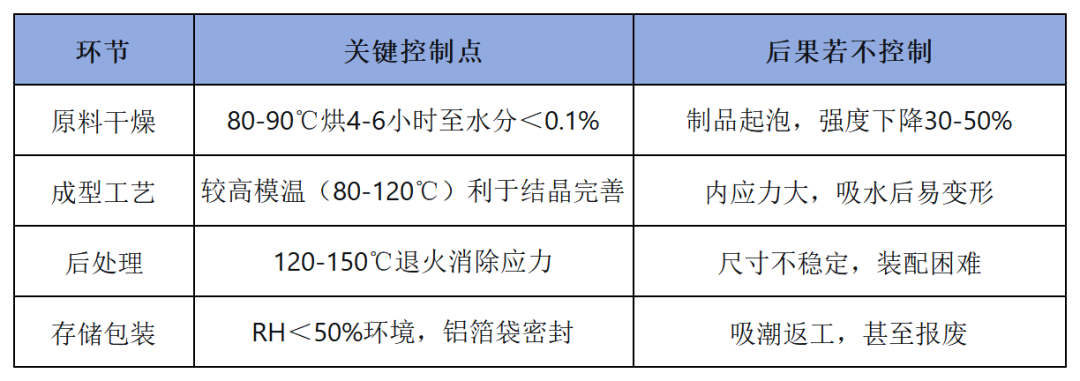
Don't underestimate the drying of raw materials - some people take shortcuts and don't dry them thoroughly, resulting in bubbles in the product, and the strength is reduced by half, leading to the entire batch being scrapped.
04Two questions, one approach.
Fiber floating and water absorption, one is about "appearance" and the other about "substance," but the approaches to solving them are interconnected: the material formula is the foundation, the molding process is the key, and mold design is the guarantee.
In actual production, it often takes multiple approaches to achieve the desired results. Someone tried more than ten additives without solving the problem of fiber flotation, only to find out that the mold temperature was 20°C too low; another person modified the formula but the water absorption rate was still high, only to find out later that the raw materials had not been properly dried. This industry is like that — details determine success or failure.
【Copyright and Disclaimer】The above information is collected and organized by PlastMatch. The copyright belongs to the original author. This article is reprinted for the purpose of providing more information, and it does not imply that PlastMatch endorses the views expressed in the article or guarantees its accuracy. If there are any errors in the source attribution or if your legitimate rights have been infringed, please contact us, and we will promptly correct or remove the content. If other media, websites, or individuals use the aforementioned content, they must clearly indicate the original source and origin of the work and assume legal responsibility on their own.
Most Popular
-

Continental Plans to Begin Sale of ContiTech in Early 2026
-

$4 Billion! Medtronic Makes Another Acquisition
-
BASF Delivers First Batch of Innovative Cathode Materials for Semi-Solid-State Batteries to Weilan New Energy
-

Why did a century-old european dental instrument giant relocate its manufacturing hub to china?
-
Profit and Revenue Growth Struggle to Conceal Debt Repayment Pressure; Success of Kingfa Sci & Tech's High-End Strategy Yet to Be Seen