



Samsara Eco Partners with Global Outdoor Brands to Tackle Synthetic Fiber Recycling Challenges and Create Circular Nylon
Recently, significant progress has been made in the field of synthetic fiber recycling. The Nylon Materials Alliance has closely connected a recycling technology startup with a European outdoor brand to collaboratively tackle the challenges of synthetic fiber recycling, bringing new hope for sustainable development in the industry.
Australian factory goes into production, circular nylon gains attention.
Jerrabomberra, Australia has sent the news.Samsara Eco's commercial synthetic recycling plant located here officially started production in September this year. Currently, there is a significant recycling gap in the nylon sector. As a high-performance material, nylon has an annual production of 7 million tons, but its recycling rate is less than 2%, with the main sources of recycling limited to fishing nets and carpets. At the same time, nylon, as the second largest synthetic fiber after polyester, is widely used to make windbreakers, backpacks, swimsuits, and other products; however, most of these products ultimately end up in landfills, resulting in severe resource waste and environmental burdens.
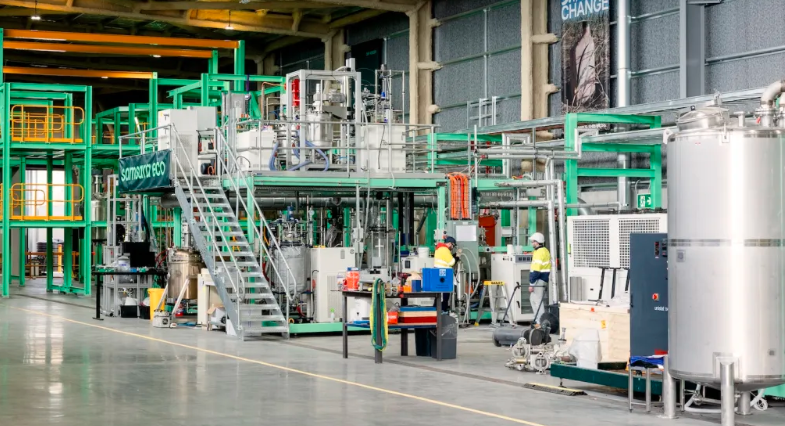
To promote the recycling and utilization of textile waste nylon, the Nylon Materials Alliance will collaborate with Australian materials innovation enterprises.Samsara Eco is closely tied to numerous clothing companies. On November 25, Samsara Eco reached a strategic partnership with the European Outdoor Group, representing over 150 brands. The group's members include well-known brands such as Arc'teryx, Marmot, Fjällräven, and The North Face, and the project is open to global brands as well.
Katie, Head of Sustainability at European Outdoor GroupStevens stated, "By integrating demand with expertise, we enable brands to more easily incorporate high-performance recycled materials into their product lines, which is a substantial step forward in promoting sustainability in the outdoor industry." Samsara Eco's Chief Commercial Officer, Sarah Cook, also emphasized, "The recycled nylon we offer performs as well as virgin materials but without the environmental burden, filling a long-standing market gap and achieving a win-win for both the industry and the ecosystem."
Technological breakthroughs to tackle recycling challenges.
Samsara Eco has achieved a key technological breakthrough by using enzymatic technology to break down nylon polymer chains and reconstruct them into new nylon. The company's CEO, Paul Riley, noted last year: "We directly tap into the supply chain, allowing brands to replace the traditional fossil-based material input without needing to modify processes or equipment."
Currently, the company is focusing on two mainstream nylon varieties. Polyamide.Nylon 6 is commonly used in the production of swimwear and stockings, with companies like Econyl already recycling this material from fishing nets. However, recycling Nylon 6,6 is more challenging, and it is widely used in performance gear, backpacks, and climbing pants. When nylon is blended with spandex to enhance elasticity, the complexity of recycling further increases. However, Adam Gardner, the project leader for recycling at the Textile Exchange Center, stated, "Advanced recycling technologies can now decompose blended fibers, providing solutions for processing complex materials."
Market collaboration, lowering brand barriers.
Sustainability experts praised the strategic advantages of cross-brand demand integration for the nylon materials alliance. The Colorado materials consulting agency.Bonnie Schupp, founder of Rewildist, pointed out: "This model lowers the barriers for small and medium brands to access high-performance recycled nylon, which has strength and durability comparable to virgin materials."
This model is not the first of its kind. Earlier this year,Circ has established the Fiber Club, and Circ in Danville, Virginia is promoting the development of recycled Lyocell fiber through this organization. The collaborating brands include Eileen Fisher, Everlane, Zalando, Bestseller, and others.
However, the fashion industry’s transition to circular materials is still in its early stages. Numerous startups are competing to develop closed-loop recycling technologies for synthetic textiles, primarily polyester.Samsara Eco has formed the T2T Alliance with companies such as Circ, Circulose, Syre, and Re&Up to jointly promote the EU textile recycling policy legislation, aiming for long-term development in the industry.
【Copyright and Disclaimer】The above information is collected and organized by PlastMatch. The copyright belongs to the original author. This article is reprinted for the purpose of providing more information, and it does not imply that PlastMatch endorses the views expressed in the article or guarantees its accuracy. If there are any errors in the source attribution or if your legitimate rights have been infringed, please contact us, and we will promptly correct or remove the content. If other media, websites, or individuals use the aforementioned content, they must clearly indicate the original source and origin of the work and assume legal responsibility on their own.
Most Popular
-

List Released! Mexico Announces 50% Tariff On 1,371 China Product Categories
-

Nissan Cuts Production of New Leaf EV in Half Due to Battery Shortage
-

Mexico officially imposes tariffs on 1,400 chinese products, with rates up to 50%
-

New Breakthrough in Domestic Adiponitrile! Observing the Rise of China's Nylon Industry Chain from Tianchen Qixiang's Production
-
Dow, Wanhua, Huntsman Intensively Raise Prices! Who Controls the Global MDI Prices?

