Role of Coupling Agent in Nylon Modification
In the world of nylon blending modification, coupling agents play a crucial role as "molecular bridges." They act like an outstanding "interface engineer."The core function is to solve interfacial incompatibility problems between different materials caused by “mismatched properties” such as polarity and non-polarity.thereby firmly combining components that are inherently difficult to coexist (such as nylon with inorganic fillers or reinforcing fibers, or nylon with polyolefin elastomers), and creating high-performance composites that achieve “1+1>2.”
The Four Core Functions of Coupling Agents
Act as a “compatibilizer” to enhance interfacial bonding strength.It is one of the most effective ways to address the incompatibility of polymer blends (such as nylon/polyolefin blends). By forming stable chemical bonds at the interface, it firmly binds together two otherwise immiscible polymers.
2. Reduce interfacial tension and improve the microstructureAdding a compatibilizer can effectively reduce the interfacial tension between incompatible components, significantly decrease the size of the dispersed phase, and enable the blend to form a stable and fine microstructure.
3. Act as a "surface modifier" to improve filler dispersion.It can effectively coat and bond to the surface of inorganic fillers (such as calcium carbonate, wollastonite, and kaolin), alter their polarity, enable them to be uniformly dispersed in the nylon matrix, and prevent agglomeration.
4. Construct a “robust interface” to enable stress transfer.Under stress, a robust interface can effectively transfer stress from the nylon matrix to the dispersed phase, thereby significantly improving the material’s mechanical properties, heat resistance, and dimensional stability.
Key Mechanism of Action of Coupling Agents
Coupling agents can achieve the above functions because of their unique molecular structure. Their molecules are like a “two-headed snake”: one end is a group with affinity for inorganic substances (such as the alkoxy group in silanes), which can firmly “grasp” the hydroxyl groups (-OH) on the surface of inorganic fillers; the other end is a group with affinity for organic substances (such as amino or epoxy groups), which can form close bonds with nylon molecules (-CONH-) through chemical reactions or hydrogen bonding.
Common Types of Coupling Agents and Selection Guide
Choosing an appropriate coupling agent is the key to successful modification. There are many types of coupling agents on the market, among which the ones commonly used for nylon modification are mainly silane-based and titanate-based coupling agents.
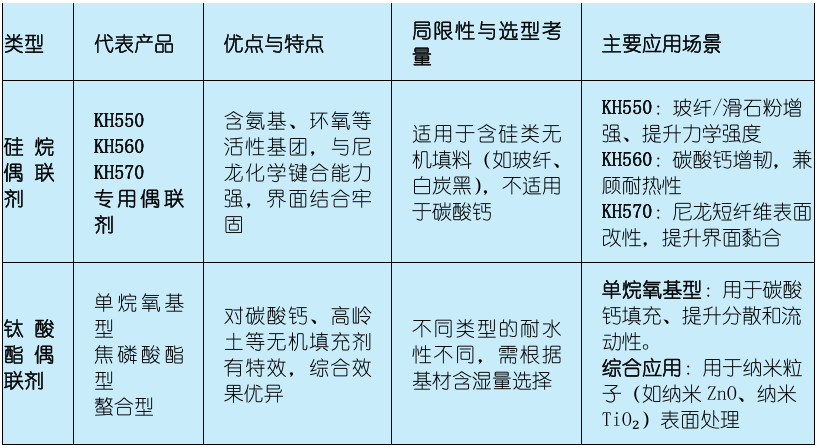
In short: Translate the above content into English and output only the translation, without any explanation.Silica-containing fillers such as glass fiber and fumed silica are usually preferentially treated with silane coupling agents; whereas filler systems such as calcium carbonate and kaolin generally respond better to titanate coupling agents.
Specific effects of coupling agents on nylon properties
1. Significantly improve mechanical propertiesCoupling agents can effectively enhance a material's impact resistance, flexural modulus, and tensile strength by improving the interface. For example, in a PA6/kaolinite system, the use of the KH550 coupling agent can increase the tensile strength of the material.16.9%,In PA66/glass fiber systems, the use of a special interfacial bonding agent can increase tensile strength by up to54.8%。
2. Improvement of thermal and processing propertiesCoupling agents can act as “lubricants” between the filler and the polymer melt, improving the system’s...Melt Flow Rate (MFR).Meanwhile, the modified filler can act as a heterogeneous nucleating agent.Increase the crystallization temperature and crystallization rate of nylon, thereby enhancing the thermal stability of the material.
3. Enhance special propertiesCoupling agents can significantly improve materials’ friction and wear properties, dimensional stability, hydrophobic/oil-resistant properties, and flame-retardant performance. For example, treating nano-SiO₂ with KH-550 can enhance the mechanical and wear-resistant properties of nylon 1010 composites.Treating wood flour or calcium carbonate with long-chain alkyl silane coupling agents can reduce the water absorption of the composite material.Reduce by approximately 30%;The newly developed temperature-responsive coupling agent can also catalyze char formation during high-temperature combustion, significantly enhancing flame retardancy.
Summary: How to Choose and Use
In short, the key to making good use of coupling agents during modification lies in:
-
Clarify modification objectives.Select according to the final performance requirements (such as high strength, high toughness, flame retardancy, etc.).
-
Consider the substrate and components.Different types of nylon have different concentrations of reactive end groups; at the same time, the type of inorganic filler or fiber that needs to be modified should be specified.
-
Preferred coupling agent typeFollow the principle of "silane with glass fiber, titanate with filler" for preliminary screening.
-
Optimization of Additive Quantity and ProcessThe amount added is usually at0.5% to 2%there is an optimal value between them,It needs to be determined through experiments. Surface modification of inorganic fillers with a coupling agent before processing usually produces better results than direct blending.
【Copyright and Disclaimer】The above information is collected and organized by PlastMatch. The copyright belongs to the original author. This article is reprinted for the purpose of providing more information, and it does not imply that PlastMatch endorses the views expressed in the article or guarantees its accuracy. If there are any errors in the source attribution or if your legitimate rights have been infringed, please contact us, and we will promptly correct or remove the content. If other media, websites, or individuals use the aforementioned content, they must clearly indicate the original source and origin of the work and assume legal responsibility on their own.
Most Popular
-

Layoffs, Divestments, Plant Closures While Pouring Billions: BASF Undergoes Major Transformation!
-

Ascend Adipic Acid Hit By Force Majeure, Market Expects Supply Resumption In Mid-September
-

Raw Material Supply Shortage! INEOS Phenol Declares Force Majeure on Phenol and Acetone Businesses
-
South Korea initiates anti-dumping investigation against Chinese PVC suspension resin! The target is Tianjin Bohua and Wanhua Chemical. How to break through?
-

Sixth national procurement set to be implemented: A “Reshuffling” Moment for the $10-Billion Medical Device Market