Pvc yellowing: How to Solve and Prevent It?
In the production, processing, and use of PVC products, yellowing is a common quality problem that plagues the industry. It not only affects the aesthetic appearance of the product but also potentially reduces the mechanical properties and service life of the material. As a professional in PVC material research and development and application, Rongjia New Materials has been deeply involved in the industry for many years. Today, we will delve into... Chemical mechanism Practical Application Here's a two-dimensional breakdown of six core strategies to prevent PVC yellowing, solving the yellowing problem from the source.
The essence of PVC yellowing The process involves the dehydrochlorination of molecular chains, leading to the formation of conjugated double bonds. Subsequently, oxidation, light exposure, and other factors catalyze the continuous growth of the conjugated chain, ultimately resulting in a yellow to brown-black appearance. Key to anti-yellowing To inhibit dehydrochlorination, block conjugated chain growth, scavenge free radicals, and isolate from photo-oxidative attack, we will now analyze the specific implementation methods one by one.
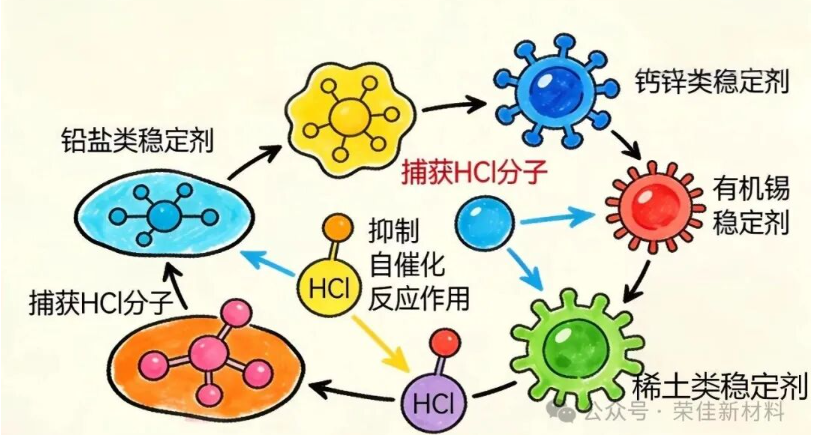
I. Use highly effective heat stabilizers: inhibit dehydrochlorination from the source (core of chemical defense).
Root mechanism The thermal degradation of PVC starts with the elimination of unstable chlorine atoms (such as allyl chloride, tertiary chloride) from the molecular chain, forming HCl. HCl autocatalytically accelerates the decomposition of more chain segments, leading to the formation of conjugated polyene structures (chromophores).
Core strategy: Translate the above content into English, output the translation directly, without any explanation.
- Lead salts :Traditional and efficient, neutralization of HCl with lead stabilizers is effective, but environmentally restricted. Suitable for cables and pipes where environmental compliance is not required.
- Calcium-zinc based: The mainstream approach to environmental protection involves a synergistic composite effect (Ca soaps capturing HCl, Zn soaps replacing labile chlorine atoms and inhibiting discoloration), which requires auxiliary stabilizers (such as β-diketones and polyols) to prevent "zinc burning." The Preferred Choice for Food, Medical, and Environmental Protection Hardware 。
Organotin compounds Efficient and transparent direct suppression of conjugated sequence growth via esterification. High clarity soft and rigid products (such as bottles, sheets) required options.
Rare earth elements Emerging high-efficiency and environmentally friendly stabilizer that stabilizes PVC molecular chains through unique coordination, possessing both long-term heat stability and improved processing fluidity, suitable for... High-end outdoor and engineering products.
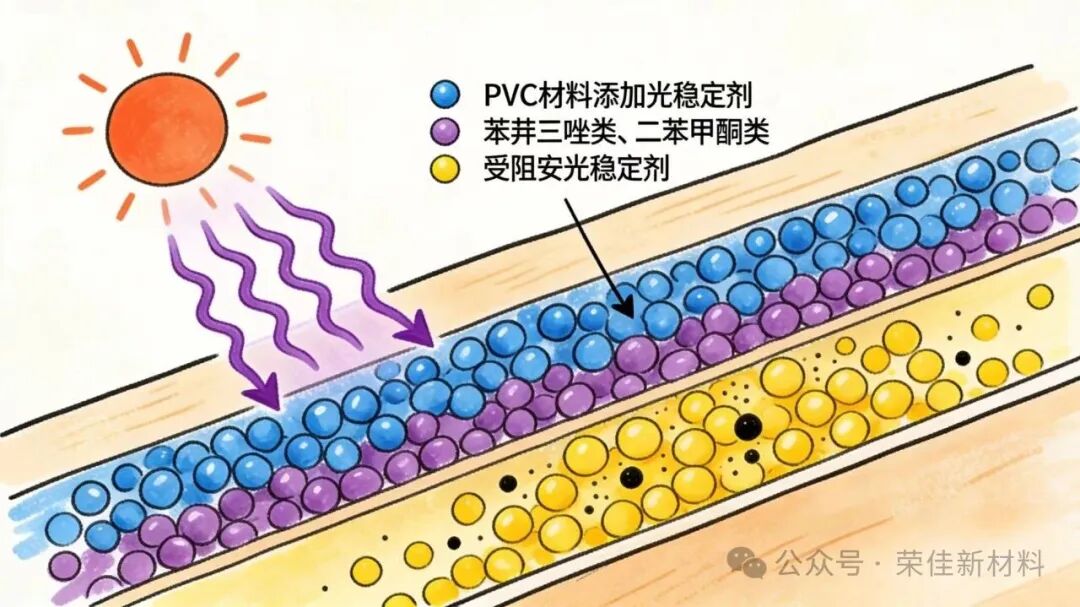
II. Adding Light Stabilizers: Precisely Targeting UV Erosion (Key to Preventing Yellowing Outdoors)
Root mechanism UV light (290-400nm) possesses sufficient energy to break the C-Cl bonds in PVC, initiating free radical photo-oxidation reactions and accelerating the formation of conjugated structures.
Core strategy:
UV absorbers Benzotriazoles (Tinuvin 326) , acting like "sunscreen," preferentially absorbs and converts UV light energy, providing the first line of defense for PVC.
Hindered amine light stabilizer HALS(Tinuvin 770)As a "free radical scavenger," it can continuously capture free radicals generated by photo-oxidation and be recycled for reuse, making it essential for long-term outdoor weathering products (such as profiles and coils).
III. Optimize Processing Conditions: Eliminate Thermal and Oxygen Processing Stress
Root mechanism Excessive processing (>200°C) or localized shear overheating, as well as contact of the melt with oxygen, directly induces thermo-oxidative degradation.
Core Strategy:
- Precise temperature control and shear management Progressive heating screw Set precise processing temperature windows, control processing parameters. Avoid excessive back pressure and high shear rates. Shorten the dwell time of the material in the barrel to prevent localized overheating.
- Inert gas protection and vacuum degassing Introduction at the feed port or die head , or using Vacuum vented extruder Effectively remove oxygen and volatiles, block oxidation from the processing environment, and reduce the probability of oxidative yellowing.
IV. Selection of Additive System: Avoid "Bad Teammates" Causing Secondary Degradation
Root mechanism Some additives are inherently prone to migration, oxidation, or color reactions with PVC degradation products.
Core strategy:
- Build antioxidant synergistic system Primary antioxidant (Phenols, such as BHT ) + Auxiliary antioxidant (Phosphites, such as 168 ) Compound, phenols capture free radicals, phosphites decompose hydroperoxides, inhibiting oxidation in two stages during initial processing and long-term use.
- Choose stable plasticizers and fillers. Priority Choose plasticizers with high molecular weight and migration resistance, such as trimellitates and polyester types. Avoid using inexpensive plasticizers containing unsaturated bonds. Choose fillers that are surface-treated and have low iron ion content.
V. Structural Modification: Enhancing the Intrinsic Stability of Polymers (Fundamental Solution)
Root mechanism Reducing weak points (tertiary chlorine, allyl chlorine) in PVC molecular chains or introducing structures that can block degradation chains.
Core Strategy:
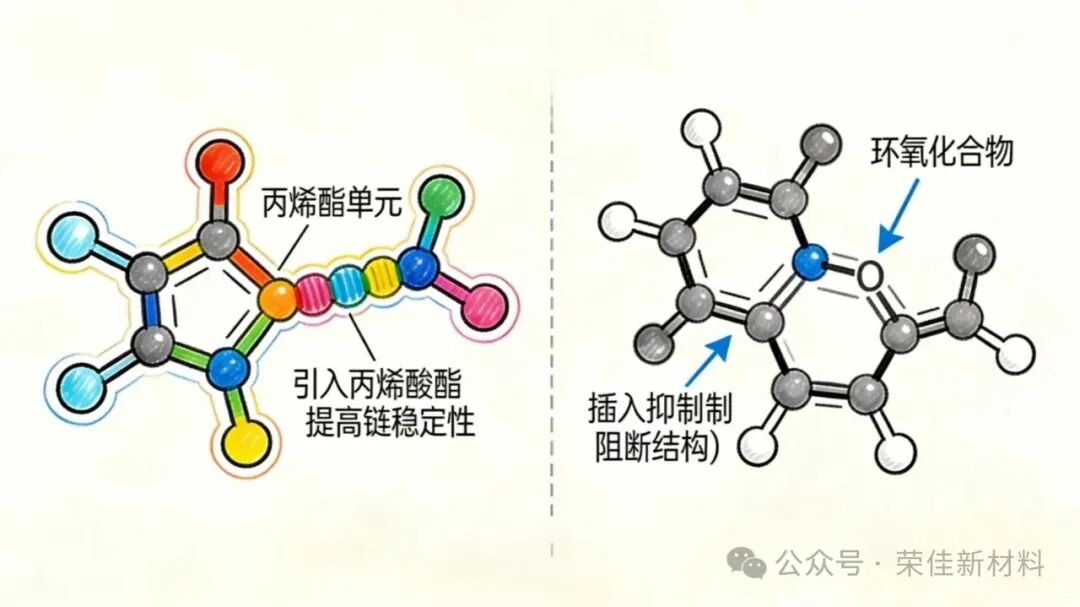
Copolymer modification Vinyl acetate (EVA) Copolymerization with other monomers disrupts the regularity of the molecular chain and reduces the rate of HCl elimination.
Grafting/Crosslinking Introduced by irradiation or chemical methods Acrylate Side chains are introduced, forming partial network structures, restricting molecular chain movement, reducing the content of tertiary chlorine atoms in the molecular chain (tertiary chlorine is a weak site for HCl elimination), and improving heat resistance. Recommend Rongjia New Material's modifier series.
- Add conjugate blocking agent: Epoxidized soybean oil , whose epoxy group can actively attack and add to the formed conjugated double bond. Undermining the foundation; to pull the firewood from under the cauldron. Ground blocks the path of color deepening.
VI. Building Physical Barriers: Isolating External Erosion of Light and Oxygen (The Last Line of Defense)
Root mechanism Form a dense, isolating layer on the material surface.
Core Strategy: Translate the above content into English, and output the translation directly without any explanation.
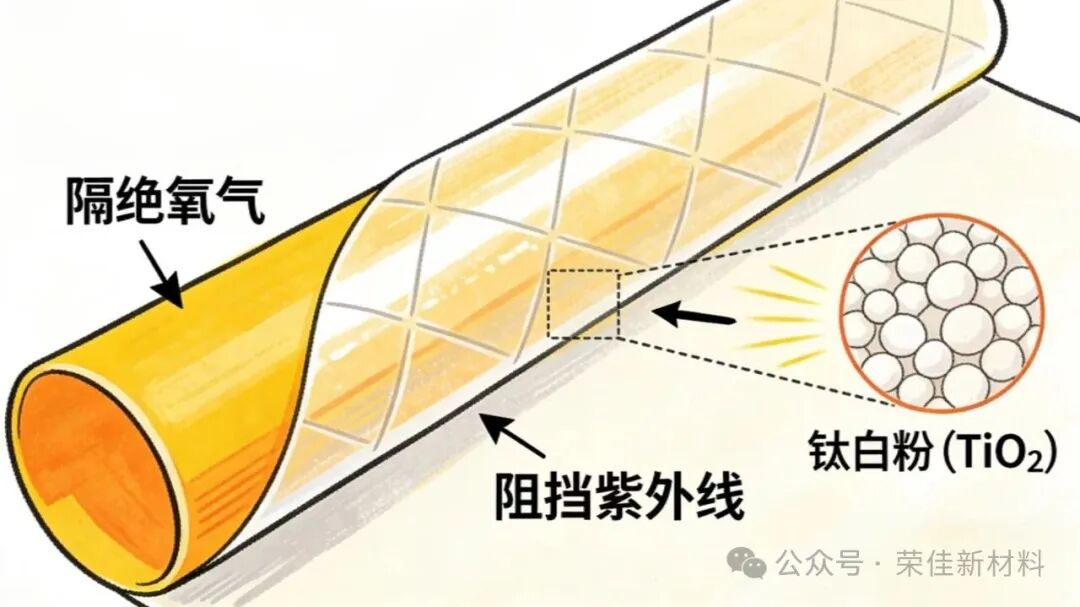
Surface treatment technology: Co-extrusion A protective layer containing a high concentration of light stabilizers, or applying... UV curing coating, fluorocarbon spraying , achieving high efficiency and weather resistance.
Functional pigments/fillers
Rutile titanium dioxide Ideally, a material with both excellent UV reflection and shielding capabilities is preferred, and it should be used in a sufficient quantity.
- Carbon black: The strongest UV absorber and antioxidant, but only suitable for black products, and high-structure, pure grades must be selected.
Preventing PVC yellowing is not a problem that can be solved by a single additive; rather, it's a... Stable system + Lean manufacturing + Structural design Systems engineering.
Recipe compounding synergy Core is Heat stabilizer + light stabilizer + antioxidant Optimize the antioxidant ternary combination of phenols, phosphites, and thioethers, and determine the dosage and ratio based on the product life cycle requirements.
Scenario-based customization.
Indoor general products Key focus: thermal stabilizers and processing.
Outdoor weather-resistant products : It is imperative to strengthen the triple protection of "light stabilizer + antioxidant + titanium dioxide".
* High transparency products: Select a transparent combination of organotin with a highly efficient UVA/HALS.
Eco-friendly high-end products High-performance Calcium-Zinc/Rare Earth + Polymer Additive all-environmentally-friendly solution.
3. Process full control: Minimize exposure to heat, light, and oxygen throughout the entire process, from raw material storage (protected from light and moisture) to processing and subsequent storage and transportation.
【Copyright and Disclaimer】The above information is collected and organized by PlastMatch. The copyright belongs to the original author. This article is reprinted for the purpose of providing more information, and it does not imply that PlastMatch endorses the views expressed in the article or guarantees its accuracy. If there are any errors in the source attribution or if your legitimate rights have been infringed, please contact us, and we will promptly correct or remove the content. If other media, websites, or individuals use the aforementioned content, they must clearly indicate the original source and origin of the work and assume legal responsibility on their own.
Most Popular
-

Continental Plans to Begin Sale of ContiTech in Early 2026
-

$4 Billion! Medtronic Makes Another Acquisition
-
BASF Delivers First Batch of Innovative Cathode Materials for Semi-Solid-State Batteries to Weilan New Energy
-
Profit and Revenue Growth Struggle to Conceal Debt Repayment Pressure; Success of Kingfa Sci & Tech's High-End Strategy Yet to Be Seen
-
Why did a century-old european dental instrument giant relocate its manufacturing hub to china?