



“plas” origin | is pha considered “plastic”? — a reexamination based on scientific literature and eu regulatory logic
In recent years, alongside the accelerated global effort to address plastic pollution, the question of “what constitutes plastic” has moved from the laboratory into the legislative arena. Under the framework of the European Union’s Single-Use Plastics Directive (SUPD), polyhydroxyalkanoates (PHA) are classified as “plastics.” This classification has sparked ongoing debate in both academic and industrial circles. Is PHA truly a plastic, or is it a natural polymer material that has been misunderstood? Based on published academic literature and the current regulatory texts of the European Union, this article systematically reviews the scientific nature and regulatory logic behind this issue.
Where does the controversy over PHA's "identity" originate?
The root of the issue lies in the SUPD’s definitional framework for “plastic.” The Directive defines plastic as “a material consisting of a polymer,” while establishing a key exemption for “natural polymers that have not been chemically modified.” In other words, if a material is classified as a “natural polymer” and has not been chemically modified, it is not subject to the restrictions applicable to single-use plastic products under the SUPD. Whether PHA is considered plastic depends on whether it satisfies the conditions for this exemption.
In the implementation guidelines for the SUPD released by the European Commission in 2021, it was explicitly stated that PHA does not qualify as a natural polymer and therefore cannot be exempted. The core reason is that, although PHA is synthesized by microorganisms, large-scale production is carried out in industrial fermenters and involves artificial induction and chemical engineering steps; therefore, the polymerization process “does not occur in nature.” The conclusion drawn from this is: PHA = plastic.
However, this line of reasoning is scientifically open to question. The following discussion will elaborate on this from four dimensions: the core definitions in the ECHA guidance, comparisons with other “natural polymers,” the material nature of PHA, and the window for regulatory revision.
1. Key Definitions in the ECHA Guidelines: Where Does the Polymerization Process Occur?
The authoritative interpretation of “natural polymers” in the EU comes from the guidance of the European Chemicals Agency (ECHA). The guidance explicitly states: “Natural polymers are polymers whose polymerization occurs in nature, regardless of the method by which they are extracted.”
This sentence contains two key pieces of information:
Firstly, "the polymerization reaction occurs in nature." This emphasizes the setting of the polymerization process itself—specifically, the environment in which monomers connect to form polymer chains—rather than the "degree of human intervention" in that environment. The polymerization of PHA takes place entirely within the cells of living microorganisms, catalyzed by naturally occurring PHA synthases, from the first monomer connection to the last. The role of industrial fermentation tanks is to provide these microorganisms with nutrients and suitable temperatures, enabling them to carry out metabolic activities that would naturally occur in the environment more efficiently. The polymerization process itself has not departed from the biological entity.
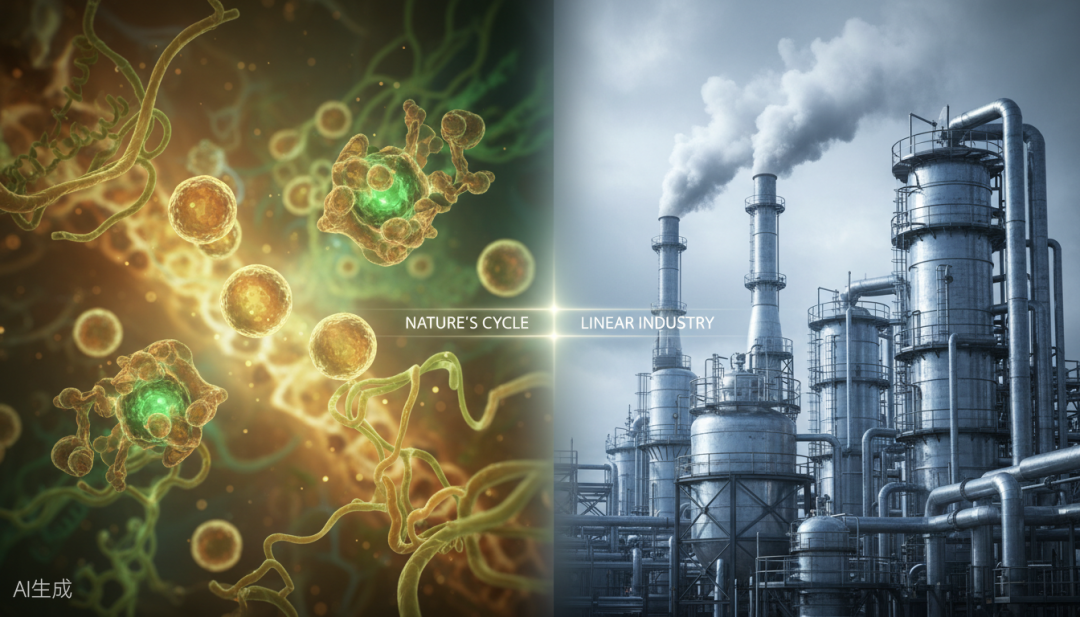
Figure: Natural microbial synthesis of PHA vs. industrial production of traditional plastics
Second, “irrespective of the extraction method.” ECHA explicitly excludes the extraction/production method from affecting the determination in its guidance. In other words, whether a material is “collected from the wild” or “obtained from a factory workshop” should not be a basis for determining whether it is a natural polymer. This provision means that the European Commission’s logic of denying PHA’s natural attributes on the grounds of “industrial fermentation” is inherently inconsistent with the determination criteria formulated by ECHA itself.
Furthermore, ECHA further clarifies in its definition of “natural substance” that “substances occurring in nature” include substances obtained from plants, microorganisms, and animals. Microorganisms are biological entities and have the same status as plants and animals. Therefore, substances obtained through the cultivation of microorganisms should, like substances obtained from plants and animals, be regarded as natural substances. In the position paper submitted to the European Union, GO!PHA accordingly states that, based on ECHA’s dual definitions of natural polymers and natural substances, PHA should be recognized as a natural polymer that has not been chemically modified.
2. Comparison with Other “Natural Polymers”: Inconsistencies in Standards
The determination of “natural polymers” under the SUPD framework has shown inconsistencies in practice.
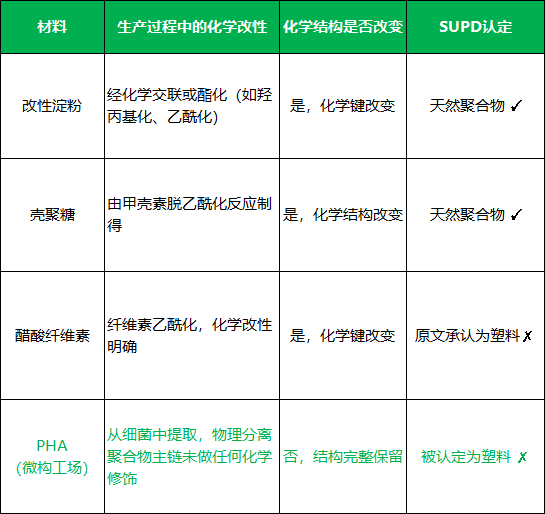
Figure: Classification Differences of Different Materials under SUPD Identification Standards
Modified starch, chitosan and other materials have been recognized as natural polymers under the SUPD framework. However, these materials undergo explicit chemical modification during production: modified starch requires chemical crosslinking or esterification reactions, while chitosan is produced from chitin through a deacetylation reaction—both involve artificial changes to their chemical structures. In contrast, the extraction of PHA from bacteria is a physical separation process, during which the polymer backbone does not undergo any chemical modification and its chemical structure remains fully intact.
This means that materials whose chemical structures have been altered are granted the status of “natural polymers,” while PHAs, whose chemical structures have never been altered, are instead excluded. In practice, the current definition produces outcomes that contradict its own scientific principles.
Viscose and lyocell fibers have been reclassified as natural polymers in the latest guidance and are exempted from the SUPD. ECHA’s reasoning is that the assessment should be based on the “end point,” namely the state of the product at the end of the extraction process: if the resulting product is a natural polymer and has not been chemically modified, it should qualify for exemption. In its position paper, GO!PHA argues that if this “end-point reasoning” is applied equally to PHA—taking the polymer produced at the end of microbial fermentation as the object of assessment—then PHA should logically receive the same treatment.
In addition, the EU has established a precedent for recognizing fermentation products as “natural” in its food flavoring regulation (Regulation (EC) No 1334/2008): flavoring substances produced through fermentation or microbial processes are regarded as natural flavoring substances, provided that they are identical to substances identified in nature. GO!PHA recommends that the EU extend this logic to the field of polymers—PHA is produced through fermentation, and its chemical structure is completely identical to that of PHA naturally occurring in the environment, and should therefore be granted the same recognition.
3. The Material Essence of PHA: Why Is It More Than Just a Bioplastic?
In 2024, Park et al. published a systematic review paper titled “PHA is not just a bioplastic!” in the journal Biotechnology Advances. From four dimensions—source, synthesis process, material properties, and application scenarios—they comprehensively demonstrated the essential differences between PHA and conventional plastics (including most bio-based plastics).
From the source perspective, PHA is not a synthetically designed compound but a natural metabolic product of microorganisms. Approximately 92 genera of bacteria in nature can naturally synthesize and store PHA as a carbon and energy reserve, and these microorganisms are widely found in soil, marine, and freshwater environments. From an evolutionary standpoint, PHA has existed in nature for millions of years, and its ecological role is highly similar to that of other natural polymers (such as cellulose, starch, and proteins).
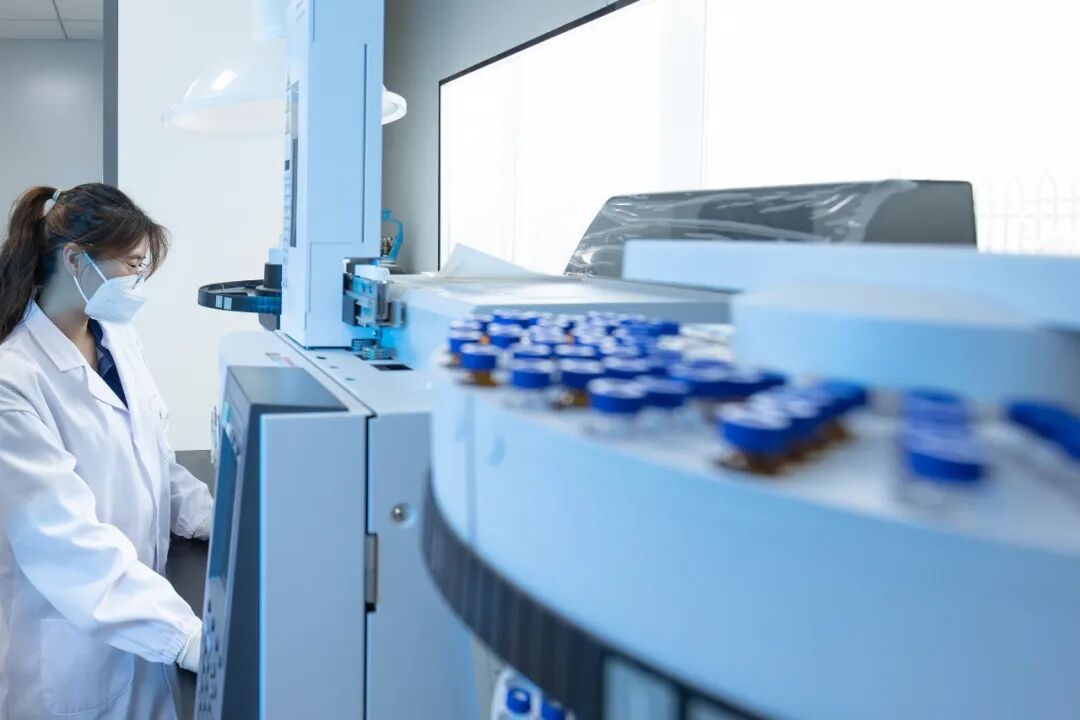
From the synthesis process perspective, conventional bioplastics such as polylactic acid (PLA) require chemical condensation polymerization under high-temperature and high-pressure conditions, a process carried out entirely under artificial conditions. In contrast, the polymerization of PHA is catalyzed by natural enzymes within microbial cells and is completed under ambient temperature and pressure, with the polymerization reaction never leaving the interior of the living organism.
From the perspective of material properties, PHA is a large family of materials: short-chain PHA has properties similar to polypropylene (PP) and polyethylene terephthalate (PET), medium-chain PHA exhibits rubber-like elasticity, and ultra-high molecular weight PHA can be used for high-strength fibers. Its properties can be customized and adjusted through metabolic engineering, and its application boundaries far exceed those of traditional natural polymer materials such as cellulose and starch.
From the perspective of application scenarios, the applications of PHA have long extended far beyond the scope of “packaging materials,” covering a wide range of fields such as medical implants, tissue engineering scaffolds, drug controlled-release carriers, agricultural soil improvement, and carbon sources for wastewater treatment. These diverse application scenarios indicate that simply classifying PHA as a “single-use plastic” is neither scientifically accurate nor conducive to unlocking its innovation potential in critical fields.
Of particular note is PHA’s unique performance in environmental degradation. Unlike conventional fossil-based plastics, PHA can be completely degraded by microbial activity in a variety of natural environments, including the ocean, freshwater, and soil, and is ultimately mineralized into carbon dioxide and water without generating persistent microplastics. This characteristic is not found in any current conventional plastic, whether fossil-based or bio-based.
4. Regulatory Window: The Final Outcome Has Yet to Arrive
The decision to classify PHA as a plastic is not “final.” Under Article 15 of the SUPD, the European Commission is required to evaluate and revise the Directive. The SUPD is currently within the legally mandated evaluation and revision window.
In March 2026, European Bioplastics (EUBP), in its assessment submitted to the European Commission, explicitly called for the definition of “plastic” under the SUPD to be clarified or adjusted so as to exempt certified biodegradable polymers; it stated that a targeted revision of the SUPD could strengthen environmental outcomes while supporting European innovation.
GO!PHA and nova-Institut conducted a systematic review of the definition of "natural polymers" in EU policies and scientific literature. The analysis shows that the scientific community generally considers materials produced through biological processes (such as fermentation) that have the same chemical structure as polymers found in nature to be natural materials. However, current policy interpretations often rely solely on the location of polymer production, which may create unnecessary barriers for "nature-identical materials." Based on this, the report proposes three pathways to align policy with science: revising the definition of natural polymers, adopting assessment methods based on environmental performance (such as biodegradability), and introducing a category for "nature-identical polymers" to ensure fair regulatory treatment for biomanufactured materials. Between 2025 and 2026, GO!PHA, in collaboration with EUBP, nova-Institut, and other organizations, formed a cross-industry "Natural Polymers Coalition" to continuously submit technical opinions to the European Commission. Their core demand is to exclude PHA from the restrictive plastic definitions in the SUPD and to return to its scientific essence as a natural polymer.
The key milestone in this window is expected to be around 2027. Before then, there remains a substantive possibility that PHA’s status under SUPD may be revised. It is not yet time to draw a conclusion.
Realistic Response: Current Path of PHA Coated Paper Cups
The above discussion has focused on clarifying scientific definitions, but the more pressing issue facing industry is this: during the transitional period before the definitions are revised, how should products such as PHA-coated paper cups respond?
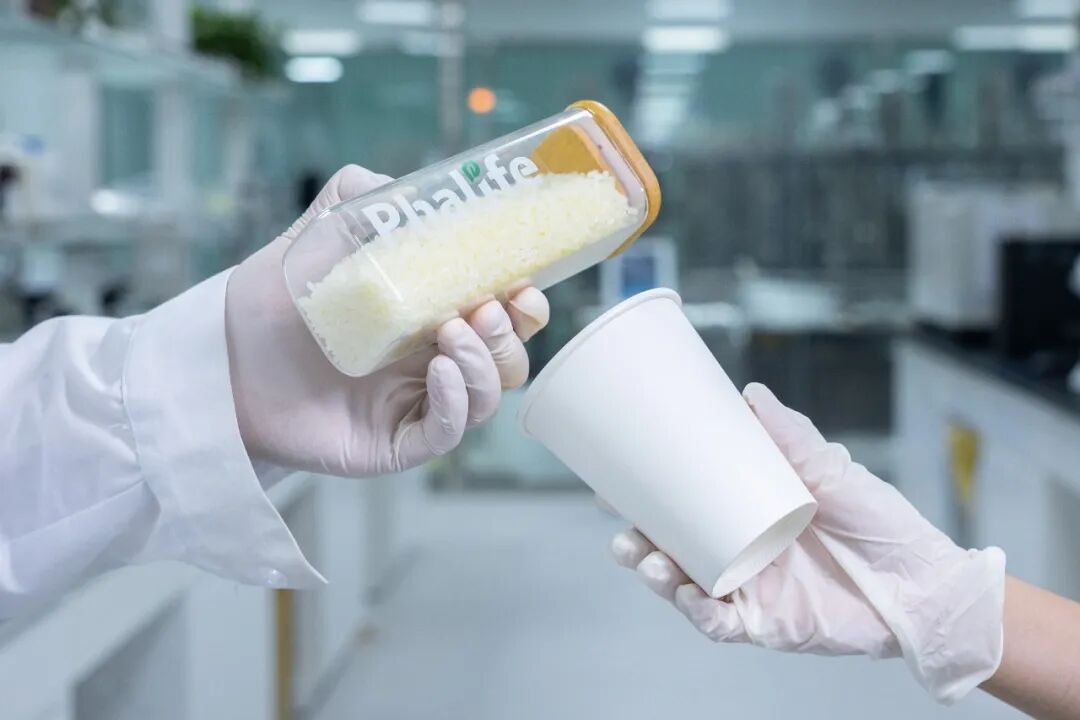
First, we need to face the current reality. PHA’s current situation under the SUPD framework is an industry-wide challenge, and avoiding it serves no purpose. Regulatory realities must be respected, and compliance risks must be factored into decision-making. But this does not mean the industry can only stand still and wait.
Secondly, the EU is not the only market in the world. In markets such as North America, Asia-Pacific, and the Middle East, the compostable properties of PHA are already recognized by certification systems. Some PHA producers have obtained international certifications such as TÜV OK Home Compost and BPI for their products, providing a clear and well-defined compliance pathway in these markets. Differentiated market strategies therefore offer practical commercial flexibility for PHA products.
More importantly, the debate over definitions should not be abandoned. The revision window for the SUPD around 2027 represents a genuine opportunity for the PHA industry to reclaim its rightful recognition. At present, the GO!PHA alliance, together with European Bioplastics, nova-Institute, and other organizations, has formed a cross-industry “Natural Polymers Alliance,” which continues to submit technical input to the European Commission and advocate for restoring the definition of “natural polymers” to a scientifically grounded basis. Sustained academic argumentation and policy advocacy are the core driving forces behind this battle over definitions.
To do a good job with the application and to promote the clarification of definitions are not mutually exclusive choices. The former pertains to the present, while the latter focuses on the future. Both paths are worth pursuing seriously.
PHA is not a kind of plastic that needs to be “given special leniency,” but rather a biochemical product that has existed in nature and circulated on Earth for millions of years—it is synthesized by microorganisms, widely found in soil, marine, and freshwater ecosystems, and is the only polymeric material that can be completely mineralized in the marine environment without leaving microplastics.
The ultimate purpose of scientific definition is not to serve any particular material or any specific interest, but to ensure that regulations truly and precisely fulfill their original legislative intent: reducing environmental pollution, protecting ecosystems, and promoting the sustainable development of human society. In this sense, setting the record straight for PHA is not only a clarification of a material, but also a respect for the scientific spirit of regulation.
【Copyright and Disclaimer】The above information is collected and organized by PlastMatch. The copyright belongs to the original author. This article is reprinted for the purpose of providing more information, and it does not imply that PlastMatch endorses the views expressed in the article or guarantees its accuracy. If there are any errors in the source attribution or if your legitimate rights have been infringed, please contact us, and we will promptly correct or remove the content. If other media, websites, or individuals use the aforementioned content, they must clearly indicate the original source and origin of the work and assume legal responsibility on their own.
Most Popular
-

A Look at the Material Suppliers Behind SpaceX
-
Government's Triple Action, Enterprises' Three Arrows in Five Days, Semiconductor Reshuffle! What Signal Does Japan's Chemical Industry Release?
-

Next-generation motors of new energy vehicles: Single-Round Thousand Horsepower, Replacing Brakes, How Powerful Are They?
-
Shutdowns And Production Cuts! Widespread Price Quotes Suspended, Chemical Products May Still Be Easier To Rise Than Fall In June-July!
-

Japan Plans To Sell Lithography Giant JSR! Fujifilm And Mitsubishi Chemical Interested In Taking Over, How Much Time Window Is Left For China?


