



Panic Escalates! Chemicals "Price Hike Wave" Sweeps the Globe!
On the 3rd local time, Mohammad Akbarzadeh, Deputy Commander of the Islamic Revolutionary Guard Corps Navy, stated that the Strait of Hormuz is now fully under the control of the Iranian Navy, and more than ten oil tankers have been hit by shells in the strait.
On the same day, Iraq's Ministry of Oil stated: Due to the closure of the Strait of Hormuz and disruption of shipping, oil tankers in the Persian Gulf have been blocked and southern ports are short of vessels; production has been suspended in the southern Rumaila oilfields; exports from the Kurdistan Region in the north to Turkey’s Ceyhan port have been halted; West Qurna Phase 2 oilfield has cut output by 450,000 barrels per day; and the Maysan oilfield has reduced production by 325,000 barrels per day due to full storage tanks.
As of March 4, 2026, the Brent crude oil continuous contract reached a intra-day high of 82.77, setting a new high in recent years, while the main contract of crude oil reached an intra-day high of 641.1, marking a new high in nearly two years.
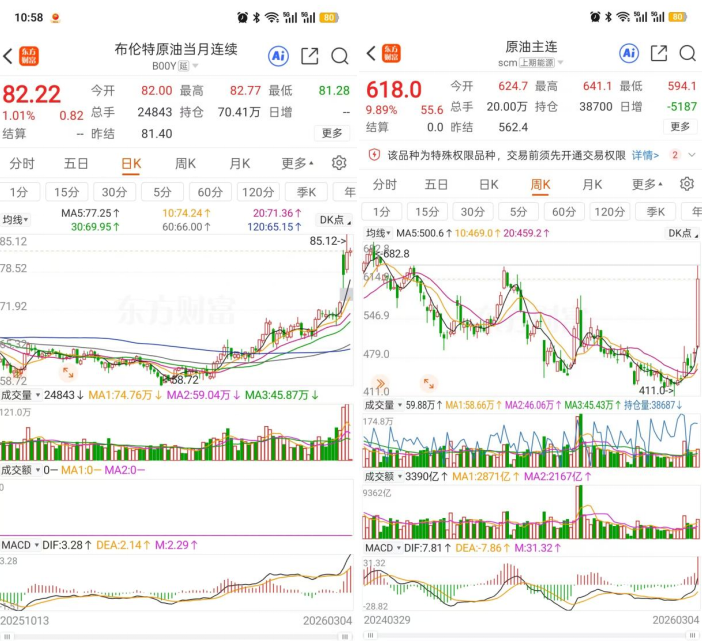
Recently, influenced by multiple factors including international geopolitical tensions and crude oil price volatility, fuel oil futures prices have surged significantly, driving heightened market trading sentiment. Current market movements are notably driven by event-driven factors and emotional resonance, resulting in high uncertainty. Escalating geopolitical tensions among the U.S., Israel, and Iran have particularly fueled substantial price increases in both high-sulfur and low-sulfur fuel oil futures.
US gasoline prices see biggest jump in four years
On Tuesday, Eastern Time, as the war in the Middle East intensified, crude oil prices continued to soar, and the price of gasoline at U.S. gas stations had risen significantly, increasing from about $2.9 per gallon to over $3.1 in just two days.
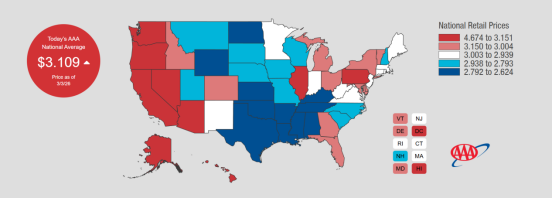
According to data from the American Automobile Association (AAA), the national average gasoline price at U.S. service stations rose by $0.10 per gallon over the past 24 hours, reaching nearly $3.11 per gallon. This is the largest single-day increase in U.S. gasoline prices since March 2022.
Shipping through the Strait of Hormuz is disrupted. JPMorgan warns that if the restriction lasts 3–4 weeks, Brent crude prices could surpass $100 per barrel, compared to the current level of around $80 per barrel, with WTI crude trading above $76 per barrel.
Escalating Middle East conflicts lead to rising gasoline prices in Singapore
Due to the ongoing escalation of conflicts in the Middle East, which has cut off an important oil supply route with no end in sight, gasoline prices have surged significantly.
On the morning of March 3, Shell was the first to raise the price of the popular 95-octane gasoline by 4 cents, to S$2.92 per liter.
Caltex raised prices in the afternoon, matching Shell's prices, and Esso followed shortly after.
Global leading shipping companies collectively raise prices, with multiple surcharges approaching
Affected by the continuous tension in the security situation in the Strait of Hormuz and its surrounding waters, the world's top four shipping companies - Hapag-Lloyd, CMA CGM, Maersk, and Mediterranean Shipping Company (MSC) - have announced an increase in multiple maritime surcharges starting from March 2026. This move directly adds to the import and export costs for shippers, posing new operational challenges for already pressured foreign trade enterprises.
Hapag-Lloyd has taken the lead in introducing a new War Risk Surcharge (WRS), explicitly applicable to all cargo moving to and from the Shanghai Bay, Arabian Gulf, and Persian Gulf. The charge is uniformly set at USD 1,500 per TEU (twenty-foot equivalent unit) and will take effect on March 2.
CMA CGM has simultaneously introduced an Emergency Crisis Surcharge (ECS), which takes effect on March 2, the same as Hapag-Lloyd. The charging standards are differentiated according to container types: $2,000 per 20-foot dry container, $3,000 per 40-foot dry container, and $4,000 per container for reefers and special equipment. The surcharge applies to a wide range of countries in the Middle East, including Iraq, UAE, Saudi Arabia, and more than ten other Middle Eastern nations, covering most cargo on Middle Eastern routes.
Maersk has adopted a "multi-pronged" pricing adjustment strategy, announcing three surcharge-related adjustments at once, covering multiple core routes: including from Far East to Latin America, Middle East Gulf and Indian Subcontinent to North Europe and the Mediterranean, and Southeast Asia to West Africa. The charging standards and effective dates for different routes vary, comprehensively covering high-risk and core trade routes.
Mediterranean Shipping Company (MSC) has adopted a more direct approach to price adjustments, increasing the base freight rates for several core routes starting from March 15, while also requiring shippers to pay additional surcharges. As a result of this dual increase, the overall shipping costs for shippers have risen significantly, further exacerbating cost pressures.
1. Suspend all new booking activities from worldwide destinations to the UAE (excluding Fujairah and Khor Fakkan), Qatar, Bahrain, Iraq, the Kingdom of Saudi Arabia (excluding Jeddah), and Kuwait.
2. Suspend all new bookings from UAE (excluding Fujairah, Halul), Qatar, Bahrain, Iraq, Kingdom of Saudi Arabia (excluding Jeddah), and Kuwait to the world.
The global natural gas "artery" has been cut! European gas prices soar by 50%
On March 2, QatarEnergy, the world's largest natural gas producer, urgently announced that its liquefied natural gas (LNG) export facilities had been forced to halt operations entirely following a military attack. On the same day, European natural gas prices surged, at one point soaring by 50%, triggering widespread market panic.
Qatar Energy stated in an official statement that its integrated facilities located in Ras Laffan, the world's largest liquefied natural gas (LNG) export base, were deliberately attacked by drones. The attack damaged a water storage tank at a power plant and another key energy facility. To ensure safety, the company immediately suspended all LNG production operations. So far, Qatar Energy has not released a specific timeline for the repair of the facilities and the resumption of production, and the market's concerns over the supply gap continue to rise.
As the “behemoth” of the global LNG market, QatarEnergy accounts for approximately 20% of global liquefied natural gas exports; the shutdown of its export facilities is equivalent to instantly severing a “main artery” of global natural gas trade, directly impacting the global energy supply landscape.
Goldman Sachs analysts noted that, unlike the oil market, European natural gas prices contained virtually no geopolitical risk premium related to Iran prior to the outbreak of the recent Middle East conflict, implying significant upside potential for European natural gas prices going forward and suggesting that energy market volatility may continue to intensify.
PX prices rise in Asia, Europe, and other regions
Asian paraxylene prices increased by $20/ton, closing at $994-996/ton FOB Korea and $1019-1021/ton CFR China.
PX price in Europe increased by 15 USD/ton, closing at 965-967 USD/ton FOB Rotterdam.
The U.S. paraxylene price increased by $19/MT, closing at $1,070–$1,080/MT FOB U.S. Gulf.
The price of paraxylene in China has increased by 600 yuan/ton, and the current price is 8200 yuan/ton, with this price being implemented in East China, North China, Central China, and South China. Petrochemical plants such as Yangzi Petrochemical and Zhenhai Petrochemical are operating stably with normal sales.
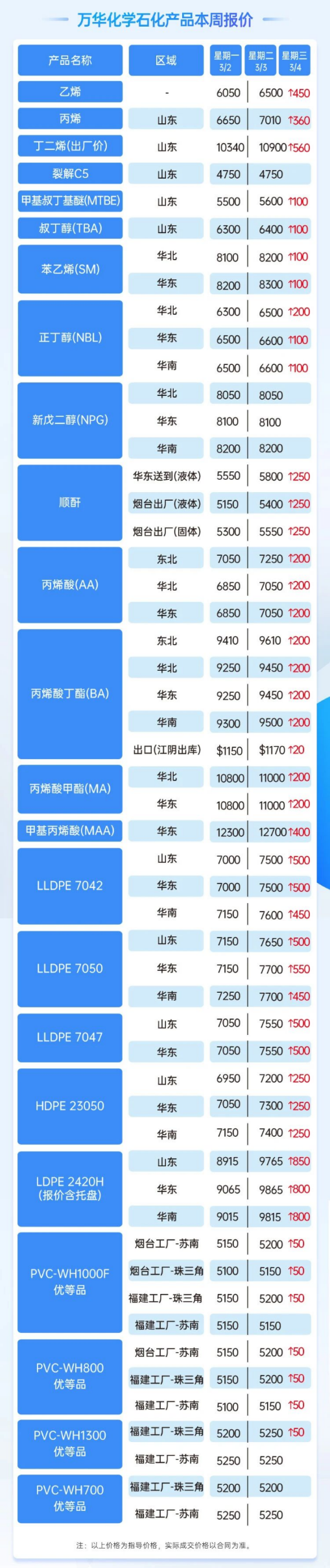
Domestic chemical products are experiencing a wave of concentrated price hikes.
Supported by rising crude oil prices, escalating geopolitical risks, and tightening supply, domestic chemical products are experiencing a wave of price increases, with numerous companies raising their quotations.
Sinopec and Refining and Chemical Enterprises Price Adjustment
Sinopec East China Diethylene Glycol: Increased by RMB 650 per ton
Sinopec Zhanjiang Petrochemical Diethylene Glycol: Increased by RMB 450/ton, premium grade ex-works self-pickup price at RMB 3,780/ton.
Sinopec South China Toluene/Xylene: both increased by 300 yuan/ton
Guangzhou Petrochemical, Maoming Petrochemical, and Zhongke Refining & Chemical: toluene at RMB 6,100 per ton, xylene at RMB 6,450 per ton.
Sinopec butadiene: increased by CNY 600/ton, effective price CNY 11,000/ton.
Supported by geopolitical conflicts, rising crude oil prices, and robust downstream demand, the market remained relatively strong.
Propylene, propylene, aniline all rose.
Acrylonitrile
Tianchen Qixiang increased the price by RMB 400/ton, now at RMB 7,500/ton.
Jilin Petrochemical, Fushun Petrochemical, and Shandong Keru’er each increased their prices by RMB 300 per ton, to RMB 7,600 per ton, RMB 7,600 per ton, and RMB 7,500 per ton, respectively.
Propylene:
Shandong Huifeng Petrochemical increased its price by 420 RMB/ton to 7,070 RMB/ton.
Aniline:
Dongying Huatai, Dongying Jinmao, Shandong Jinling increase by 100 yuan/ton.
Jiangsu Fuchang increases by 100 yuan/ton.
Chongqing Changfeng increases by 100 yuan/ton.
EPS: Dongying Hairong increases by 100 yuan/ton.
PS: Zhanjiang Xin Zhongmei has increased its price by 300 yuan/ton.
Dichloromethane: Shandong Dongyue increased prices by RMB 200 per ton, and Luxi Chemical increased prices by RMB 220 per ton.
n-Butanol: Shandong Lihuayi raised the price by RMB 100/ton.
Isopropanol: Lihua Yimeng increases by 300 yuan/ton.
DMF: Spot delivery price in South China is RMB 4,200–4,300 per ton, with market sentiment continuing to shift upward.
Sodium metabisulfite: Industrial grade in Hebei rose by RMB 100/ton to RMB 2,400/ton, driven by high costs of sulfur and soda ash.
Ammonium sulfate: Hualu Hengsheng increased the price of caprolactam-grade ammonium sulfate by RMB 10 per ton to RMB 1,280 per ton, and power plant-grade ammonium sulfate by RMB 40 per ton to RMB 1,175 per ton.
Caprolactam: Hualu Hengsheng's delivered price in East China increased by 550 yuan/ton.
Fourth, TPU industry has seen a significant price increase.
Wanhua Chemical, Huafeng, Meirui New Materials, Yinuowei, Daowen High Molecular, Leide New Materials, Jintang Technology, and Huada Chemical—eight companies—jointly announced price increases, raising prices for mainstream products by RMB 1,000–1,500 per ton; specialty materials saw even higher increases, and cost pass-through is accelerating.
Overall, with ongoing geopolitical tensions, rising costs of crude oil and shipping, and robust downstream demand, the domestic chemical market is clearly on an upward trend and is expected to maintain a strong performance in the short term.
MTBE offshore market closed higher:
The Asian MTBE market closed up 39.13 USD/ton from the previous trading day, with FOB Singapore at 817.53-819.53 USD/ton.
The European MTBE market closing price increased by 40.5 USD/ton compared to the previous trading day, with FOB ARA at 885.24-885.74 USD/ton.
The U.S. MTBE market closed $30.74/MT higher than the previous trading day, with FOB Gulf Coast prices settling at $806.57–$806.92/MT ($227.74–$227.84/gal).
The ongoing escalation of geopolitical conflicts in the Middle East, with the security situation in the Strait of Hormuz and its surrounding waters becoming increasingly tense, is causing a new round of severe disruptions to the global energy, shipping, and chemical industry chains, and the impact on the chemical industry has become fully evident.
Overall, the escalating tensions in the Middle East have evolved from a localized regional risk into a comprehensive cost shock across the entire value chain—spanning energy, shipping, chemical raw materials, and finished products. The global chemical industry is now simultaneously grappling with rising raw material prices, higher freight costs, supply instability, and delivery delays. As a result, the industry’s cost curve and supply chain landscape are undergoing fundamental restructuring.
【Copyright and Disclaimer】The above information is collected and organized by PlastMatch. The copyright belongs to the original author. This article is reprinted for the purpose of providing more information, and it does not imply that PlastMatch endorses the views expressed in the article or guarantees its accuracy. If there are any errors in the source attribution or if your legitimate rights have been infringed, please contact us, and we will promptly correct or remove the content. If other media, websites, or individuals use the aforementioned content, they must clearly indicate the original source and origin of the work and assume legal responsibility on their own.
Most Popular
-
A Look at the Material Suppliers Behind SpaceX
-
Government's Triple Action, Enterprises' Three Arrows in Five Days, Semiconductor Reshuffle! What Signal Does Japan's Chemical Industry Release?
-
Fire breaks out at jiangsu meiside!
-
Name change without tax change: POM Anti-Dumping Duty Rate Inheritance Implemented
-
Ethylene: Production Capacity Accelerates Expansion, Global Industry Landscape Is Being Reshaped


