Nylon Toughening Masterbatch: Helping Nylon Products Say Goodbye to Brittleness
Under the trend of lightweight engineering plastics, nylon materials are widely used in automotive components, new energy parts, electronics, industrial ties, and pipes and fittings due to their excellent mechanical properties, wear resistance, and chemical corrosion resistance.
However, the inherent toughness of nylon is insufficient, leading to prominent issues such as easy cracking under stress, embrittlement at low temperatures, and damage after repeated bending, resulting in a high product cracking rate, fluctuations in yield, and poor environmental adaptability, which restricts the improvement of production quality and efficiency.
Traditional toughening schemes mainly rely on high proportions of elastomer blends or inorganic filler additions. The former typically requires an addition of over 10%, which can enhance toughness but significantly reduces the material's rigidity, strength, and heat deflection temperature. The latter has limited toughening efficiency, and excessive addition can lead to stress concentration.
Both types of solutions face limitations such as difficulty in compatibility control, narrow process windows, and rising comprehensive costs, making it challenging to balance quality and cost-effectiveness. The downstream production end urgently requires a specialized masterbatch that has a low additive amount, broad adaptability, and good process compatibility, effectively improving the toughness shortcomings of nylon without significantly adjusting existing formulations and processes.
Low-addition functional toughening masterbatch offers a feasible solution to this issue. By optimizing the compatibility between its molecular structure and the nylon matrix, the dispersed phase can be uniformly distributed within the matrix and form a stable interfacial bond, thereby achieving the desired toughening effect at a relatively low addition level while avoiding the deterioration of other material properties caused by conventional high-loading blending.
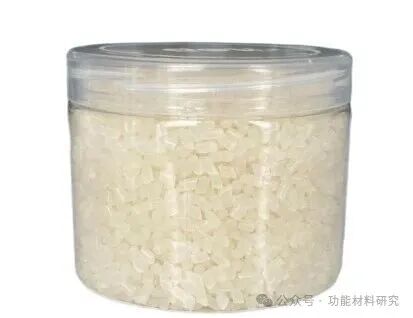
The product has the following core features:
According to the tests conducted in accordance with ISO 179-1 and ISO 527-2 standards, the performance data at different addition ratios are as follows:
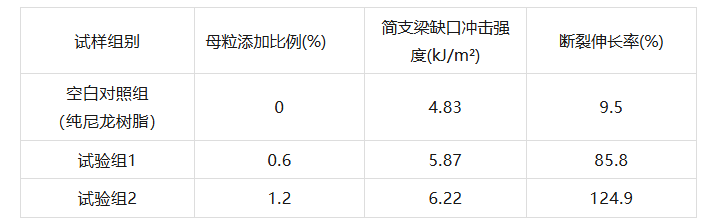
Nylon toughening masterbatches, characterized by low addition, high efficiency, and process compatibility, provide a cost-effective and simplified technical path for nylon modification. They are suitable for fields requiring toughness, such as automotive parts, new energy components, electronic appliances, and industrial pipes.
【Copyright and Disclaimer】The above information is collected and organized by PlastMatch. The copyright belongs to the original author. This article is reprinted for the purpose of providing more information, and it does not imply that PlastMatch endorses the views expressed in the article or guarantees its accuracy. If there are any errors in the source attribution or if your legitimate rights have been infringed, please contact us, and we will promptly correct or remove the content. If other media, websites, or individuals use the aforementioned content, they must clearly indicate the original source and origin of the work and assume legal responsibility on their own.
Most Popular
-

Layoffs, Divestments, Plant Closures While Pouring Billions: BASF Undergoes Major Transformation!
-
Ascend Adipic Acid Hit By Force Majeure, Market Expects Supply Resumption In Mid-September
-

Raw Material Supply Shortage! INEOS Phenol Declares Force Majeure on Phenol and Acetone Businesses
-
South Korea initiates anti-dumping investigation against Chinese PVC suspension resin! The target is Tianjin Bohua and Wanhua Chemical. How to break through?
-

Sixth national procurement set to be implemented: A “Reshuffling” Moment for the $10-Billion Medical Device Market