



Not Making Cars but Defining Them: The Technological Underpinnings Behind HarmonyOS Intelligent Mobility's "Five Realms"
Six years have passed since Huawei announced its statement, "We do not make cars, we focus on ICT technology to help car manufacturers make better cars." During this period, the HarmonyOS Intelligent Drive system has gradually expanded, with its five brands: Wenjie, Zhijie, Xiangjie, Zunjie, and Shangjie collectively forming the "Five Realms" matrix. Their market performance has continued to rise, becoming an undeniable force in the smart vehicle field. By November 2025, the total deliveries of the "Five Realms" have ranked among the top ten domestic car manufacturers and first among new car-making forces. This achievement not only validates the feasibility of Huawei's technology empowerment model but also prompts more discussions about the industrial positioning of HarmonyOS Intelligent Drive.

With the launch of the "Jingxi" brand by Yiwang Intelligent, Huawei's in the smart automotive sector has become increasingly clear. Recently, the annual live event "Extraordinary Step | Together, Harmony Smart Travel" held in Shanghai became a key milestone. During this event, Huawei officially announced a comprehensive deepening of strategic cooperation with the "Wujie" brand, marking the transition of Harmony Smart Travel from a loose partnership system to a standardized technological alliance, and attempting to reshape industry rules through ecological collaboration.
Huawei's Dual-Track Parallel Intelligent Vehicle Strategy
Huawei's layout in the smart car sector has always centered around the commitment of "not manufacturing complete vehicles," but its involvement goes far beyond that of traditional suppliers. In recent years, Huawei has advanced its automotive strategy through two parallel yet clearly defined paths: one led by the Consumer Business Group (BG), centered around the "Jie" series; the other managed by the Intelligent Automotive Solutions Business Unit (Car BU), using the "Jing" series as a platform. These two paths do not compete with each other; instead, they form a complementary and collaborative ecological matrix based on the distinct demands and capability structures of partnering car companies.
Prior to this strategic partnership upgrade, the operational model of HarmonyOS Intelligent Travel leaned more towards a loosely coupled, line-based collaboration. Although Huawei's Consumer Business Group played a leading role in product positioning, design, and manufacturing, its partnerships with car manufacturers like Seres, Chery, and BAIC were conducted on a one-to-one basis. Each brand exhibited differences in terms of reliance on marketing channels and standards for building backend service systems. Under this model, the "Wujie" brand, apart from sharing Huawei's technological endorsement and the "jie" branding, had weak horizontal connections. This not only led to issues of redundant internal investments but also caused confusion among consumers regarding the brand identity of HarmonyOS Intelligent Travel, with some users even questioning "what kind of brand is HarmonyOS Intelligent Travel." As the market expands and industry competition intensifies, this loosely allied model can no longer meet development needs, making the unification of standards and integration of resources an inevitable choice.

This cooperation upgrade is centered around the concept of "unified standards and resource co-construction." A series of measures implemented not only address past development pain points but also clearly define the industrial positioning of HarmonyOS Intelligent Driving. On the technical level, HarmonyOS Intelligent Driving promotes the standardization and platformization of core technologies and components such as cockpit, intelligent driving, and cloud services. Through unified quality control and ecological interfaces, it effectively reduces internal redundant R&D investment and improves the operational efficiency of the entire system. This means that products from different "boundary" brands will share the same core technology experience, avoiding inconsistencies in user experience caused by technological fragmentation. In terms of service system construction, the cross-brand shared after-sales service center network will achieve standardized services throughout the entire process, including pre-sales, delivery, and after-sales.
Currently, the "Jie" series collaboration model heavily relies on Huawei's Consumer Business Group's experience in consumer electronics and channel advantages. From Wenjie to Shangjie, each model is deeply involved in product definition, industrial design, intelligent experience, and even sales, with Huawei's participation. When consumers walk into Huawei stores, they see not only smartphones and tablets but also smart cars that uniformly adopt the Harmony cockpit and are equipped with the ADS advanced driving system. This model ensures a high consistency in user experience and enables Huawei to quickly convert the brand momentum from the consumer electronics sector into actual sales in the automotive market. By 2025, the cumulative delivery of the "Five Jie" continues to rise, confirming the effectiveness of this model in the market. More importantly, Huawei, through the Consumer Business Group, controls user touchpoints and data loops, laying the foundation for subsequent software services and ecological expansion.

Meanwhile, the "Jing" series targets large state-owned car companies such as GAC and Dongfeng, adopting a cooperation approach that emphasizes the leading role of the OEMs. In this pathway, Huawei Car BU provides a full-stack technical solution, including the QianKun intelligent driving system, HarmonyOS smart cockpit, and cloud service support, and deploys a team of hundreds for joint development. However, brand ownership, sales channels, and manufacturing systems are still led by the partner car companies. This type of cooperation avoids drastic disruptions to the existing systems of traditional car companies, allowing them to retain their brand DNA while achieving intelligent transformation. For example, GAC's "Qijing" and Dongfeng's "Yijing" have not entered Huawei's sales channels but share the same technical foundation as the "Jie" series in terms of core technology, demonstrating Huawei's standardized capability in technology output.
From product alliances to service communities: ecological collaboration
In the early stages, Hongmeng Intelligent Driving focused more on the success of individual vehicle models, while the current deepening of the "Five Realms" alliance marks Huawei's push to transition the entire cooperation system from product-level collaboration to ecological-level integration. The various initiatives announced at this Shanghai event are centered around breaking brand boundaries and building a unified user value network. Among these, the two most notable directions are the unification of service systems and the co-construction of an energy replenishment network.
In terms of after-sales service, although brands from various "Jie" have shared Huawei's technology in the past, there have been differences in service outlets and standards. With the establishment of the alliance mechanism, Huawei is promoting cross-brand shared service centers, allowing users who purchase Wenjie or Zunjie to enjoy the same standard of repair, maintenance, and technical support at any authorized outlet. This change greatly enhances user convenience and reduces the cost for partner car companies to build separate service systems.

Furthermore, Huawei extends the "user-centric" concept from the consumer electronics field to the automotive sector, creating a so-called "HarmonyOS Grand Hotel" style service space — offering free high-quality dining, children's play areas, business office facilities, and even 24-hour "starry night service." This service experience, surpassing the traditional 4S store model, is becoming an important label that distinguishes HarmonyOS Smart Mobility from other new forces.
The co-construction of the energy replenishment network is a key step in addressing users' long-standing pain points. Previously, although the "Five Realms" models generally supported fast charging, the lack of a dedicated charging network had been a major complaint from users. This alliance's clear commitment to jointly invest in building "Harmony Smart Charging Stations" means that in the future, vehicle owners can enjoy a reliable and efficient energy replenishment experience at charging facilities with unified branding and standards. This not only enhances convenience of use but also strengthens brand loyalty, marking a substantial step for Harmony Smart Mobility in its transformation from "selling cars" to "providing full lifecycle mobility services."
Moreover, measures such as technology standardization, joint innovation centers, and integrated marketing further enhance the collaborative efficiency within the alliance. By standardizing the interface specifications of the Harmony cockpit and intelligent driving systems, partners can reduce redundant validation and adaptation work, accelerating product iteration. The joint innovation center provides a collaborative research platform for next-generation smart vehicle technologies (such as vehicle-road-cloud integration and AI large-model in-car applications). Meanwhile, the alliance-level marketing mechanism helps integrate resources to create resonance at significant milestones, preventing the dilution of communication caused by isolated efforts.
During this live broadcast, Yu Chengdong systematically unveiled the product blueprint for HarmonyOS Intelligent Mobility for next year: at least 12 new or refreshed models are set to hit the market, an unprecedented density covering all mainstream and high-end segments, from coupe, SUV to MPV. This vast product network has clear divisions of labor across different "fields" and will work in coordination.
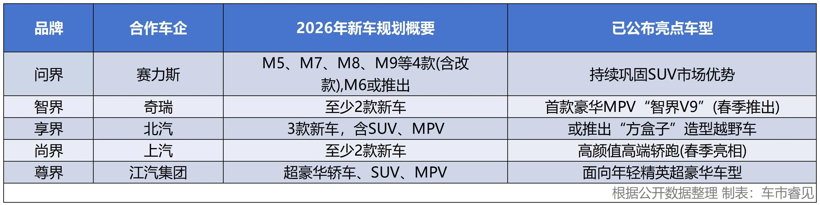
This comprehensive collaboration from products to services, from technology to ecosystem, is essentially building an "operating system ecosystem" for smart cars centered around Huawei. In this ecosystem, car manufacturers are no longer isolated competitors but participants in jointly maintaining user experience standards; users are no longer merely car buyers but part of the HarmonyOS digital life. Although Huawei does not have the qualification for complete vehicle manufacturing, it achieves deep integration into critical links of the industry chain by defining experience standards, controlling core interaction interfaces, and integrating service resources.
The formation of the HarmonyOS Intelligent Driving "Five Realms" Alliance not only reflects Huawei's clear positioning within the automotive industry—as neither a traditional Tier 1 supplier nor a vehicle manufacturer, but as an ecosystem architect and experience definer—but also reveals that the essence of future intelligent vehicle competition will shift from single product performance to the system capability of full-chain user experience. The success of this model will ultimately depend on whether it can consistently deliver on the promise of "consistent and high-quality" user experience and maintain technological leadership and service innovation amidst fierce market competition.
【Copyright and Disclaimer】The above information is collected and organized by PlastMatch. The copyright belongs to the original author. This article is reprinted for the purpose of providing more information, and it does not imply that PlastMatch endorses the views expressed in the article or guarantees its accuracy. If there are any errors in the source attribution or if your legitimate rights have been infringed, please contact us, and we will promptly correct or remove the content. If other media, websites, or individuals use the aforementioned content, they must clearly indicate the original source and origin of the work and assume legal responsibility on their own.
Most Popular
-

List Released! Mexico Announces 50% Tariff On 1,371 China Product Categories
-
Nissan Cuts Production of New Leaf EV in Half Due to Battery Shortage
-

EU Changes ELV Regulation Again: Recycled Plastic Content Dispute and Exclusion of Bio-Based Plastics
-

Clariant Unveils Cost-Cutting Plan Details, Plans to Shut Down Multiple Plants
-

Mexico officially imposes tariffs on 1,400 chinese products, with rates up to 50%

