Multiple Reversals! Can the Crude Oil Market Still Believe Peace Signals?
The current oil market is going through a psychological game similar to the "boy who cried wolf." Last Friday night, Iran reportedly signaled the possible reopening of the Strait of Hormuz, and the market seemed to believe it, expecting a easing of geopolitical tensions, which caused oil prices to drop sharply. However, the dramatic turnaround over the weekend not only recovered the previous losses, but also made the market deeply skeptical about future "calm signals." This is like the story of the boy who cried wolf; after several repeated incidents, the market's sensitivity to peace signals may be decreasing. In the future, even if Tehran once again shows goodwill, the market is unlikely to experience the same intense panic selling as last Friday, because investors, having been "tricked" several times, may become more cautious and suspicious.
Brent Crude Oil, Fooled
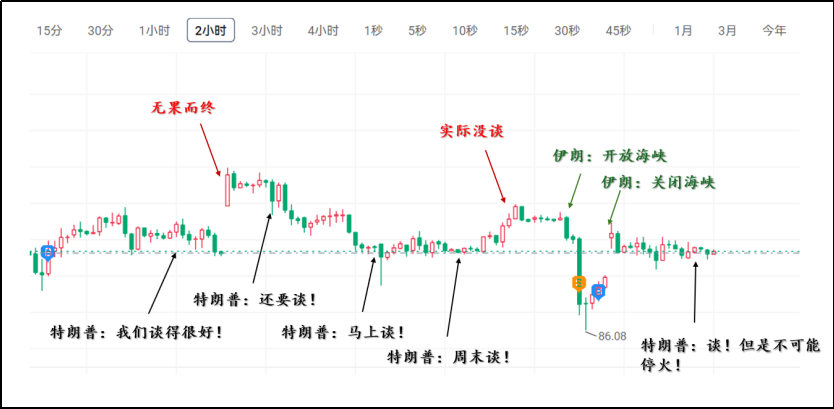
Current analysis must confront a reality: the passage issue in the Strait of Hormuz is seemingly evolving from an “emergency incident” into a “protracted stalemate.” The repeated developments over the weekend suggest that Iran’s internal stance on leveraging this energy corridor as a bargaining chip may be exceptionally resolute. For traders, attention is likely shifting from “speculating when the strait will reopen” to “calculating the cost of the blockade.” As long as the strait remains inaccessible to free navigation, a potential daily global supply shortfall of nearly 20 million barrels is an objective reality. This physical shortage will inevitably escalate—from inventory alerts to actual refinery supply disruptions—exerting a far more tangible impact than any diplomatic rhetoric.
After April 20, oil prices may enter a state of “high-frequency volatility.” Last Friday’s sharp decline followed by a weekend reversal may have formed a massive “bear trap” on the chart. As market sentiment recovers upon Monday’s opening, the geopolitical premium could swiftly rebound—potentially triggering a retaliatory surge as market participants feel “misled.” For downstream industries, such erratic fluctuations at the crude oil level pose the greatest challenge, significantly increasing risk-hedging costs across the supply chain. Prior to the tangible assurance of unimpeded strait navigation, any short positions based solely on expectations of “de-escalation” carry substantial uncertainty.
The following logical chain may be: repeated passage issues may lead the global shipping system to operate inefficiently. To avoid risks, insurers and shipowners may keep freight and insurance costs high, which are likely to be reflected in oil prices. Even if the strait reopens in the future, the increased supply chain costs may not disappear immediately. Therefore, the current "war premium" may consist of two parts: one is the temporary emotional fluctuations that may subside at any time, and the other is the already genuinely increased supply chain restructuring costs. From the current situation, the latter is becoming an indispensable supporting factor for the oil price floor.
【Copyright and Disclaimer】This article is the property of PlastMatch. For business cooperation, media interviews, article reprints, or suggestions, please call the PlastMatch customer service hotline at +86-18030158354 or via email at service@zhuansushijie.com. The information and data provided by PlastMatch are for reference only and do not constitute direct advice for client decision-making. Any decisions made by clients based on such information and data, and all resulting direct or indirect losses and legal consequences, shall be borne by the clients themselves and are unrelated to PlastMatch. Unauthorized reprinting is strictly prohibited.
Most Popular
-
Continental Plans to Begin Sale of ContiTech in Early 2026
-

$4 Billion! Medtronic Makes Another Acquisition
-

BASF Delivers First Batch of Innovative Cathode Materials for Semi-Solid-State Batteries to Weilan New Energy
-
Why did a century-old european dental instrument giant relocate its manufacturing hub to china?
-
Profit and Revenue Growth Struggle to Conceal Debt Repayment Pressure; Success of Kingfa Sci & Tech's High-End Strategy Yet to Be Seen