Market Closed, Hoarding Supplies, Sky-High Prices: Widespread Chemical Raw Material Shortages—How Long Can Downstream Factories Hold On?
Recently,The global chemical industry is shrouded in a series of sudden supply disruptions. Due to the escalating geopolitical conflicts in the Middle East, near-halt of shipping through the Strait of Hormuz, and India's domestic policy interventions aimed at securing energy supplies, the global supply chain for chemical raw materials has suffered its most severe shock since the COVID-19 pandemic.
Core supply disruptions erupted intensively, causing a comprehensive halt in the supply of basic raw materials.Circuit break
Naphtha
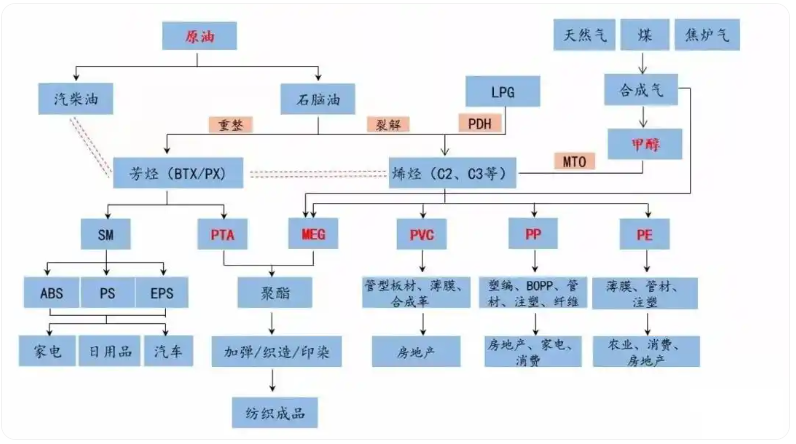
The disruption of shipping through the Strait of Hormuz is the core trigger of this crisis. According to shipping analysis firms,According to TankerTrackers data, since early March, the tanker traffic in the strait has decreased by more than 98% compared to normal levels. Reuters, citing traders, reported that over 60% of naphtha imports and about 66% of monoethylene glycol (MEG) imports in the Asian region depend on the Middle East, and the shipping schedules for these routes have been indefinitely delayed. An ICIS report pointed out that this has directly led to the reduction in load or early maintenance of cracking facilities in many parts of Asia due to a lack of raw materials, exacerbating the supply shortage of ethylene and propylene.
As the world's largest methanol exporter, Iran's supply is crucial. According to industry information agency ICIS,According to an ICIS report in mid-March, due to geopolitical tensions and natural gas supply issues, over 80% of methanol production facilities in Iran have been shut down. Historical data from China's General Administration of Customs shows that 50%-60% of China's imported methanol comes from Iran. This supply disruption has caused Asian methanol spot prices to surge sharply in the short term, leading to a severe market shortage.
Press Trust of India (PTI reported on March 9 that India's Ministry of Petroleum and Natural Gas has directed Chennai Petroleum Corporation Limited (CPCL) to suspend production of products such as propylene and prioritize crude oil for liquefied petroleum gas (LPG) production to ensure the supply of domestic fuel.
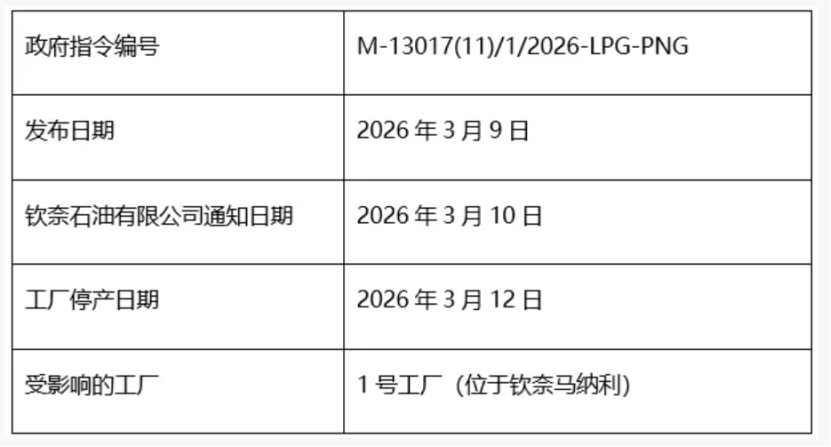
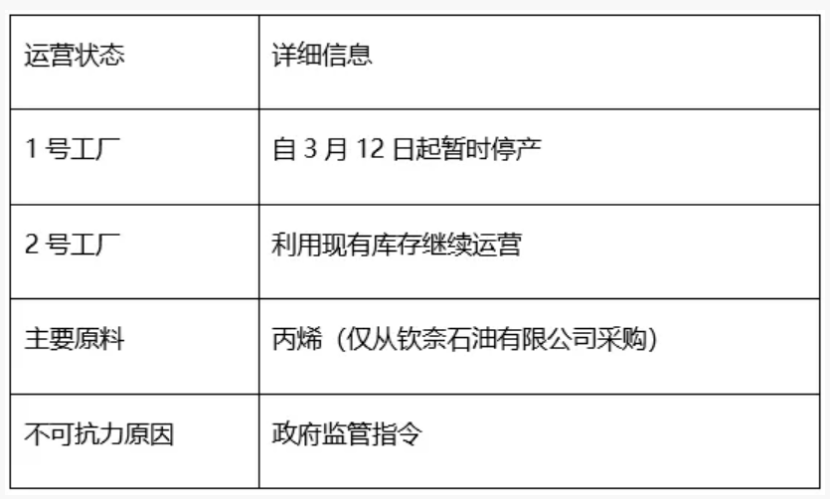
This directly led polyether polyol producers toThe Chennai plant of Manali Petrochemicals Ltd (MPL) has been completely shut down since March 12. The Business Line confirms that the shutdown of the plant has caused a regional shortage of propylene oxide (PO) and polyether polyol (PPG) in India.
Global Chemical IndustryWidespread force majeure is spreading
According to Morgan StanleyThe latest Force Majeure tracking report released on March 13 shows that force majeure declarations for major chemical products globally have shown a chain reaction across regions and product categories since the outbreak of the Iran conflict, involving core products such as ethylene, propylene, polyethylene, polypropylene, PVC, and liquefied natural gas. The affected companies span multiple countries and regions, including China, Japan, South Korea, Singapore, Indonesia, Poland, Germany, Kuwait, Saudi Arabia, and Qatar.
The spot market has already reacted first.— North American ethylene spot prices rose by 24.0% compared to the last week of February; North American propylene prices increased by 12.8%; and North American polypropylene spot prices surged by 25.0%. Morgan Stanley noted that feedstock availability is currently the most critical bottleneck. Should the conflict persist and the Strait of Hormuz remain inaccessible for an extended period, operating rates in the Middle East and Asia may decline further; even if some companies have not formally declared force majeure, actual production losses will continue to widen.
The olefin industry chain has become a severely affected area.
A portion of the global ethylene capacity has already3.9% are in a state of force majeure, with propylene at 3.2%, both increasing by about 1.7 percentage points from the tracking data on March 6. In terms of regional distribution, the impact is most concentrated in Southeast Asia and Central Europe, with 20.4% of Southeast Asian ethylene capacity affected, and 60.2% of Central European ethylene capacity affected.
In terms of specific enterprises, Formosa Petrochemical Corporation will…It announced on March 9 that its Mawei Olefins division has entered a force majeure status, due to the escalation of the Middle East conflict causing a disruption in naphtha supply, involving about 29.3 million tons per year of ethylene capacity and 24.3 million tons per year of propylene capacity.
SingaporeAster Chemicals and Energy declared force majeure on March 6, involving 1.15 million tons/year of ethylene, 500,000 tons/year of propylene, and 290,000 tons/year of benzene, due to a severe disruption in maritime transportation in the Strait of Hormuz, leading to an interruption in raw material supply, with the cracking unit's load rate dropping to about 50%.
Polyolefins and the breakdown of the downstream polymer supply chain transmit to downstream sectors
Global Polyethylene1.4% of polyethylene (PE) capacity is already under force majeure, and 1.0% for polypropylene (PP). On March 12, Formosa Plastics of Taiwan declared force majeure on petrochemical products, citing a shortage of key raw materials such as ethylene and propylene, along with logistics delays caused by the blockade of the Strait of Hormuz.
Chlor-alkali and vinyl product chain Chinese companies jointly declare force majeure
5.2% of PVC capacity is currently under force majeure, along with 5.4% for VCM, 6.4% for EDC, and 1.4% for caustic soda.
Tianjin Bohua Chemical Development Co., Ltd.Force majeure was declared on March 11, involving 905,000 tons/year of caustic soda, 1.5 million tons/year of EDC, 1.29 million tons/year of VCM, and 1.37 million tons/year of PVC.
Market Transmission and Price Fluctuations: From"Stockpiling and withholding from sale" to "price" It seems there's a part of the original text that wasn't fully translated. The correct full translation should be: "Stockpiling and withholding from sale" to "price out of control"
In categories explicitly discontinued, more raw materials, although not completely discontinued,"Disruption of flow," but market sentiment and actual circulation volume have undergone a qualitative change. According to Longzhong Information's monitoring data, due to refineries reducing loads and undergoing concentrated maintenance, the industry's operating rate has decreased by nearly 3 percentage points, leading to a significant reduction in the spot circulation volume.
Traders and producers generally adopt strategies of suspending quotations and limiting sales, causing the market to fall into a stalemate.A chaotic state of "high prices but no market" or "exorbitant prices in search of goods."
The shortage of ethylene and propylene has directly driven up polyethylene prices.prices of general-purpose resins such as polyethylene (PE) and polypropylene (PP). Meanwhile, European TDI and MDI plants entered their maintenance season, compounded by supply issues of raw materials (e.g., aniline and chlorine), pushing global core polyurethane raw material prices into an upward trend.
Price transmission shows obvious characteristicsAlthough upstream prices surge and downstream sectors face pressure, the magnitude and speed of downstream product price adjustments generally lag behind the rise in raw material costs, resulting in a significant “price scissors gap” that is eroding the profits of midstream and downstream manufacturing enterprises.
The plastic industry is under pressure, with multiple sectors facing a survival crisis.
Chemical raw materials as“Industrial grain,” whose supply disruption and price surge are rapidly rippling through the entire downstream industrial chain.
Polyurethane Industry
Suffered a source-level strike. IndiaThe shutdown of the MPL factory has disrupted the local supply chain, while the global shortage and rising prices of PO, PPG, and TDI/MDI have placed downstream sponge, coating, adhesive, and automotive interior companies in a dilemma: either suspend production due to material shortages or absorb soaring costs, resulting in unprofitable orders. Many small- and medium-sized furniture and thermal insulation material manufacturers have already halted order acceptance.
Plastic processing industry
"Resin and additive shortage" dilemma.China Plastics Processing Industry AssociationRecent surveys show that a large number of small and medium-sized plastic product companies have seen their production rates drop due to high and unstable prices of polyolefin resins, as well as difficulties in restocking key additives such as antioxidants and lubricants.Profit margins in the packaging, appliance accessories, and daily goods sectors have been drastically compressed, with some general products now operating at a loss.
Paints, Pigments, and Textile Dyeing and Printing Industry
Industry Response and Future Outlook: Building Diversified and Resilient Supply Chains Has Become a Consensus
Facing an unprecedented supply chain crisis, industry insiders and institutions have proposed a series of short-term response measures and long-term development strategies.
Short-term responseDownstream companies are urgently adjusting their procurement strategies, increasing communication with existing suppliers to lock in orders and quantities, and actively exploring alternative raw material sources and supply channels. At the same time, they are optimizing order structures, focusing resources on producing core customers and profitable orders, and using financial tools such as futures to hedge against part of the price risks.China Petroleum and Chemical Industry FederationIt is recommended that enterprises strengthen the scientific management of inventory and, where funds permit, establish safety stock for critical raw materials.Buffer stock
Long-term OutlookThis crisis has profoundly exposed the vulnerability of the global chemical industry supply chain, which is overly dependent on critical geographic nodes (such as the Strait of Hormuz) and single supply sources.BASF, DowMajor multinational chemical companies all mentioned in their latest strategic briefings that they will reassess and drive their supply chains.Regionalization and diversification layout.
Enhancing the supply capacity of local or near-shore markets, investing in more resilient logistics solutions, and utilizing digital tools to improve supply chain visibility and risk warnings have become an industry consensus. This crisis may serve as a catalyst for the reshaping of the global chemical industry chain, driving the industry towards a safer, more flexible, and more sustainable direction.
【Copyright and Disclaimer】This article is the property of PlastMatch. For business cooperation, media interviews, article reprints, or suggestions, please call the PlastMatch customer service hotline at +86-18030158354 or via email at service@zhuansushijie.com. The information and data provided by PlastMatch are for reference only and do not constitute direct advice for client decision-making. Any decisions made by clients based on such information and data, and all resulting direct or indirect losses and legal consequences, shall be borne by the clients themselves and are unrelated to PlastMatch. Unauthorized reprinting is strictly prohibited.
Most Popular
-
Continental Plans to Begin Sale of ContiTech in Early 2026
-

$4 Billion! Medtronic Makes Another Acquisition
-

BASF Delivers First Batch of Innovative Cathode Materials for Semi-Solid-State Batteries to Weilan New Energy
-
Profit and Revenue Growth Struggle to Conceal Debt Repayment Pressure; Success of Kingfa Sci & Tech's High-End Strategy Yet to Be Seen
-
Why did a century-old european dental instrument giant relocate its manufacturing hub to china?