L4 Autonomous Driving Accelerates Scenario-Based Implementation, The Application Status of Ten Typical Scenarios Needs Further Exploration
Level 4 autonomous driving is accelerating its penetration into multiple application scenarios. As an important practice under the path of leapfrog development, Level 4 autonomous driving relies on vehicle-cloud collaboration and vehicle-road-cloud collaboration technologies. It has been widely applied in low-speed closed scenarios and is gradually expanding to high-speed open scenarios. Currently, Level 4 autonomous driving has established relatively mature business models in scenarios such as ports and warehousing. It is exploring innovative commercial development in scenarios such as mining, urban, and intercity environments. Scenario-based implementation is the core of industry development.
L4 autonomous driving is an important practice in the leapfrog development path.
Autonomous driving can be divided into gradual development paths and leapfrog development paths. The gradual development starts with single-vehicle intelligence and gradually progresses toward connectivity, steadily enhancing the level of autonomous driving. The leapfrog development heavily relies on networked technologies such as vehicle-cloud collaboration and vehicle-road-cloud collaboration, rapidly improving the level of autonomous driving through multi-end collaboration. Level 4 autonomous driving is the main battlefield for the leapfrog development path, and its commercialization is gradually expanding from low-speed closed scenarios to high-speed semi-closed scenarios, low-speed open scenarios, and high-speed open scenarios.
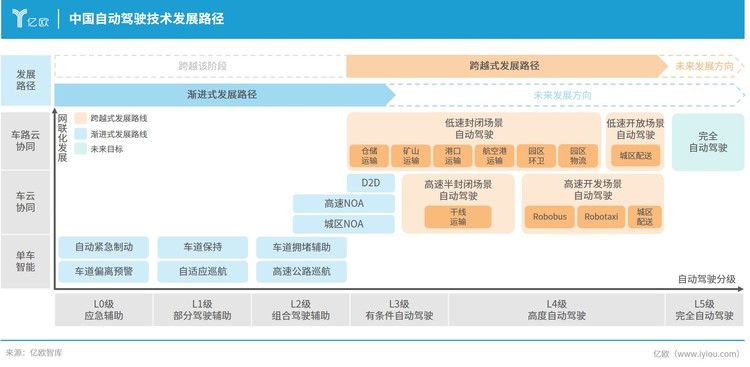
Level 4 autonomous driving is currently widely used in multiple scenarios.
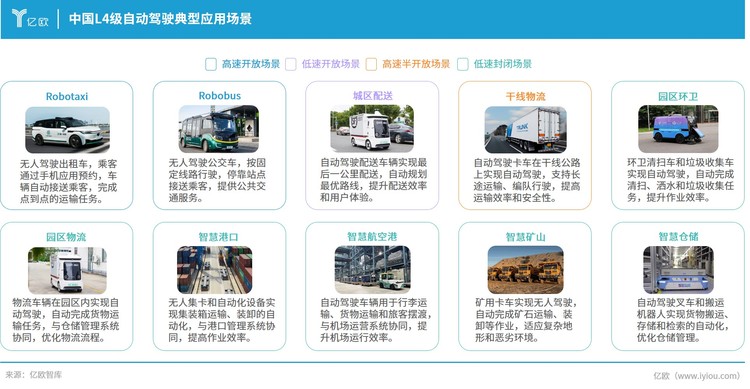
Level 4 autonomous driving technology, with its high degree of automation and intelligence, is being widely applied in several key areas, showcasing strong application potential and value. Level 4 autonomous driving technology has already found extensive applications in low-speed and relatively closed scenarios such as park sanitation, park logistics, smart ports, smart airports, smart mines, and smart warehousing. Meanwhile, it is in the trial operation stage in high-speed open scenarios like Robotaxi and Robobus, low-speed open scenarios for urban delivery, and high-speed semi-open scenarios for trunk logistics.
Taking Ninebot Intelligent as an example, it possesses a product matrix of unmanned logistics delivery vehicles composed of the "Z", "E", and "L" series, which have basically covered all scenarios of urban logistics. The Z series is positioned as versatile, developing general-purpose unmanned vehicles for urban logistics delivery scenarios. The E series emphasizes specialization, creating efficient and low-cost models for lightweight express deliveries. The L series focuses on heavy-load efficiency, meeting customers' needs for heavy-load deliveries.
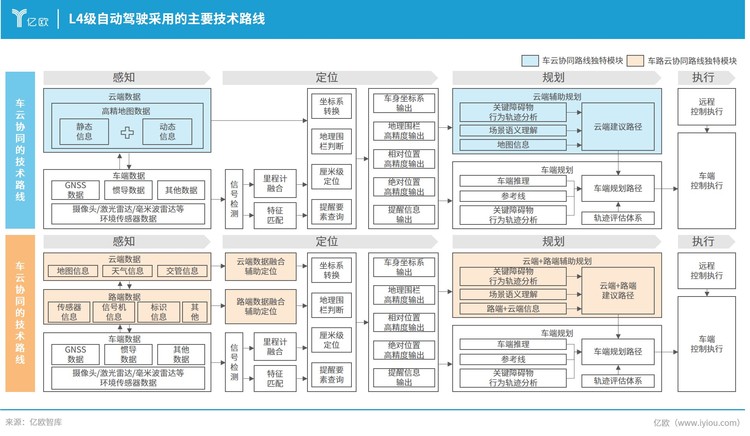
L4 autonomous driving can be divided into two technological routes: vehicle-cloud collaboration and vehicle-road-cloud collaboration.
Vehicle-cloud collaboration and vehicle-road-cloud collaboration are the main technical routes currently adopted for L4-level autonomous driving. The vehicle-cloud collaboration scheme achieves intelligent positioning and path planning by combining vehicle-end perception and computing capabilities with high-precision maps. The vehicle-road-cloud collaboration intelligent path planning system integrates roadside information and cloud-based multi-dimensional data analysis to provide intelligent decision support for vehicles.
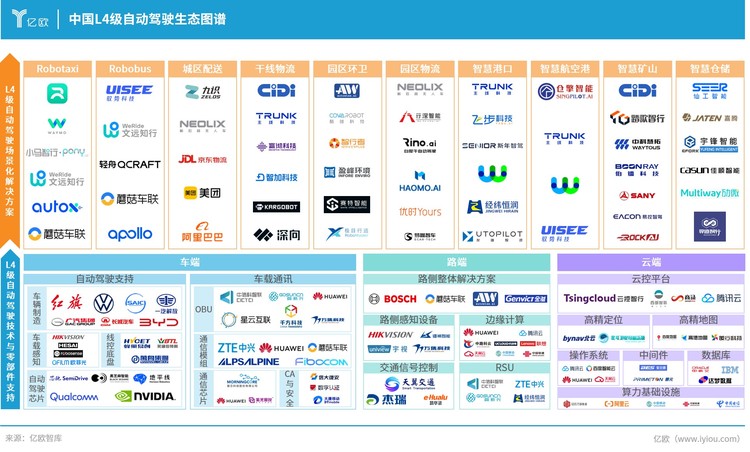
The scenario-based implementation of Level 4 autonomous driving is crucial.
Level 4 autonomous driving has a vast ecosystem, with upstream consisting of technology and component providers in the vehicle, road, and cloud sectors, and downstream primarily made up of scenario-based solution providers. In the context of Level 4 autonomous driving gradually being applied, scenario-based solutions are key to the current industrial development. Currently, Level 4 autonomous driving has established mature business models in scenarios such as ports and warehouses, and has also entered trial operation phases in complex scenarios like mines, urban areas, and intercity settings, beginning to explore innovative business models.
What is the current application status of Level 4 autonomous driving in various scenarios? What innovative business models have been adopted in these scenarios? Which scenarios are likely to form a mature business loop in the future? What are the future development directions of the Level 4 autonomous driving industry? These questions need to be answered urgently.
EO Intelligence is writing the "2025 China L4 Autonomous Driving Scenario Commercialization Development Insight Report."
The report will comprehensively analyze the development background, technical framework, industrial chain ecosystem, and commercial application status of L4 autonomous driving. It will cover 10 major scenarios including park logistics, park sanitation, urban delivery, Robotaxi, Robobus, trunk logistics, ports, airports, mining, and warehousing. The report will also provide an in-depth analysis of the application situation in each scenario through typical cases. Additionally, it will offer insights into the technological and commercial development trends of L4 autonomous driving, and forecast the market size from 2024 to 2035, providing readers with a reference for understanding the development trends of L4 autonomous driving.
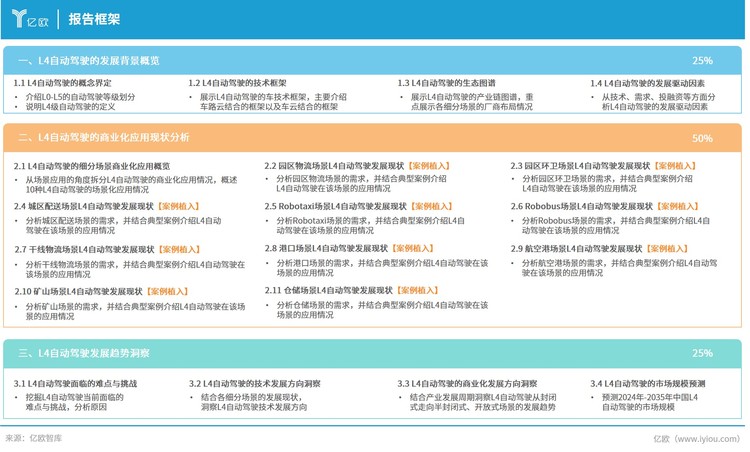
The report is divided into three parts.Overview of the Development Background of L4 Autonomous Driving, Analysis of the Current Status of Commercial Applications of L4 Autonomous Driving, and Insights into the Development Trends of L4 Autonomous Driving.
Part One: Introduce the concept and definition of Level 4 autonomous driving, explain the technical framework of Level 4 autonomous driving, present the ecological map of Level 4 autonomous driving, and analyze the driving factors for the development of Level 4 autonomous driving.
Part Two: Focus on the Current Status of Commercial Applications of Level 4 Autonomous Driving, analyzing the applications of Level 4 autonomous driving in campus logistics, campus sanitation, urban delivery, Robotaxi, Robobus, trunk logistics, port transportation, port terminal transportation, mining transportation, and warehousing transportation.
Part 3: Analyze the challenges and difficulties faced by L4 autonomous driving. Examine the future development directions of the L4 autonomous driving industry from both the technological development and commercialization perspectives. Additionally, predict the market size of L4 autonomous driving in China.
Yiou Intelligence hopes to establish connections with more upstream and downstream enterprises in the L4 autonomous driving industry to jointly discuss and exchange topics and market information related to L4 autonomous driving.
【Copyright and Disclaimer】The above information is collected and organized by PlastMatch. The copyright belongs to the original author. This article is reprinted for the purpose of providing more information, and it does not imply that PlastMatch endorses the views expressed in the article or guarantees its accuracy. If there are any errors in the source attribution or if your legitimate rights have been infringed, please contact us, and we will promptly correct or remove the content. If other media, websites, or individuals use the aforementioned content, they must clearly indicate the original source and origin of the work and assume legal responsibility on their own.
Most Popular
-

Mexico Imposes Tariff Up to 36% on Cross-Border E-Commerce Products, Effective January 1, 2026; Plastic Shows Partial Fluctuation Today
-

4.5 Million Tons! Wanhua Chemical Dominates Globally in MDI, Heavy Investment in Battery Materials Spurs New Storm
-

Trump Delays Tariff Increase on Furniture, Cabinets, and Vanities
-
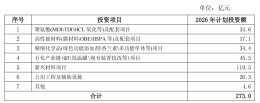
Wanhua Chemical Invests $27.3 Billion, 2026 Investment Map Revealed, $1.1 Billion Bet on Battery Materials
-
Back-to-back major joker moves! covestro’s 1.32 million ton mdi dual-line expansion and hdi acquisition reshape global polyurethane landscape