



Jiangsu's 12,000-Ton Annual Bio-Based Succinic Acid Project Completes Commissioning and Trial Operation, Set to Reach Full Production in September
In the "Three Summers" season, in Zhouzhuang Village, Xinjitown, Guannan County, Jiangsu, after the harvesters have done their work in the wheat fields, the balers come on stage, turning the scattered straw into bundles that resemble egg rolls.
Xu Pengfei, the person in charge of the Huitian Straw Recycling Specialized Cooperative, stood on the edge of the field, busy directing the loading of the trucks. “Around here, turning straw into useful products is nothing new. Besides the mushroom cultivation substrate that everyone is familiar with, we now have some new applications!”
To find out more, the reporter followed a straw transport truck and, half an hour later, arrived at Juwei Yuanchuang (Lianyungang) Biotechnology Co., Ltd., located in the Guannan Economic Development Zone.
Entering the workshop, you are greeted by a row of pot-shaped cooking equipment. The workshop manager, Wu Chenghua, picks up a bundle of straw and explains on-site how they turn grass into gold.
Chopped, washed, steamed, and subjected to hydrothermal treatment, the straw is transformed into a yellow-brown coarse slurry. After solid-liquid separation, humic acid is turned into agricultural fertilizer and can be further processed into hard carbon anode material for sodium-ion batteries. The remaining light-yellow solid fibers enter the saccharification workshop, where enzymatic hydrolysis converts them into xylo-oligosaccharides, xylose, and glucose. The glucose is then fermented in a sealed system and purified to obtain a white powder—succinic acid, the core raw material for biodegradable plastics.
“These products are shipped to downstream companies in Shandong, Anhui, Xinjiang, and other places, where their value can increase twentyfold,” said Wu Chenghua.
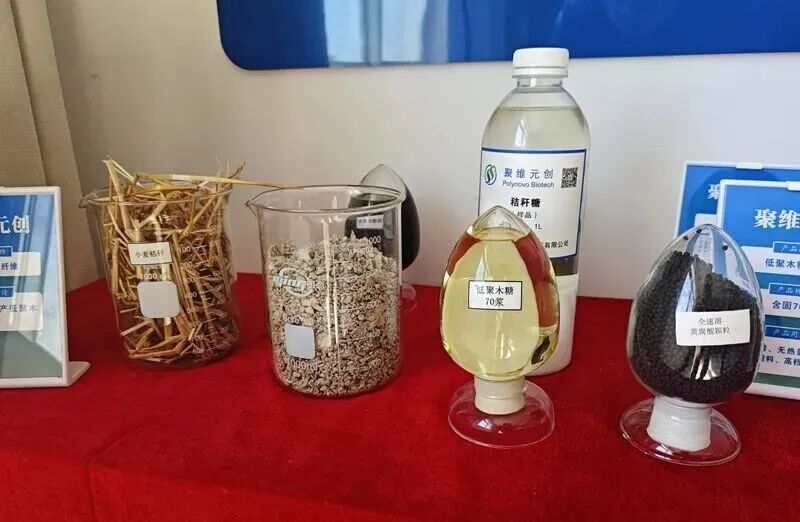
Guannan is a major agricultural county and also a key county in the comprehensive utilization of crop straw designated by the central government. Pan Bin, director of the county’s Agriculture and Rural Affairs Bureau, said that since the beginning of the new century, the county has carried out diversified exploration and industrialized practices in areas such as using straw as feed, as a substrate, and as a raw material. The county’s comprehensive straw utilization rate has remained above 97% for many consecutive years. Taking substrate use as an example, more than 100,000 tons of straw are turned into mushroom beds each year, supporting Guannan County’s development into one of China’s main production areas for factory-cultivated edible fungi.
When it comes to the synthetic biology industry, straw becomes even more attractive. “The traditional raw material for succinic acid is food crops such as corn. You should know that straw contains about 70% of the sugar found in grain crops, yet its price is only about 15% of that of grain,” said Liu Depeng, general manager of Polywise Yuanchuang (Lianyungang) Biotechnology Co., Ltd.
The cost-effectiveness is so high that achieving a technological breakthrough is no easy feat. As it turns out, straw cellulose and lignin are tightly cross-linked, making them difficult to separate; traditional enzyme preparations depend on imports and are costly; ordinary strains have poor tolerance and produce large amounts of acidic substances during fermentation, requiring continuous alkali addition, which in turn generates waste salts and severely undermines economic viability.
Juweiyuan Chuang was incubated from the Tsinghua University innovation platform in 2018 and is headquartered in Suzhou. The company's R&D team spent eight years focusing on two main areas: AI-assisted enzyme design and gene editing to modify bacterial strains.
"Previously, screening enzymes and strains relied entirely on manual work, which was time-consuming and labor-intensive. Now, we use AI to learn from a vast amount of cellulase protein sequences, customizing and synthesizing the enzymes we need, and then using gene editing to modify non-model strains to be acid-resistant and high-yielding." Liu Depeng introduced that the AI-customized enzymes have brought the straw saccharification rate close to 85%, reducing the sugar production cost by nearly 1,000 yuan per ton compared to corn starch; the modified acid-resistant strains no longer require frequent pH adjustments, shortening the fermentation cycle to 30 hours, with a single tank capacity reaching 16 tons.
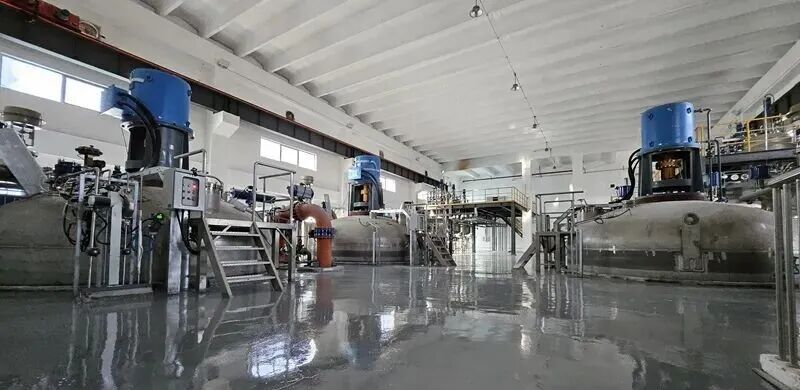
The fermentation tank in the workshop of Juwei Yuanchuang (Lianyungang) Biotechnology Co., Ltd.
Why was Guannan chosen for the industrialization of the project? Liu Depeng told reporters that the local straw collection and storage system is well established, and the area enjoys river-sea intermodal transport with access to the Yangtze River and the ocean. More importantly, the local officials are knowledgeable and their services are efficient and responsive. He said that as soon as the project was launched in 2023, the development zone assigned a dedicated task force to support it. It was subsequently listed as a provincial major project in 2024 and a nationally supported key project for energy conservation and carbon reduction in 2025. The county also granted a comprehensive “one project, one policy” award and subsidy package of 15 million yuan, along with equipment renewal subsidies.
“Phase I has completed integrated commissioning and trial runs, and is scheduled to reach full production capacity in September. It will be able to process 50,000 tonnes of straw annually, producing 12,000 tonnes of bio-based succinic acid, 30,000 tonnes of humic acid, and more than 1,000 tonnes of xylose,” Liu Depeng said. Once the Phase II project is completed in 2030, the annual straw processing capacity will reach 250,000 tonnes, making it one of the world’s largest straw-based biosynthesis bases.
【Copyright and Disclaimer】The above information is collected and organized by PlastMatch. The copyright belongs to the original author. This article is reprinted for the purpose of providing more information, and it does not imply that PlastMatch endorses the views expressed in the article or guarantees its accuracy. If there are any errors in the source attribution or if your legitimate rights have been infringed, please contact us, and we will promptly correct or remove the content. If other media, websites, or individuals use the aforementioned content, they must clearly indicate the original source and origin of the work and assume legal responsibility on their own.
Most Popular
-

A Look at the Material Suppliers Behind SpaceX
-

Government's Triple Action, Enterprises' Three Arrows in Five Days, Semiconductor Reshuffle! What Signal Does Japan's Chemical Industry Release?
-
Name change without tax change: POM Anti-Dumping Duty Rate Inheritance Implemented
-

Global Chemical Giants Accelerate Production Capacity Restructuring, Dow and Celanese Optimize Global Industry Layout
-
Fire breaks out at jiangsu meiside!


