Is Your Nylon Toughening Really Done Right?
Nylon (PA)As the top-ranking among the five major engineering plastics, it is widely used thanks to its excellent mechanical strength, wear resistance, and chemical resistance.Automotive, Electronics and Electrical, Rail Transitand other fields. However, those familiar with nylon are well aware of its two persistent “pain points”:Strong water absorption and poor low-temperature toughness。
Unmodified nylon significantly decreases in impact strength in dry or low-temperature environments (such as -30°C), becoming as brittle as glass. This severely limits its application in high-impact scenarios. How can nylon maintain its original rigidity while gaining excellent toughness, achieving a balance of "strength and flexibility"? The answer isToughening Modification。
This article will start fromToughening Mechanisms, Toughening Agent Types, Core Applications, and Future TrendsFour aspects, systematically sort out the toughening technology of nylon.
01 )
Why should nylon be toughened?
Nylon molecular chains contain a large number of amide groups, which can form strong intermolecular hydrogen bonds, resulting in high crystallinity and melting point. However, this regular structure also leads to a lack of effective energy dissipation mechanisms under impact, making it prone to brittle fracture.
Especially under low-temperature conditions (e.g., −40 °C), molecular chain segment motion is frozen, causing the impact strength to drop to less than one-tenth of that at room temperature. Moreover, in the dry state, when moisture content is low, nylon’s toughness also decreases significantly.
The core objective of toughening modification is to incorporate a second phase—typically an elastomer—into the nylon matrix, thereby inducing matrix yielding and plastic deformation under impact loading to absorb substantial impact energy. Ideally, the notched impact strength of toughened nylon can be enhanced by more than tenfold compared to pure nylon, while still maintaining acceptable stiffness and heat resistance.
02 )
Mechanism of Nylon Toughening: A Microscopic Perspective"Energy Absorption Battle"
The mechanism of nylon toughening agents can be figuratively understood as setting up a large number of "energy absorption stations" inside the material. The widely accepted toughening theory is the craze-shear band theory.
In a blend system, the toughening agent is dispersed in the nylon matrix as fine particles (typically 0.1–1.0 micrometers in size). When the material is subjected to impact, these elastomeric particles act as stress concentrators, triggering two effects:
Induce crazingNumerous tiny crazes (similar to microcracks) form around the particles, and the development of these crazes consumes energy.
Induce shear yieldingParticles simultaneously induce shear yielding of the matrix, forming shear bands.
Silver streaks and shear bands can interact with each other.When silver streaks encounter shear bands, their development is terminated, preventing them from evolving into destructive cracks; the formation of shear bands can further dissipate energy. The key is that the toughening agent particles must have good interfacial bonding with the nylon matrix, otherwise the particles will become defects, thereby reducing the toughness.
The key technology for achieving a good interface compatibility is reactive compatibilization. The most common approach involves using maleic anhydride (MAH)-grafted elastomers, such as POE-g-MAH or EPDM-g-MAH. The anhydride groups can chemically react with the amino end groups of nylon to form graft copolymers, which preferentially localize at the interface between the two phases, acting like “bridges” to firmly “anchor” the nylon and the elastomer together. In ideally toughened nylon, the elastomer particle size is typically controlled within the range of 200–500 nm.
03 )
Mainstream Nylon Toughening Agents: Types and Characteristics
Based on chemical structure and mechanism of action, nylon toughening agents can be primarily classified into the following categories. Selection should take into account factors such as nylon type, performance requirements, processing conditions, and cost.
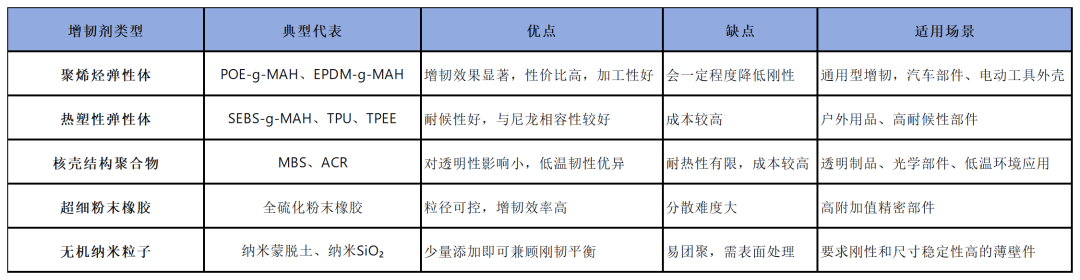
It is particularly worth mentioning thatMetallocene Polyolefin Elastomer(POE). POE grafted with maleic anhydride (POE-g-MAH) is currently one of the most widely used toughening agents for nylon. Due to its saturated molecular chain and excellent aging resistance, it can still provide nylon with excellent impact resistance at -40°C. Domestic companies such as Nengzhiguang have developed a series of POE-g-MAH products for different needs, for example, special toughening agents that can withstand ultra-low temperatures as low as -60°C.
04 )
Core application areas of toughened nylon
Toughened nylon, with its excellent impact resistance and low-temperature resistance, has become an indispensable material in many high-end manufacturing fields.
Automotive Industry (Largest Application Market)The dual demands of automotive lightweighting and safety have driven the widespread application of toughened nylon in components such as engine compartment parts, intake manifolds, fuel system components, door handles, and mirror bases. For instance, PA66 bumper materials must combine high heat resistance with excellent low-temperature impact strength. Components in new energy vehicles, such as battery pack brackets and charging connectors, also impose higher requirements on materials for flame retardancy, electrical insulation, and impact resistance.
Electrical and ElectronicWith the miniaturization and integration of electronic products, the requirements for thermal stability and dimensional stability of internal components have increased. Toughened nylon is widely used in components such as connectors, circuit breakers, switches, and coil bobbins, where these applications often need to meet both V-0 level flame retardancy and high toughness requirements.
Power ToolsHousings and handles of power tools such as electric drills and saws must withstand frequent drops and impacts. Toughened nylon has become a classic material choice in this field due to its excellent feel, chemical resistance, and impact strength.
Sports Equipment and Outdoor GearSki bindings, mountaineering equipment, ice skates, bicycle pedals, etc., require materials with high fatigue resistance and flexibility in low-temperature environments. Toughened nylon maintains good impact resistance even at -40°C, perfectly meeting these requirements.
Rail TransitInterior components, connectors, and seat frames of metro and high-speed rail vehicles must simultaneously meet stringent fire safety standards (e.g., EN45545-2) and high impact resistance requirements.
Industrial ComponentsPrecision gears, bearing cages, fan blades, and other components that require wear resistance, noise reduction, and fatigue resistance are widely made of toughened nylon.
05 )
New Trends in Toughening Technology: Green, Efficient, and Multi-functional
Looking ahead, nylon toughening technology is advancing in the following directions:
Efficiency and Multi-function IntegrationR&D personnel are exploring "multi-functional" toughening agents. For example, by introducing specific functional groups through molecular design, the toughening agent can enhance toughness while also improving the material's fluidity, flame resistance, anti-static properties, or aging resistance.
Green Environmental Protection and Bio-basedGlobal environmental regulations are tightening, driving the development of toughening agents toward bio-based and recyclable directions. Bio-based toughening agents prepared from renewable resources such as castor oil and straw have significantly reduced carbon footprints and are gradually entering the high-end application markets.
Nanocomposite TougheningUsing nanofillers (such as montmorillonite nanoparticles, carbon nanotubes) in combination with elastomers, the "pinning" and "bridging" effects of nanoparticles can achieve simultaneous enhancement of rigidity and toughness at very low addition levels, breaking the limitation of traditional toughening "exchanging rigidity for toughness".
Process and Formula IntegrationThrough computer simulation and advanced rheological characterization, more precisely design screw configurations and processing temperatures to accurately control the microphase morphology of the toughening agent, thereby maximizing toughening efficiency.
Toughening modification is an art of "balance."How to maximize the retention of a material's rigidity, heat resistance, and processability while enhancing its toughness.As the automotive, electronics, and new energy industries continue to upgrade, the demand for nylon materials with both high strength and high toughness will only become more urgent. Mastering the core of toughening technology might just be the key for you to stand out in the fierce market competition.
【Copyright and Disclaimer】The above information is collected and organized by PlastMatch. The copyright belongs to the original author. This article is reprinted for the purpose of providing more information, and it does not imply that PlastMatch endorses the views expressed in the article or guarantees its accuracy. If there are any errors in the source attribution or if your legitimate rights have been infringed, please contact us, and we will promptly correct or remove the content. If other media, websites, or individuals use the aforementioned content, they must clearly indicate the original source and origin of the work and assume legal responsibility on their own.
Most Popular
-

Continental Plans to Begin Sale of ContiTech in Early 2026
-

$4 Billion! Medtronic Makes Another Acquisition
-

BASF Delivers First Batch of Innovative Cathode Materials for Semi-Solid-State Batteries to Weilan New Energy
-
Profit and Revenue Growth Struggle to Conceal Debt Repayment Pressure; Success of Kingfa Sci & Tech's High-End Strategy Yet to Be Seen
-

Why did a century-old european dental instrument giant relocate its manufacturing hub to china?